South Korea cannot come close to matching that private-sector firepower. So Seoul is reaching for something Silicon Valley does not need nearly as much — the state balance sheet.
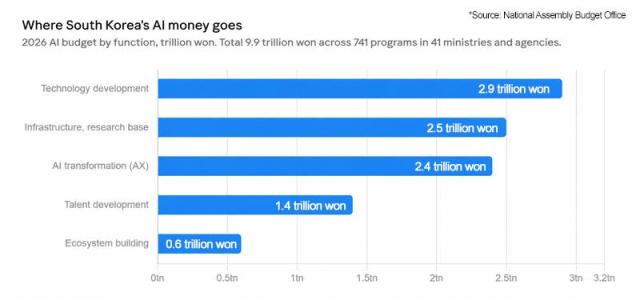
The government's 2027 budget bill submitted to the National Assembly on Sept. 3 lifts spending on AI and three linked mega-projects by 97.2 percent to 21.3 trillion won ($15.8 billion), equivalent to about 2.6 percent of total government expenditure of 820.9 trillion won.
Their share was about 1.5 percent this year.
Gartner forecasts worldwide AI spending will reach $2.59 trillion in 2026, up 47 percent from a year earlier. The four biggest U.S. hyperscalers — Amazon, Microsoft, Google and Meta — alone plan around $725 billion in capital expenditure this year, up 77 percent from 2025, according to Value Add VC's tracker.
Korea's wager is different.
Private AI investment in the country came to a paltry $1.78 billion in 2025, compared with $285.9 billion in the United States, according to Stanford University's 2026 AI Index.
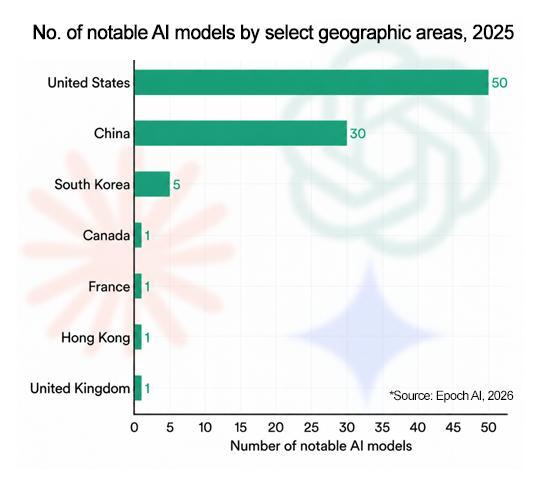
Still, Korea ranked first globally in AI patents per 100,000 people, at 14.31, and third in notable AI models released.
The mismatch points to the problem Seoul is trying to solve through state-led investment. Korea has technological capability, but the pools of private capital needed to scale it remain far smaller than in the United States.
The treasury is moving to fill part of that gap.
The 2027 money goes beyond R&D. It includes another 10,000 high-end graphics processing units, 3.1 trillion won for physical AI and roughly 2,000 domestically produced robots to be deployed in defense, policing, firefighting, care services and agriculture.
Korea has reason to believe the factory floor could be its strongest AI battlefield.
It already has the world's highest industrial robot density, with 1,220 robots for every 10,000 manufacturing workers, according to the International Federation of Robotics. Singapore is second at 818, while Germany and Japan have 449 and 446, respectively.
China illustrates the size of the challenge. It installed 295,000 industrial robots in 2024, accounting for 54 percent of all installations worldwide, and operates roughly 2 million robots, according to the IFR.
South Korea is therefore trying to combine its semiconductor and automation strengths with a government-financed AI layer.
AI colleges will expand from KAIST to all four national science and technology institutes, alongside new industry-linked graduate programs. The science ministry's budget rises 24.5 percent to a record 29.6 trillion won next year.
Deputy Prime Minister and Science Minister Bae Kyung-hoon, who oversees 9.4 trillion won of the ministry's budget, has framed physical AI as an export strategy.
Korea will "export the Republic of Korea's factories to the world" on a homegrown physical AI platform, he told a fiscal strategy meeting at the presidential compound in June.
The budget push sits inside a much larger corporate investment drive unveiled by President Lee Jae Myung that month.
Samsung Electronics, SK hynix and suppliers plan about 800 trillion won in new semiconductor investment, including fabrication plants in southwestern Korea, while SK Group, GS Group and Naver are backing an initial 550 trillion won buildout of AI data centers.
Those sums are corporate investment rather than direct government expenditure. Seoul is seeking to accelerate them through infrastructure, policy support and public investment.
"We must secure the core elements of AI faster than any other country," Lee said in announcing the three mega-project strategy.
Nvidia is another part of the buildout. Chief Executive Jensen Huang said his company had agreed to supply 260,000 GPUs to the Korean government and four conglomerates, describing Korea as "the only government that has directly purchased AI chips for national R&D."
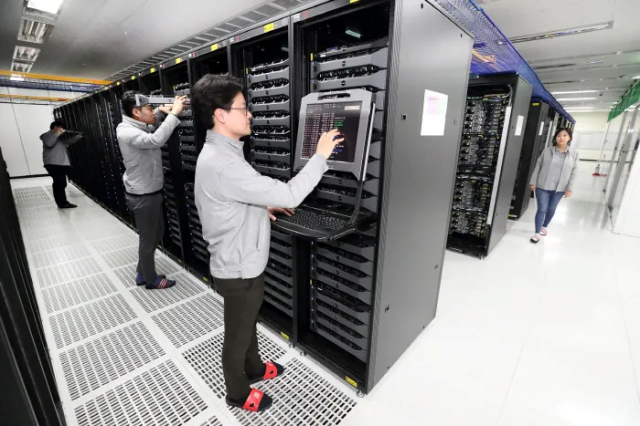
The supply would push Korea's chip stock above 300,000 units from about 65,000 and feed new computing infrastructure, including a 2.41 trillion won national computing center in Haenam that broke ground in August.
The model stands in sharp contrast to the United States.
Japan has taken a more interventionist approach, setting aside about 1.23 trillion yen ($8 billion) for advanced chips and AI this fiscal year, while India's five-year IndiaAI Mission totals 103.72 billion rupees ($1.09 billion).
China offers the closer parallel, having long used government guidance funds and industrial policy to direct capital toward semiconductors, AI and other strategic technologies.
Seoul is also extending its strategy beyond chips and robots.
The Ministry of Land, Infrastructure and Transport on Wednesday presented a "K-AI City" strategy in Busan that would apply AI to building permits, municipal control rooms and other urban functions. Wonju, Cheonan-Asan, Saemangeum and Gwangju have been selected as pilot areas.
Land Minister Kim Yun-duk said the program would be judged by whether it made everyday life safer rather than by the sophistication of the technology itself, promising "a people-centered AI city, where technology is not the goal itself."
Money, however, may not remain Korea's biggest constraint.
Electricity is emerging as another.
The semiconductor factories and AI data centers planned across the country could require an additional 25 to 30 gigawatts of power, roughly equivalent to the output of 20 nuclear reactors, Reuters reported Tuesday, citing government estimates. Nuclear power currently supplies nearly a third of Korea's electricity.
Korea may therefore find that financing GPUs and factories is easier than supplying them with enough electricity.
There is also a fiscal vulnerability built into Seoul's strategy.
National tax revenue is forecast to jump 49.8 percent next year, with the semiconductor upcycle creating much of the fiscal room for the government's spending expansion.
The global AI boom is generating extraordinary profits and tax receipts from Korea's memory-chip industry. Seoul is recycling part of that windfall into an attempt to build a broader domestic AI industry.
A reversal in the memory cycle would weaken both sides of the equation at once.
For now, the government is treating the race as one Korea cannot afford to sit out.
Ha Jung-woo, standing vice chair of the Presidential Council on National AI Strategy since Aug. 31, described it Tuesday as "an all-out national contest that decides industry, security and growth."
Unlike the United States, where companies are financing most of that contest, Korea is making the government one of its biggest early investors.
AJP Takeaways
- Korea nearly doubles 2027 spending on AI and three linked mega-projects to 21.3 trillion won.
- Private AI investment remains a fraction of U.S. levels despite Korea's strength in patents and notable AI models.
- Seoul is betting heavily on physical AI, building on the world's highest industrial robot density.
- Electricity demand and reliance on the semiconductor upcycle pose longer-term risks to the state-led strategy.

Copyright ⓒ Aju Press All rights reserved.