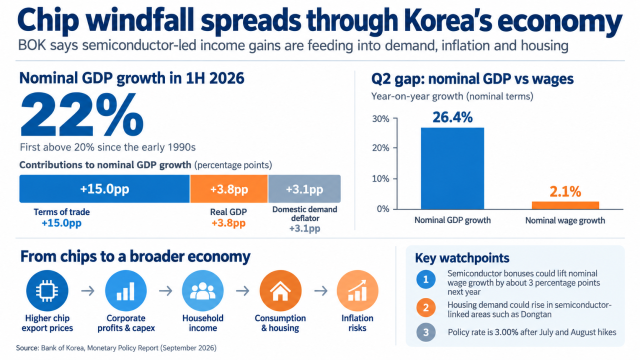
The central bank said in its September Monetary Policy Report pointed to the first-half nominal gross domestic product that grew about 22 percent, the first increase above 20 percent since the early 1990s.
Improved terms of trade contributed about 15 percentage points to the increase, compared with 3.8 percentage points from real growth and 3.1 percentage points from the domestic demand deflator.
The improvement was largely driven by export prices, with DRAM and NAND flash memory prices rising three to five times from a year earlier. Prices of other IT products, chemicals and primary metals increased between 10 percent and 40 percent.
The BOK said the current episode differs from previous periods of rapid nominal growth because rising export prices, rather than rapid real growth or domestic inflation, have been the dominant driver.
Even during the 2015 - 2017 semiconductor upcycle, increases in export prices and the terms of trade were only about 20 percent and 50 percent, respectively, of the magnitude seen this time.
The income gains are already visible in corporate earnings, investment and government revenue.
Sales at IT companies, including semiconductor makers, jumped 76 percent in the first quarter, while their operating profit margin reached 42 percent. Facility investment increased more than 20 percent from a year earlier in both June and July.
National tax revenue rose 17.4 percent from a year earlier to KRW 223 trillion ($165 billion) in the first half, with the central bank expecting stronger semiconductor earnings to lift corporate tax receipts further.
The spillover to households, however, has been slower. Nominal wage growth eased to 2.1 percent in the second quarter from 3.4 percent in the first.
The BOK said the sharp rise in nominal growth has yet to translate into a broad improvement in household income conditions.

Park said the unusually large scale of the income gains meant the effects were likely to appear first in regions benefiting directly from the semiconductor boom before spreading through channels including tax revenue. A longer-than-expected transmission lag, however, could limit the impact.
He pointed to nominal gross national income as an indication of the scale of the income shock. Its growth exceeded 17 percent from a year earlier in the first quarter and reached 26.4 percent in the second, he said.
Increases of that magnitude were more reminiscent of Korea's high-growth era and were changing the underlying conditions for consumption, asset markets and monetary policy, Park said.
The household effect could become more visible next year, with the BOK estimating that bonus payments by major semiconductor companies alone could raise overall nominal wage growth by about 3 percentage points.
The BOK estimated that when the output gap is positive, the effect of a demand shock on core inflation is two to three times greater than when the output gap is negative. The effect also lasts three to four quarters longer.
The eventual inflation impact will depend on how much of the additional income flows into domestic consumption rather than savings or asset purchases, the central bank said.
Choi Chang-ho, director general of the BOK's Monetary Policy Department, said the unusually wide gap between income and production indicators was one reason the central bank was paying greater attention to nominal growth.
Nominal income and real growth generally move in similar directions, Choi said. Income not immediately reflected in real growth could eventually feed into domestic demand and inflation or flow into asset markets, worsening financial imbalances.
Housing is one potential channel.
The BOK said large semiconductor bonuses could increase home-buying demand in areas benefiting directly from the chip boom, adding upward pressure to housing prices in the Seoul metropolitan area.
Bonus payments and expectations for expanded employee housing loans have already coincided with steep price gains in Hwaseong's Dongtan district and other areas described in the report as the country's "semiconductor belt."
Rapid nominal GDP growth could mechanically lower Korea's household debt-to-GDP ratio, but improved purchasing power could simultaneously increase housing demand and leverage.
The BOK estimated that the household debt ratio could fall toward the lower end of the 80-to-85-percent range this year if nominal GDP grows between 15 percent and 20 percent. Korea remained sixth-highest among 44 economies tracked by the Bank for International Settlements at the end of 2025.
The BOK raised its benchmark rate by 25 basis points in both July and August to 3.00 percent as stronger growth, persistent inflation and financial-stability risks increasingly pointed toward tighter policy.
Park said the consecutive increases should restrain inflation with a lag, while improving income conditions could work in the opposite direction by strengthening demand.
It is too early to determine which effect will ultimately prove stronger, he said.
The central bank said it will determine the timing and pace of additional rate increases while monitoring inflation, growth and financial-stability conditions.
AJP Takeaways
- South Korea's nominal GDP grew about 22 percent in the first half, driven largely by soaring semiconductor export prices and improved terms of trade.
- Corporate earnings, investment and tax revenue are already benefiting, while the improvement in household income has emerged more slowly.
- The BOK expects the semiconductor windfall to spread through the wider economy with a lag rather than remain confined to chip companies and related workers.

Copyright ⓒ Aju Press All rights reserved.