SEOUL, September 10 (AJP) - The arthritis painkiller meloxicam slowed muscle wasting in old mice by restoring a protein that muscles lose with age, researchers at two South Korean universities have found.
Sarcopenia, the gradual loss of muscle mass and strength that comes with age, contributes to frailty, lost mobility, metabolic problems and higher death rates in older adults, the researchers wrote. The processes that drive it are still not fully understood, they added, which has held back the development of drugs that target it.
Bae Gyu-un, a professor in Sookmyung Women's University's Division of Pharmacy, and Kang Jong-sun, a professor at Sungkyunkwan University School of Medicine, led the study, which was published online Aug. 12 in the journal Experimental & Molecular Medicine.
The work focused on Cdon, a protein on the surface of muscle cells. Earlier research had shown that it helps muscle stem cells develop into mature muscle and keeps the connections between nerves and muscles stable, but its role in adult muscle and in aging had not been established.
The team found that Cdon levels fall in aging human muscle, in people with sarcopenia and in patients with several muscle-wasting diseases, including amyotrophic lateral sclerosis, the nerve disease also known as Lou Gehrig's disease.
Across 891 human muscle samples from a public tissue database, lower Cdon went together with higher activity in genes linked to muscle breakdown and with smaller muscle fibers. Muscle cells from a 68-year-old donor carried far less of the protein than cells from a 17-year-old, and old mice showed a similar decline.
Bae said in a statement released by Sookmyung Women's University on Monday that the team had confirmed the loss of Cdon as "a major indicator of muscle aging."
To look for a way to bring Cdon back, the researchers engineered mouse muscle cells to give off light whenever the Cdon gene switched on. They then tested 2,485 drugs already approved by the U.S. Food and Drug Administration, and the screen singled out meloxicam as a potent activator of the gene.
In lab dishes, the drug raised Cdon levels and helped both mouse and human muscle cells grow into larger fibers, including cells from the older donor. The benefit held only within a narrow range, as a dose 100 times higher than the most effective one began to kill cells.
Young mice given the drug by mouth every day for two months built more leg muscle, gripped harder and ran farther than untreated mice. Their hearts, livers and kidneys showed no change in weight.
The researchers then treated 16-month-old mice for 10 weeks. Untreated old mice kept losing weight over that period, while treated mice lost less and had slightly lower blood sugar.
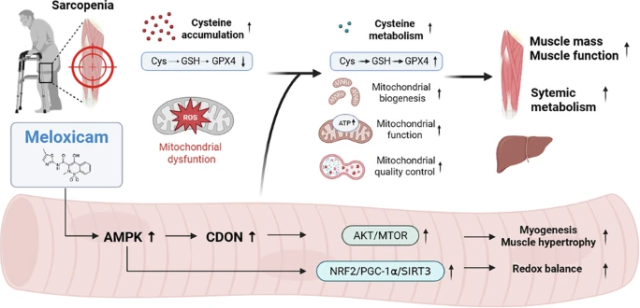
The treated older animals had stronger grips, and nerve signals reached their muscles faster. Their muscles were heavier, with thicker fibers and less scarring, and their livers stored less fat. The drug caused no signs of gut damage at the dose used.
The researchers traced part of the muscle damage to cysteine, an amino acid that built up in the muscle and blood of old mice. Previously published data show the same rise in the blood of people with sarcopenia.
When the team flooded muscle cells with cysteine, the cells produced less energy and more of the unstable oxygen molecules that damage tissue, a process known as oxidative stress. Meloxicam brought cysteine levels down in old mice and reduced that damage.
Meloxicam switched on AMPK, an enzyme that serves as the cell's energy sensor, within five minutes of treatment. When the researchers blocked AMPK, most of the drug's boost to Cdon disappeared, and its protection of mitochondria, the structures that generate a cell's energy, was lost.
The mice received 0.02 milligrams of meloxicam per kilogram of body weight each day. At that dose, the drug did not change muscle levels of prostaglandin E2, an inflammation signal that its painkilling action normally suppresses. The researchers said this made it unlikely that the muscle benefits came from the drug's usual painkilling effect.
The paper discloses competing interests for Bae and Kang, which it says the two universities reviewed and approved under their conflict-of-interest policies.
All of the animal experiments used male mice, and most measurements came from groups of seven or fewer animals. In human samples, the researchers showed an association between low Cdon and muscle decline rather than a direct cause.
The authors wrote that they have not yet identified the molecule meloxicam acts on to switch on AMPK, and that the long-term effects and safety of chronic treatment still need study. Whether the same pathway can be restored in aging human muscle will require clinical evaluation, they wrote.
[Reference Information]
Journal/Source: Experimental & Molecular Medicine (IF 17.5, JCR top 2.65%)
Title: Meloxicam protects against muscle and metabolic decline in ageing through Cdon restoration and oxidative stress modulation
Link/DOI: https://pubmed.ncbi.nlm.nih.gov/42587039/

Copyright ⓒ Aju Press All rights reserved.