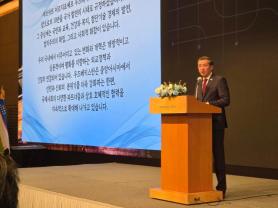
SEOUL, September 11 (AJP) - South Korea will put state financing behind partnerships between its local governments and Uzbekistan's regions, Deputy Prime Minister Koo Yun-cheol told a forum in Seoul on Friday, five days before the city hosts South Korea's first summit with the five Central Asian nations.
Speaking at the same event, Uzbek Deputy Prime Minister Jamshid Khodjaev put bilateral trade at nearly $2 billion last year and said the two governments aim to raise it to $5 billion. Korean investment in Uzbekistan has passed $8 billion in recent years, he added, and more than 700 companies with Korean capital now operate in the country.
Koo, who is also minister of finance and economy, named two of the financing tools the government would link to regional projects, the Economic Development Cooperation Fund and the Supply Chain Stabilization Fund. The government would also "take the lead in resolving any difficulties" the regions ran into on the ground, he said.
The Economic Development Cooperation Fund (EDCF), created in 1987, provides long-term, low-interest loans to developing countries. The finance ministry owns the fund, and the state-run Export-Import Bank of Korea manages it. The bank also runs the supply chain fund, launched in 2024 to back South Korean companies in industries the government considers vital to stable supply chains.
Uzbekistan is already the EDCF's largest partner in Central Asia. It accounts for about 86 percent of the fund's approvals in the region, and a framework agreement signed in 2024 allows up to $2 billion in EDCF loans to the country through 2027, according to the Export-Import Bank of Korea (Korea Eximbank).
Koo said local governments were already producing results. He cited cooperation on special economic zones between Incheon and Uzbekistan's Fergana Region, industrial workforce partnerships between South Gyeongsang Province and Tashkent Region, and smart agriculture initiatives linking South Chungcheong Province with Namangan Region.
Incheon and Fergana have been friendship cities since 2022, according to the Incheon city government, and Incheon Mayor Park Chan-dae met Fergana Gov. Khayrullo Bozorov on the sidelines of the forum.
Park also chairs the Governors Association of the Republic of Korea, which organized the event with the Uzbek Embassy in Seoul.

Delegations came from nine of Uzbekistan's 14 provincial-level administrations, including the governors of Fergana, Namangan and Tashkent regions, according to the Governors Association of the Republic of Korea (GAROK). Uzbekistan is divided into 12 regions, the autonomous Republic of Karakalpakstan and the capital, Tashkent.
"When the central government's diplomacy opens the road, exchanges between local governments get people traveling along it," Park said in a statement released by GAROK.
South Korean and Uzbek local governments have formed about 30 sister-city and other partnerships, Park told the forum. He proposed identifying at least one project for each of them and creating a single channel for investment information and consultations. Incheon and Fergana have already agreed to form a working group that will review project progress every quarter, he said.
Koo built his speech around Homer's Odyssey, comparing the hero's voyage through storms to a world economy facing geopolitical fragmentation, the artificial intelligence revolution and the restructuring of supply chains. If the central government sets "the broad direction," Koo said, "the true navigators who steer the ship and breathe vitality into local communities are the local governments and governors of both nations."
Seoul plans to use the summit to expand economic cooperation with Central Asia sharply, he said, concentrating on critical mineral supply chains, energy and bio-industry, and transportation, logistics and human resources development. "Naturally, Uzbekistan will be at the center of this initiative," Koo said.
Khodjaev tied his pitch to economic reforms under President Shavkat Mirziyoyev. Uzbekistan rose 14 places in this year's Index of Economic Freedom and entered the "moderately free" category for the first time, he said. The index, published by the Washington-based Heritage Foundation, ranks the country 86th, according to Uzbekistan's Ministry of Investment, Industry and Trade.
He proposed five areas for Korean investment and asked for joint ventures in the first of them, critical minerals. Uzbekistan holds rich reserves of copper, gold and tungsten, he said, and plans to raise its critical mineral extraction and processing to $1 billion while bringing in technology for enrichment and deep processing.
In technology, he pitched the incentives Tashkent offers. Information and communications technology companies pay no corporate tax until 2040 and receive simplified visas, Khodjaev said, and a program called Zero Risk covers their operating expenses. More than 12,500 such companies work in Uzbekistan, 1,500 of them foreign, employing over 100,000 specialists.
He invited Korean firms to open software development, information technology services and business process outsourcing centers across the regions, and named transport and logistics, tourism and health care, and agriculture as the other three areas. Uzbekistan exports 2 million tons of fruit and vegetables a year, he said, and aims by 2030 to double food production and triple the value-added share of its exports.
Khodjaev also pointed to Korean projects already running. High-speed trains built by Hyundai Rotem, the first Korean-built high-speed trains sold overseas, began service this year between Tashkent and Khiva. Incheon International Airport Corporation is modernizing Urgench International Airport and taking part in building a new airport in Tashkent, and Khodjaev thanked Korea Eximbank for consistently backing Uzbek projects.
The next step, he said, is to "expand this experience to the regional level and attract new companies and local entrepreneurs into our cooperation." Work has begun on a portfolio of joint projects for each region, he added.

The governors then made their own pitches. Bozorov said 48 companies with Korean capital operate in Fergana, whose trade with South Korea reached $70 million in the first half of the year. The region is targeting $1.5 billion in investment involving more than 400 enterprises this year, he said, and wants more Korean participation in smart agriculture, electronics and auto parts.
Tashkent Region Gov. Zoyir Mirzayev said 66 companies with Korean capital operate in his region and its trade with South Korea has passed $50 million. About 300 meetings and negotiations with foreign investors this year have produced investment agreements worth more than $2 billion, he said, naming industrial development, pharmaceuticals and agricultural processing as openings for Korean companies.
About 150 people filled the conference hall at the JW Marriott Dongdaemun Square hotel, and some who arrived could not get in.
Jung Eui-hye, deputy minister for political affairs at the Ministry of Foreign Affairs, cast the regional track as the next stage of a relationship rooted in history. Uzbekistan is home to Central Asia's largest ethnic Korean community, she noted. Many are descendants of Koreans whom Joseph Stalin deported from the Soviet Far East to Central Asia in 1937.
The two countries upgraded their relationship to a special strategic partnership in 2019.
"The stage for this cooperation must now expand beyond central governments to encompass provinces, cities, and the everyday lives of our citizens," Jung said.
She added that leaders on both sides shared a background in local administration. President Lee Jae Myung served as mayor of Seongnam and governor of Gyeonggi Province before taking office, and Mirziyoyev governed Jizzakh and Samarkand regions before becoming prime minister in 2003. Koo made a similar point, saying Mirziyoyev had voiced deep trust in local governments' ability to deliver, drawing on his own years as a governor.
Jung said Mirziyoyev's upcoming state visit to South Korea would add substantial depth to bilateral relations.
The Korea-Central Asia Summit will be held in Seoul on Sept. 16-17, with the leaders of Kazakhstan, Kyrgyzstan, Tajikistan, Turkmenistan and Uzbekistan confirmed to attend.
GAROK plans to carry the forum's results to the third Korea-Central Asia Local Government Cooperation Forum, to be held in Samarkand, Uzbekistan, in November. Gyeongju has proposed hosting the fourth edition next year, building on friendship-city ties with Samarkand that date to 2013.
Copyright ⓒ Aju Press All rights reserved.