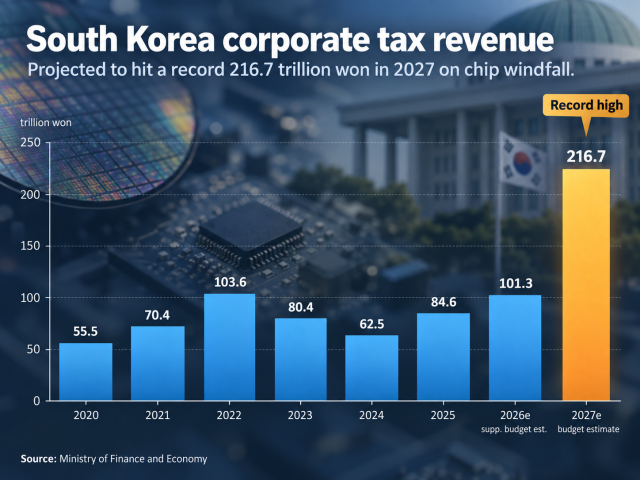
Corporate tax revenue is forecast to reach a record 216.7 trillion won ($161.5 billion) in 2027, according to the Ministry of Finance and Economy’s national tax revenue budget plan, surpassing the 180 trillion won expected from income tax.
It would mark the first time since 2012 that corporate tax receipts have exceeded income tax revenue and the first time they have topped 200 trillion won.
The surge reflects expectations for another sharp increase in operating profits, particularly at semiconductor giants Samsung Electronics and SK hynix, as the global memory-chip boom continues.
Corporate tax receipts have already rebounded from 84.6 trillion won in 2025 to an estimated 101.3 trillion won this year under the supplementary budget. The government expects the figure to more than double to 216.7 trillion won next year.
The extraordinary increase highlights how heavily Korea’s fiscal position is becoming tied to the semiconductor cycle.
Corporate tax revenue rose from the 40 trillion-won range in the early 2010s to 103.6 trillion won in 2022, before collapsing to 80.4 trillion won in 2023 and 62.5 trillion won in 2024 as the chip downturn hit corporate earnings.
The unexpected fall was a major contributor to tax-revenue shortfalls in those years, disrupting budget execution and narrowing the government’s room for fiscal policy.
Income tax, by contrast, has followed a steadier upward path, supported by inflation, employment growth and rising asset prices. Revenue rose above 100 trillion won in 2021, reached 130.5 trillion won in 2025 and is estimated at 136.8 trillion won this year before climbing to 180 trillion won in 2027.
Value-added tax, once the biggest source of national tax revenue, is projected at 91.4 trillion won next year, marginally higher from 86.6 trillion won estimated for this year.
The growing dependence on corporate taxes has renewed concerns that Korea’s public finances could become increasingly vulnerable to swings in the semiconductor cycle — generating windfall revenue during chip booms but opening large fiscal holes when the industry turns down.
The government plans to address that volatility through a new Future Response Fund, which would set aside part of tax revenue generated during boom years rather than immediately spending the entire windfall.
Under the government plan, tax receipts exceeding the trend in domestic tax revenue over the previous 10 years would be accumulated in the fund and used both for investments intended to lift Korea’s potential growth rate and as a fiscal buffer during future downturns.
The government says money accumulated during periods of strong revenue could later be transferred back to the general account when tax receipts weaken.
The 2027 budget plan calls for 45.4 trillion won of the fund to support projects in four broad areas — youth, new growth engines, regional development and education and talent — while 12.5 trillion won would be used to reduce new government bond issuance. Another 104.4 trillion won would be held as reserve funds for fiscal stabilization and future spending needs.
The government argues that using all of a temporary revenue surge for one-year spending would be inefficient, while using all of it to repay debt would also limit its ability to invest in longer-term growth. It plans to manage the accumulated assets with a target return at least equivalent to government bond yields.
AJP Takeaways
- Corporate tax revenue is projected to more than double to a record 216.7 trillion won ($161.5 billion) in 2027 from 101.3 trillion won estimated for 2026.
- Corporate tax is expected to overtake income tax for the first time since 2012, underscoring how the semiconductor boom is reshaping Korea’s tax base.
- The windfall also exposes Korea to sharper fiscal swings when the chip cycle turns. The government plans to channel part of excess tax revenue into its new Future Response Fund for growth investment and fiscal stabilization.

Copyright ⓒ Aju Press All rights reserved.