SEOUL, Sept. 15 (AJP) — The South Korean won weakened and government bond yields climbed to multi-year highs Tuesday as surging oil prices and U.S. Treasury yields fanned inflation and interest-rate concerns.
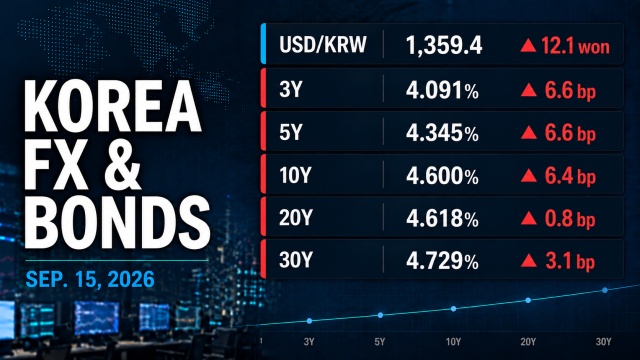
The three-year government bond yield rose 6.6 basis points to 4.091 percent, its highest close since Oct. 26, 2023. The benchmark 10-year yield gained 6.4 basis points to 4.600 percent, the highest since Oct. 21, 2022.
The won closed at 1,359.4 won per dollar in Seoul, weakening 12.1 won from Monday's 1,347.3. The dollar index stood around 99.6 at 3:30 p.m.
“A renewed move higher in oil would complicate the inflation backdrop, keep yields supported and weigh on risk sentiment,” OCBC strategist Christopher Wong said.
Oil prices jumped after Saudi Arabia shut its East-West Pipeline following a drone attack that damaged the route connecting its eastern oil fields with the Red Sea port of Yanbu.
The pipeline had been carrying about 4 million barrels of crude a day and has served as a key route bypassing the Strait of Hormuz. Its shutdown threatens flows equivalent to roughly 4 percent of global oil supply.
Shipping through Hormuz has already fallen sharply during the Middle East conflict, while renewed instability around the Red Sea and Bab el-Mandeb has added to concerns over oil flows.
Brent crude rose to $107.55 a barrel Tuesday, while West Texas Intermediate climbed to $103.27.
Eugene Investment & Securities estimated repairs to the Saudi pipeline could take two to six weeks. It said a one-month disruption could add about $10 a barrel to international crude prices and push WTI above $110.
The brokerage also said strong spot premiums, backwardation and high refining margins could keep oil above $100 for the time being.
TD Securities strategists Ryan McKay and Bart Melek also saw further upside risk to crude, saying longer repairs, reduced pipeline flows or further attacks could tighten the market.
Higher U.S. yields added to pressure on Korean financial markets.
The benchmark 10-year U.S. Treasury yield reached 5.0266 percent Tuesday, its highest level since 2007, while markets priced in a 93 percent chance of a quarter-point Federal Reserve rate increase this week.
South Korea has secured most of its near-term crude needs despite the disruption.
Domestic refiners have secured more than 90 percent of the crude needed for September and October based on year-earlier volumes, limiting the immediate risk of a physical shortage.
With near-term supplies largely secured, oil prices and global interest rates remain the main risks for Korean government bonds and the won.
AJP Takeaways
- South Korea's three-year government bond yield rose to 4.091 percent Tuesday, its highest close since October 2023, while the 10-year yield reached 4.600 percent, the highest since October 2022.
- The South Korean won weakened 12.1 won to 1,359.4 per dollar as oil prices and U.S. Treasury yields rose, with Brent crude climbing above $107 a barrel.
- Eugene Investment & Securities, OCBC and TD Securities saw further upside risk to oil prices, with Eugene estimating that a one-month disruption to Saudi pipeline flows could push WTI above $110.

Copyright ⓒ Aju Press All rights reserved.