
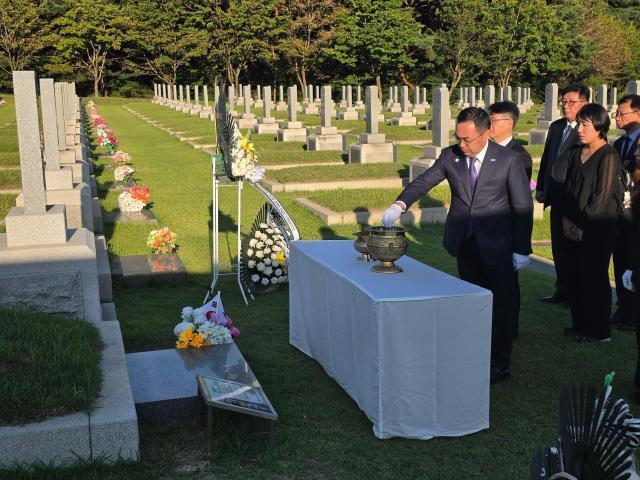
Kazakhstan's culture minister burned incense Wednesday at the grave of Hong Beom-do, the Korean independence commander who spent his final years in exile in Kazakhstan.
The gesture came a day after Arman Kyrykbayev signed an agreement with South Korea to preserve sites associated with Korea's independence movement, witnessed by Presidents Lee Jae Myung and Kassym-Jomart Tokayev.
Hong's remains were returned to Korea in 2021 after nearly eight decades in Kazakhstan, a homecoming Tokayev helped commemorate.
Amid all the talk in Seoul this week about uranium, oil, critical minerals, artificial intelligence and infrastructure, that quiet scene at Daejeon National Cemetery may have captured something equally important about South Korea's belated Eurasian turn.
Central Asia is suddenly crowded with suitors.
China gathered the five Central Asian leaders in Astana in June last year for the second China-Central Asia Summit, where President Xi Jinping signed a treaty on permanent good-neighborliness and pushed deeper cooperation in trade, energy, mining, transport and technology. The China-Kyrgyzstan-Uzbekistan railway, after decades of discussion, has moved into implementation.
Russia followed with the second Central Asia-Russia Summit in Dushanbe in October. President Vladimir Putin, whose country retains deep economic, linguistic, security and migration links to the former Soviet republics, called for greater trade with the region.
A month later, U.S. President Donald Trump brought all five leaders to the White House in the C5+1 format, with critical minerals, investment, energy and supply chains high on the agenda. President Joe Biden had held the first U.S.-Central Asia presidential gathering in New York in 2023.
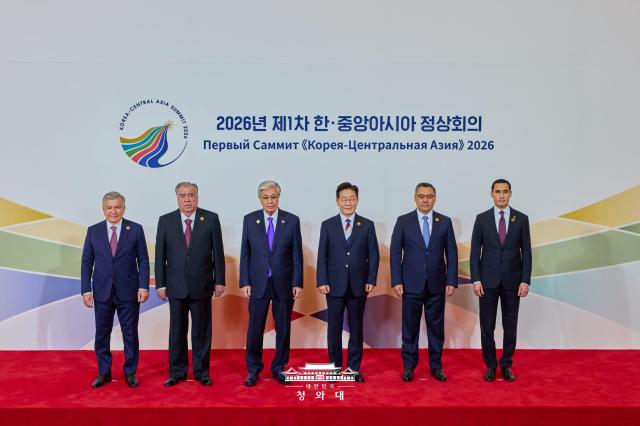
Now South Korea has joined the summit circuit.
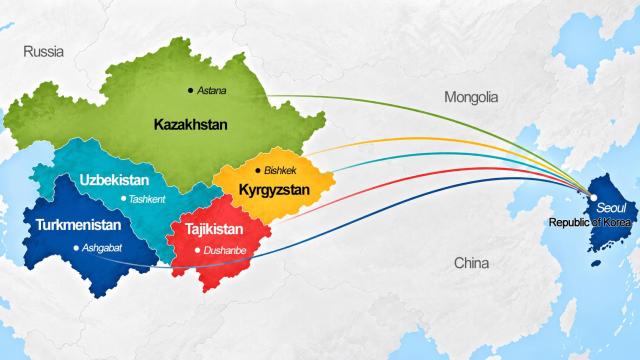
Lee hosted the first Korea-Central Asia Summit in Seoul on Wednesday after bilateral meetings with each of the five leaders. More than 70 agreements and memorandums were reached across energy, mining, infrastructure, technology and investment, while the leaders agreed to institutionalize their summit on a biennial basis, with Kazakhstan to host the next gathering in 2028.
The sudden attention is hardly mysterious.
For much of the post-Soviet era, Central Asia appeared distant from the centers of global capital: enormous in land mass, rich beneath the ground, but landlocked and constrained by Russia to the north, China to the east and difficult transport links to markets elsewhere.
Those supposed disadvantages are being reassessed as assets.
Kazakhstan alone produced about 40 percent of the world's uranium last year and holds substantial oil, gas and mineral resources. Turkmenistan sits on some of the world's largest natural-gas reserves. Uzbekistan combines gold, uranium and copper resources with the region's largest population. Kyrgyzstan and Tajikistan bring hydropower and mineral potential.
For an energy-importing country such as South Korea, the attraction has become sharper as geopolitical shocks repeatedly expose the vulnerability of concentrating supplies in a handful of regions and maritime routes.
Central Asia cannot simply replace the Middle East. It is landlocked, and moving oil, gas and minerals to East Asia still requires pipelines, railways and corridors crossing other countries. The rise of the Trans-Caspian or Middle Corridor reflects precisely the effort to create routes linking Central Asia with Europe without depending entirely on Russia, but geography remains stubborn.
Its importance therefore lies in diversification rather than substitution.
And increasingly, the prize is not simply what can be dug out of the ground.
Central Asia has begun trying to convert cheap land, electricity and energy resources into computing power.
Kazakhstan is considering an AI data-center campus in Ekibastuz that could eventually reach 1 gigawatt. Uzbekistan has introduced incentives for AI data centers in Karakalpakstan and this year discussed a proposed 125-megawatt facility expandable to 250 MW with Nvidia and Firebird representatives.
That changes the conventional image of the region. Oil fields, uranium mines and pipelines could increasingly sit alongside server farms, smart cities, renewable-energy complexes and AI infrastructure.
Demography adds another dimension.
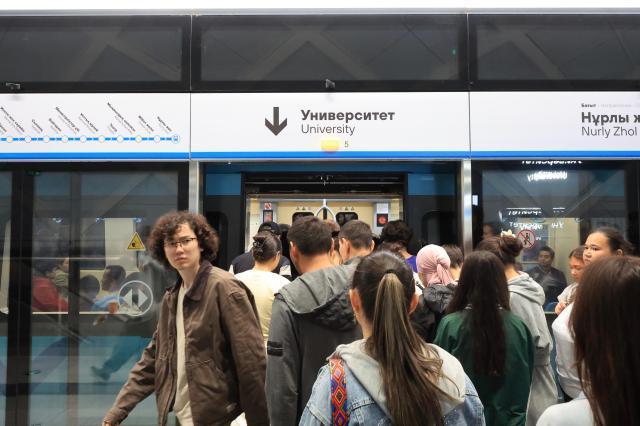
While South Korea, Japan and much of Europe are aging rapidly, Central Asia remains young. People under 25 account for roughly 30 percent of the region's population, and UN projections suggest another 20 million people could enter working age by 2050.
That means Central Asia is potentially not only a source of energy and minerals but also a growing consumer market, industrial base and pool of workers, engineers and entrepreneurs.
Its governments are also heavily involved in determining the direction of that growth. The Seoul business summit itself reflected that reality: ministers, sovereign wealth funds, state companies and national investment bodies sat alongside private businesses.
For Korea, that is a familiar economic language. Its own rise from poverty was built in large part through state-coordinated infrastructure, industrial policy, export manufacturing, education and technology acquisition before the economy and political system evolved into their present forms. Central Asian governments now speak frequently of industrial diversification, technological upgrading, special economic zones, smart cities and moving from raw-material exports into higher-value production.
Korea therefore enters the region differently from the three great powers already entrenched there.
It cannot match China's financial scale or geographic proximity. It cannot replicate Russia's Soviet-era networks, security ties and migration links. Nor does it possess the strategic reach or financial system of the United States.
The Seoul summit instead points toward another possible model: pairing Central Asian resources and young markets with Korean manufacturing, engineering, digital technology and industrial know-how.
Lee's government explicitly framed cooperation around moving beyond the simple purchase of raw materials toward joint value chains in which exploration, processing, technology and manufacturing are connected.
But technology and money alone will not distinguish Korea for long. Every major power arriving in Astana or Tashkent now comes carrying offers involving minerals, AI, digital infrastructure and logistics.
Korea possesses another asset that is harder to reproduce: living history.
Around 310,000 Koryo-saram, descendants of Koreans who settled across the former Soviet Union, live in Central Asia and Russia. Next year marks 90 years since Stalin's forced relocation of ethnic Koreans from the Russian Far East to Central Asia.
South Korea and its Central Asian partners are already planning commemorative projects, including a Koryo-saram history museum in Uzbekistan. About 150,000 Central Asian students and workers are also now in South Korea.
Hong Beom-do embodies that connection particularly vividly. Stalin's government deported him with other ethnic Koreans to Kazakhstan in 1937. Koryo-saram in Kyzylorda tended his grave for decades; Kazakhstan later agreed to return his remains to Korea, and a memorial park now stands where he was once buried.
There is no need to exaggerate this into claims of some ancient ethnic sameness between Koreans and the peoples of the Eurasian steppe. The genuine history is powerful enough.
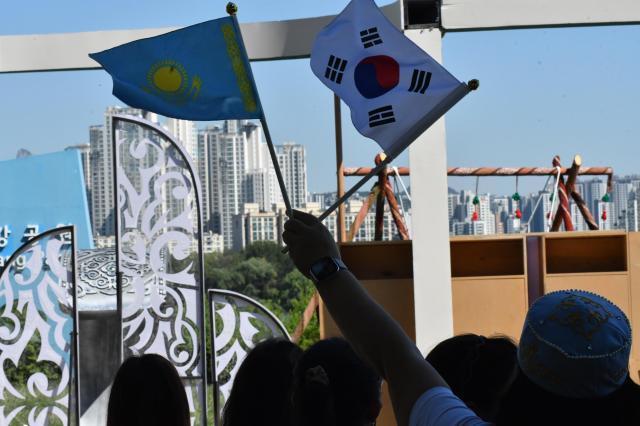
The Silk Road moved people, religions, goods and ideas between East and West long before modern national borders appeared. The Koryo-saram later created a very human bridge between Korea and Central Asia. Today students, migrant workers, businesses and popular culture are adding a contemporary layer to those ties.
The Korean presidential office chose precisely that imagery at this week's summit, describing the old Silk Road as evolving into a "digital Silk Road" connecting people, culture, technology and the future.
Heritage cooperation should go beyond museums and ceremonies.
Archives, archaeological projects, restoration, cultural-property conservation, Koryo-saram heritage, universities, tourism and digital preservation can create networks that survive commodity cycles and changes of government.
Industrial partnerships built on top of such human connections may prove more durable than memorandums built around the mineral price of the day.
Central Asia itself is seeking room to maneuver. Its governments continue to work with Russia, deepen economic links with China, welcome American investment and cultivate ties with Europe, Turkey, Japan, Korea and others.
The rush of summits is evidence not merely of great-power competition but of Central Asian governments exercising their own multi-vector diplomacy.
Korea's Eurasian engagement does not have to become another contest to "win" Central Asia from somebody else. The more durable question is whether Korea can become useful to a region that wants more partners, more routes and more choices.
* The author is the managing editor of AJP.
Copyright ⓒ Aju Press All rights reserved.
