
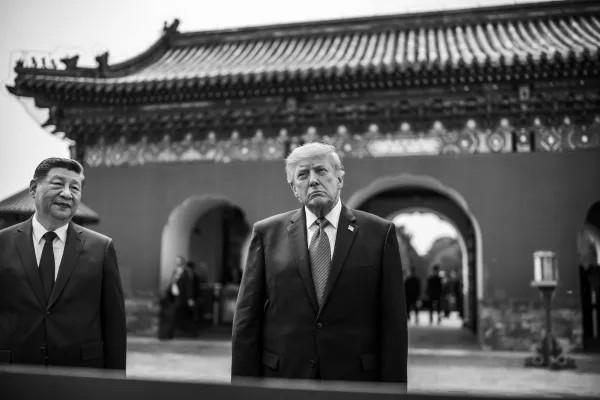
Chinese President Xi Jinping is said to be assembling an unusually large business delegation, possibly to match the high-profile entourage U.S. President Donald Trump brought to Beijing in May, which included 18 American business leaders such as Nvidia Chief Executive Jensen Huang and Elon Musk.
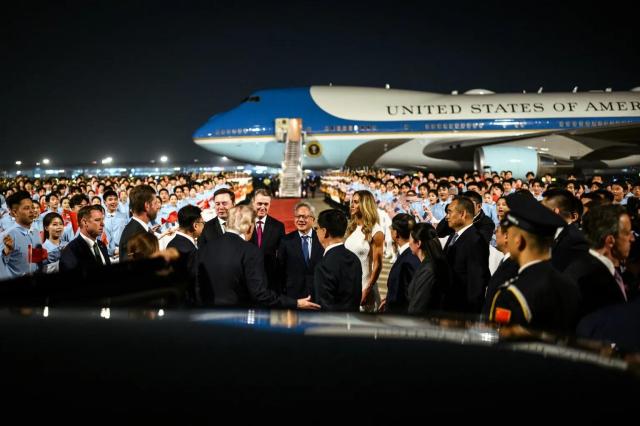
China wants relief from U.S. restrictions on technology and greater access to advanced semiconductors. Washington, meanwhile, has been pressing Beijing over critical-mineral supplies and trade barriers while seeking commitments on purchases of American goods. An existing tariff truce expires Nov. 10.
Semiconductors sit at the center of that bargaining because Washington controls access to much of the technology China still needs to move deeper into advanced chipmaking, while Beijing controls a vast technology market and important parts of the raw-material supply chain.
The United States has restricted exports of advanced AI chips and chipmaking equipment to China since 2022, although the Trump administration has selectively eased some curbs. The Commerce Department in January shifted Nvidia's H200 and comparable processors to case-by-case licensing for approved Chinese customers, while keeping tighter controls on the most advanced products.
Whether chipmaking equipment itself could become part of a summit bargain is less clear. There has been no public indication that Washington is prepared to dismantle its broader controls on advanced manufacturing technology.
But for Beijing, equipment is increasingly the missing piece.
China has made much faster strides in memory chips than it had only a few years ago.
ChangXin Memory Technologies, or CXMT, has emerged as the world's fourth-largest DRAM maker. Its global DRAM revenue share climbed to 9.5 percent in the second quarter from 7.6 percent in the first, according to TrendForce, behind Samsung Electronics at 39.4 percent, SK hynix at 24.9 percent and Micron at 23.3 percent.
CXMT this month announced mass production of LPDDR6, next-generation low-power memory used in mobile devices, after making substantial gains in DDR5. Its chips are increasingly being adopted across Chinese computing platforms.
The Chinese company is now preparing to move beyond DRAM and mulling a NAND facility.
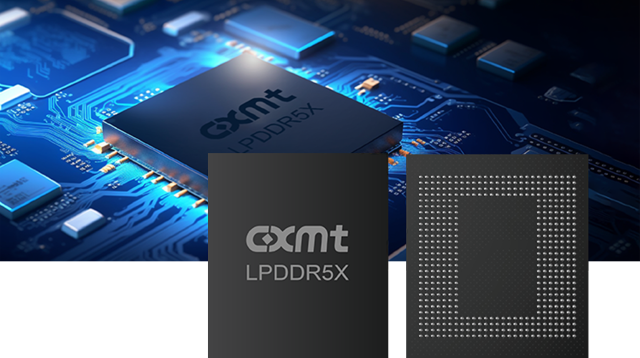
The crossing of product lines by China's two major memory producers suggests Beijing's semiconductor drive is moving from simply filling domestic supply gaps toward building companies capable of competing across the memory spectrum.
AI data-center construction has created severe shortages of both DRAM and NAND, giving even smaller suppliers greater bargaining power.
Chinese memory makers have in some cases been able to charge domestic customers more than Samsung and SK hynix during the shortage, an unusual reversal for companies long dependent on price discounts to compensate for their technological lag.
CXMT is gaining share among Chinese cloud-service providers, while domestic demand and government support give it a large captive market from which to improve yields and scale production.
TrendForce said the company is expanding server DRAM output even as restrictions on foreign equipment continue to hamper progress at more advanced nodes
High-bandwidth memory, or HBM, remains a much steeper barrier.
Samsung and SK hynix retain a wide lead in HBM, the stacked high-speed memory used alongside Nvidia and other AI accelerators.
Chinese producers are developing HBM products, but CXMT and other Chinese suppliers remain in early development and qualification stages, with limited near-term impact on the global market, according to TrendForce.
China has built increasingly capable domestic suppliers of etching, deposition and other semiconductor equipment.
Chinese equipment suppliers could capture as much as 40 percent of China's chip-tool market this year, excluding high-end technologies such as lithography.
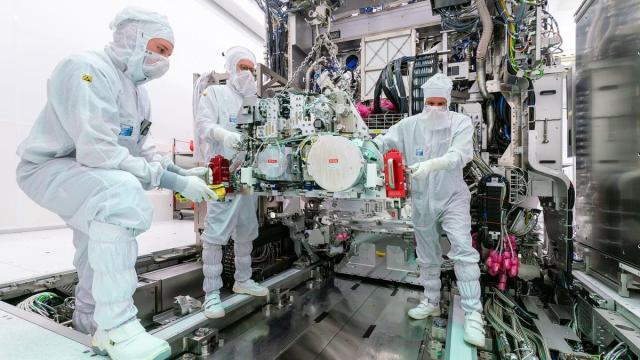
Its newest High-NA EUV systems cost about $400 million apiece and are being adopted by Samsung, SK hynix, TSMC and Intel for future generations of chips.
China is developing its own immersion deep-ultraviolet equipment, but output remains tiny compared with ASML.
Shanghai Aishengna Electronic Technology Group has targeted production of five domestic DUV systems this year and 20 next year, compared with 131 systems shipped by ASML in 2025.
The equipment gap gives Washington leverage in negotiations with Beijing — and effectively gives Korean memory makers more time.
Any meaningful loosening of restrictions that improves Chinese access to advanced lithography and other high-end manufacturing equipment could accelerate CXMT's migration to finer processes, improve yields and eventually shorten the technology gap with Samsung and SK hynix.
The impact would probably appear first in mainstream DRAM and NAND rather than HBM.
China's domestic producers already have scale and customers in those markets and better equipment would make it easier to raise yields, lower costs and push into products now dominated by the Korean and U.S. suppliers.
Continued restrictions, on the other hand, preserve part of the technological moat enjoyed by Samsung and SK hynix but create a different problem for the Korean companies.
Both have substantial manufacturing interests tied to China and must operate under an increasingly complicated U.S. export-control regime. Samsung and SK hynix have begun testing Chinese equipment partly because access to U.S.-made tools for their Chinese operations has become less certain.
SK hynix's Solidigm is also considering building a NAND plant in the United States that could reduce its dependence on its Dalian manufacturing base in China. SK hynix separately has held exploratory discussions with Intel over possible memory production in Ohio.
The pressure comes as Washington is simultaneously asking Korean chipmakers to manufacture more on American soil.
Semiconductor investment has become part of Seoul's own negotiations with Washington, with President Lee Jae Myung saying Friday that the extent of additional U.S. production by Samsung and SK hynix would have to reflect both corporate decisions and South Korea's industrial strategy.
The two countries are still negotiating details of South Korea's $350 billion U.S. investment commitment, including $200 billion of projects not earmarked for shipbuilding. Lee said questions over commercial viability, profit distribution and treatment of losses remain sticking points.
China has not caught South Korea at the top end of memory. In HBM and the manufacturing processes needed to make the most advanced chips efficiently, the gap remains substantial. But the distance below that top tier is narrowing fast.
For Samsung and SK hynix, the question surrounding the Sept. 24 summit therefore is not simply whether Trump and Xi talk about chips.
It is whether access to the equipment China still lacks becomes part of the price of a broader U.S.-China bargain — and how much time that bargain leaves Korea's memory giants before their Chinese rivals move further up the ladder.

Copyright ⓒ Aju Press All rights reserved.
