

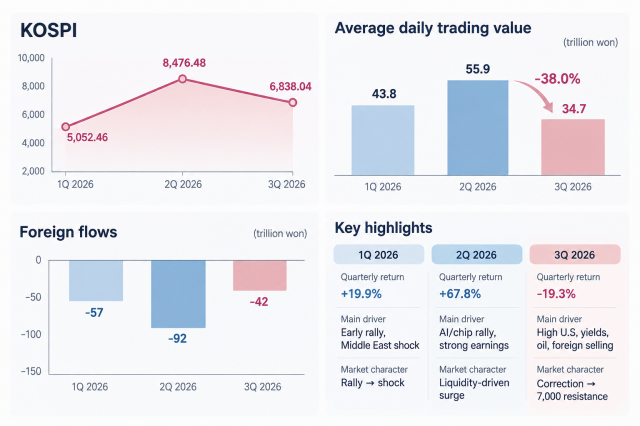
After taking nearly five years to climb from 3,000 to 4,000, the benchmark swept past successive milestones to breach 9,000 in June. Now, 7,000 has become a resistance level, raising the question of how long the next breakthrough will take.
The index ended the third quarter at 6,838.04, down 19.3 percent over the period and 25 percent below its June 22 record close of 9,114.55.
It began the fourth quarter with a 1.95 percent rebound to 6,971.35 on Thursday. Institutions bought a net 334.3 billion won of shares, helping offset foreign selling of 547.3 billion won.
The recovery left the benchmark within reach of 7,000, but the forces behind its retreat remain. Elevated oil prices, persistent inflation and U.S. long-term yields above 5 percent have eroded the appeal of equities even as corporate earnings stay strong.
Average daily turnover fell 38 percent from the second quarter to 34.66 trillion won ($25.7 billion) in the third, leaving the market with less buying power to absorb selling pressure.
Still, he sees an important distinction between the current impasse and the nearly five-year climb from 3,000 to 4,000.
“The biggest difference is that we are now in the AI era,” he said. “Samsung Electronics and SK hynix have gained a much stronger position in the global market.”
Their earnings strength could help the benchmark break out sooner, he added.
“The upside is that the market has developed some resistance to the bad news we have already seen,” Kim said. “At the same time, corporate earnings continue to improve.”
That improvement has yet to overcome the drag from global borrowing costs. The U.S. 10-year Treasury yield remained above 5.2 percent at the end of September despite an easing in oil prices, keeping pressure on equity valuations.
“By conventional valuation measures, the market looks unusually undervalued,” an analyst at Yuanta Securities said. “But that alone does not tell the full story, as external macro uncertainties are still weighing heavily on valuations.”
Higher bond yields reduce the incentive to take additional risk in Korean stocks, the analyst said, making them a greater constraint on foreign inflows than short-term currency movements.
The won traded around 1,350 per dollar on Wednesday with relatively limited volatility, yet foreigners sold a net 2.05 trillion won of KOSPI shares, concentrating on heavyweights including Samsung Electronics and SK hynix.
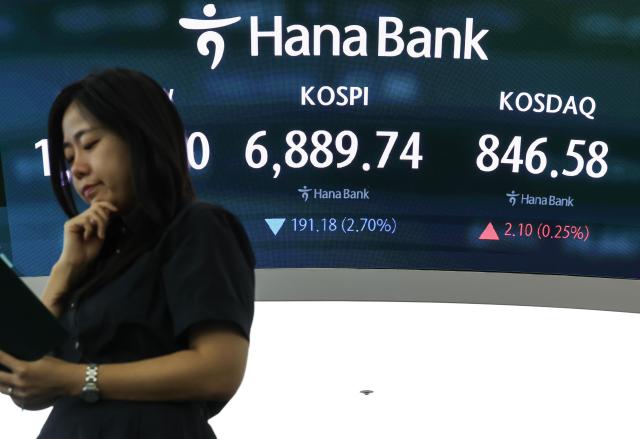
Kim Dae-jong, an economics professor at Sejong University, said further increases in U.S. long-term yields and persistent foreign selling could keep the index below 7,000 for an extended period.
Earnings offer the strongest counterweight. Consensus estimates for 109 KOSPI-listed companies put third-quarter operating profit at 218.27 trillion won, up 20.4 percent from the previous quarter. Electrical and electronics companies, led by the two chipmakers, are expected to account for 189.15 trillion won, up 25.2 percent.
AI infrastructure spending by major U.S. technology companies continues to support demand for high-bandwidth memory and other advanced chips.
“Major U.S. technology companies cannot keep increasing AI spending forever,” the Yuanta analyst said, although he sees little sign of an imminent sustained slowdown.
Goldman Sachs has maintained its KOSPI target of 12,000, arguing that investors underestimate the duration of Korea’s memory-chip earnings cycle. It projects capital spending by major U.S. technology companies could reach $1.2 trillion next year.
Australia’s Macquarie has also retained its 8,000 target, attributing the correction to lower valuations rather than weaker fundamentals.
Turning those earnings expectations into a sustained rally may require a change in who is buying.
Retail investors provided substantial support in the first half, purchasing a net 99.17 trillion won of KOSPI shares while foreigners sold a net 148.32 trillion won. The Yuanta analyst expects the next phase to follow a different pattern.
“Foreign investors would likely need to return first, and then retail investors would follow.”
Kim of Sejong said individuals could take profits or stay on the sidelines near 7,000, returning as bargain buyers after sharper declines — a pattern already evident this year.
Their willingness to commit will depend partly on the war involving the United States and Iran. A prolonged conflict, elevated oil prices and further U.S. rate increases would be the worst combination for Korean equities, the Yuanta analyst said.
Korea’s exposure is substantial. Energy imports rose 27.9 percent from a year earlier in the first 20 days of September, while crude-oil imports increased 37.3 percent, customs data showed.
A BOK official said international oil prices during Sept. 1–16 were 29 percent above the August average, posing an upside risk to producer prices.
The government last month set a target of reducing dependence on crude from any single region to below 50 percent by 2035, from around 70 percent, as it seeks to diversify supplies following Middle East disruptions.
U.S.-China tensions and the November U.S. midterm elections add another layer of uncertainty.
“Policy changes tied to the U.S.-China technology rivalry will remain an important variable for Korean stocks,” Kim of Sejong said.
“Around the U.S. midterm elections, shifts in fiscal, trade and AI infrastructure policy could also increase volatility through Treasury yields, the dollar and global equities.”
The vote could also clear some of the uncertainty, the Yuanta analyst said.
“If we are already passing the worst point, the midterm elections may not necessarily be negative for stocks,” he said. “Some of the uncertainty weighing on the market could ease once the vote is over.”
History offers some support: Hana Securities found that the S&P 500 rose in the fourth quarter in five of the six U.S. midterm-election years since 2000, with an average gain of 3.6 percent.
At home, dividends, share buybacks and cancellations have helped cushion the market, according to the Yuanta analyst.
“The market held up even when almost every macro variable was unfavorable,” he said. “If additional shareholder returns continue, there is more reason to look upward than downward.”
Any recovery, however, could remain narrow. Biotechnology and battery shares have been uneven, while buying has increasingly favored semiconductor materials, components and equipment suppliers. Easing macroeconomic uncertainty could broaden interest to nuclear power, energy storage and shipbuilding, he said.
For now, the test is whether the KOSPI can turn a move above 7,000 into a sustained recovery.
“What matters is whether trading volume and foreign inflows support the index once it gets above that level,” Kim of Sejong said.
AJP Takeaways
- The KOSPI opened the fourth quarter just below 7,000 after losing 19.3 percent in the third quarter.
- Daily turnover fell 38 percent, weakening the market’s ability to absorb selling as high U.S. yields discourage foreign inflows.
- Strong chip earnings and shareholder returns provide support, but a durable recovery will require broader buying and relief from oil and interest-rate pressures.

Copyright ⓒ Aju Press All rights reserved.
