
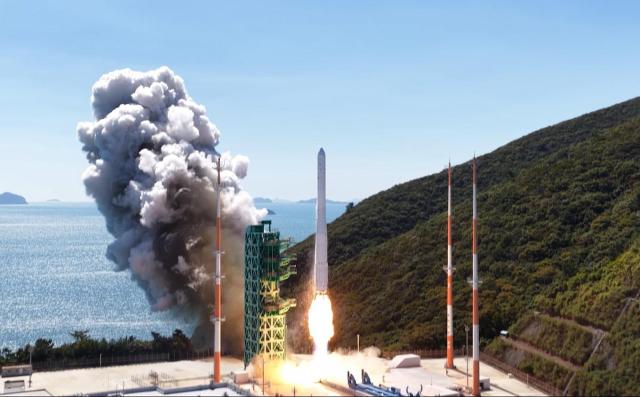
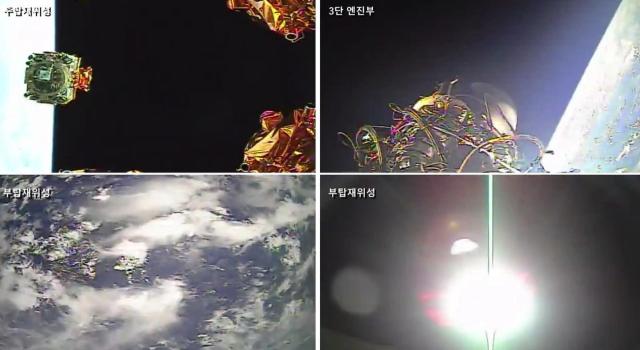
Nuri lifted off from the Naro Space Center in Goheung at 12:25 p.m. Wednesday and successfully placed all five main microsatellites into orbit.
Nine of the 10 smaller CubeSats aboard were also released, while one failed to deploy. The Korea AeroSpace Administration, or KASA, declared the launch a success, saying the rocket completed its planned flight despite the deployment failure.
The achievement did little to lift Hanwha Aerospace shares, which closed at 983,000 won, down 3.91 percent, or 40,000 won, from the previous session.
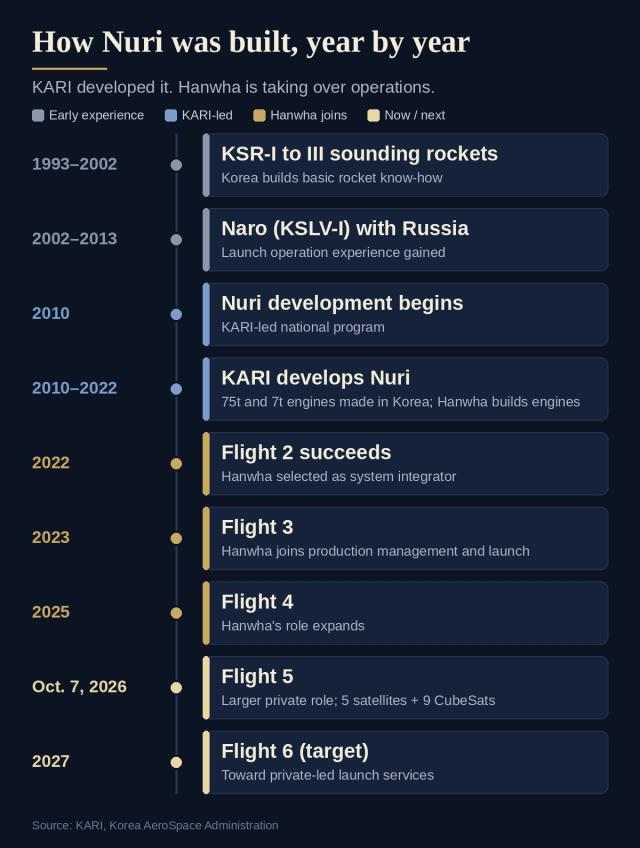
Nuri was developed primarily by the state-run Korea Aerospace Research Institute, or KARI, over more than a decade. Hanwha initially participated by manufacturing and assembling key components, including the rocket’s engines.
Nuri uses six liquid-fueled engines: four 75-ton-class engines on the first stage, one 75-ton engine on the second and a smaller 7-ton engine on the third.
Hanwha’s responsibilities have since expanded well beyond individual components.
Selected as the system integrator for the Nuri advancement program, the company is increasingly responsible for bringing together the engines, structures, electronic systems and work of hundreds of suppliers into a functioning launch vehicle.
For the fifth Nuri rocket, Hanwha oversaw overall production, final assembly and supplier quality control. KARI continued to supervise the program and lead launch operations.
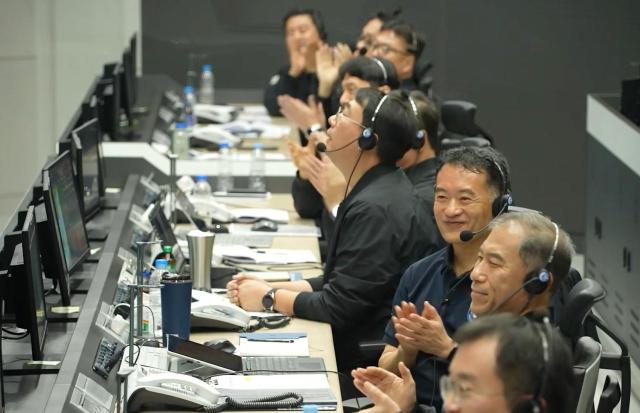
The most visible change during the fifth launch was inside the control room.
A total of 42 Hanwha employees participated in launch operations, 10 more than during Nuri’s fourth flight.
Hanwha personnel worked at 20 of the launch control center’s 22 consoles, with 18 employees directly operating equipment used to prepare, test and launch the rocket.
KARI researchers had handled most of those tasks during earlier launches. The aim is to enable private companies to provide launch services, gradually reducing dependence on the government research institute.
KARI describes the repeated Nuri launches as serving two purposes: improving the rocket’s reliability and transferring launch technology to private industry.
The fifth flight also presented a more complicated task.
Nuri carried five main microsatellites requiring separate releases into orbit, alongside 10 CubeSats. The satellite section weighed about 1,071 kilograms, up from about 960 kilograms on the fourth launch.
To protect the satellites during deployment, KARI introduced a new low-shock separation device — the mechanism that secures a satellite during launch and releases it in space.
The previous system produced a separation shock of around 2,000 g on the shock-response scale. The new device was designed to halve that to about 1,000 g, according to KARI officials.
The five main satellites were released individually at intervals of about 35 to 40 seconds. Between releases, the rocket’s upper stage changed orientation to reduce the risk of collisions.
Developed under the KARI-led program, the separation system illustrates the division of responsibilities during the transition. As system integrator, Hanwha is increasingly tasked with incorporating such changes into the rocket it manufactures and assembles.
Hanwha’s role is expected to expand further with Nuri’s sixth launch.
Under KARI’s plan, the rocket stages will be assembled at the system integrator’s own facility, then transported by sea to the Naro Space Center for final assembly.
Hanwha is also expected to operate nearly all the launch-control consoles covered by the technology-transfer program.
The handover is advancing one launch at a time. Hanwha began by building engines and components, moved on to integrating the rocket and is now taking on more of the work required to launch it.
KARI still leads the countdown. With each flight, Hanwha is moving closer to taking the controls.

Copyright ⓒ Aju Press All rights reserved.
