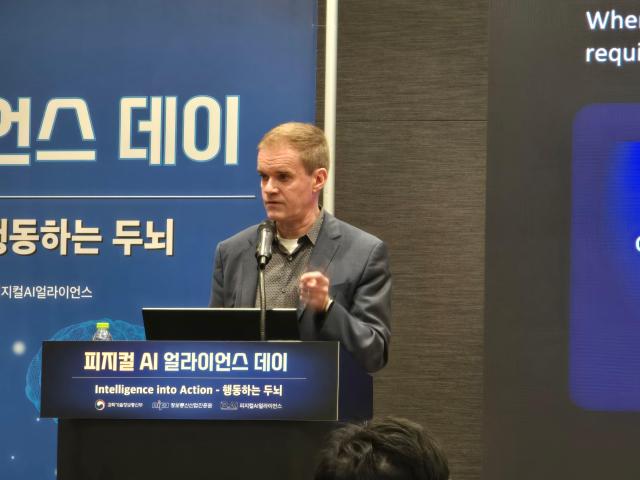
Healy spoke at the Physical AI Tech Week, hosted by the Ministry of Science and ICT at COEX. He cited The Robotics Readiness Gap, an August report in which Intel surveyed 800 leaders across six countries, including Korea.
Six in 10 expect to operate a robot fleet within five years, but only 4 in 10 have a formal strategy for working alongside robots.
"Oftentimes implementations of the model or the robot in the lab look very impressive, but in the real world it's much more challenging and difficult," Healy said.
He described the gap as "as much a technology problem as it is an organizational and workflow problem."
Healy also played down the industry's fixation on humanoids.
"We hear a lot about humanoids, and we'll see humanoids at all of the shows," he said. In Intel's report, 77 percent of respondents said a robot's performance matters more than its appearance.
Real-time response, power efficiency and safety are foundations that physical AI cannot compromise on, Healy said. He pitched Intel's chips, which combine a CPU, integrated GPU and NPU on a single platform, as a way to cut the engineering cost of moving from pilot to production.
"If you want to go fast, go alone, but if you want to go far, go together," he said.
AJP Takeaways
- John Healy, vice president of Intel's industrial and robotics division, said on Oct. 13, 2026, in Seoul that most companies are not ready to deploy robots at scale. He spoke at the Physical AI Tech Week, hosted by South Korea's Ministry of Science and ICT.
- Intel's August 2026 report, The Robotics Readiness Gap, surveyed 800 leaders in the U.S., Britain, Germany, Japan, China and South Korea. Six in 10 expect to run a robot fleet within five years, but only 4 in 10 have a formal strategy for working alongside robots.
- Healy said 77 percent of respondents value a robot's performance over its appearance, and he called open ecosystems the path to scaling physical AI.

Copyright ⓒ Aju Press All rights reserved.