The KOSPI is barely holding above 6,000 after flirting with 10,000 in June. Foreign investors sold more than 4 trillion won in KOSPI shares Tuesday, following roughly 2.5 trillion won of net selling Monday. Their net sales over the past two months have reached about 36 trillion won.
Such relentless foreign selling would have battered the Korean won. Yet the currency remains near a two-year high, supported by a flood of dollar earnings from semiconductor exports.
Currency-market participants point to an increasingly important counterweight to foreign stock selling: dollars being converted into won by exporters riding Korea’s semiconductor boom.
An FX dealer at a local bank said it was difficult to quantify the flows from chipmakers.
“What I can say with confidence is that a significant portion of current conversion demand is coming from Samsung Electronics and SK hynix,” the dealer said. “They are clearly helping support the won. That’s for sure.”
The pattern of exporter selling has also changed.
Dollar selling once concentrated around month-end has increasingly shifted toward steady conversion throughout the month, led by semiconductor companies, said Woori Bank economist Min Kyung-won.
That has turned a seasonal flow into a more persistent source of dollar supply in Seoul’s foreign-exchange market.
The underlying export boom has reached unprecedented levels. Semiconductor shipments surged 262.8 percent from a year earlier to a record $60.3 billion in September, accounting for nearly half of Korea’s record $120.94 billion in total exports, according to the Ministry of Trade, Industry and Resources.
The flow continued into October. Semiconductor exports reached $12.2 billion in the first 10 days as total exports hit $26.1 billion, the highest ever for the period.
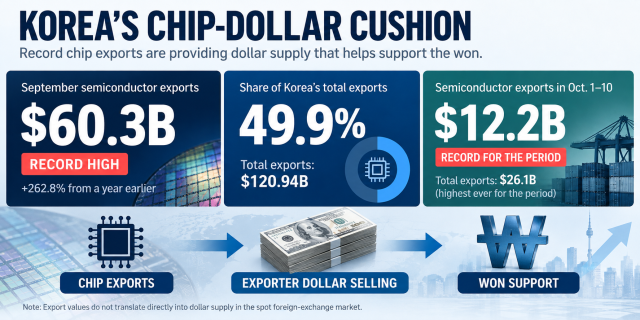
Companies can retain proceeds in foreign currency, use them for imports or overseas expenses, hedge through derivatives or delay conversion. Other exporters, portfolio flows and overseas investment by Korean residents also affect the balance.
Even with those qualifications, the durability of the semiconductor cycle matters increasingly for the won — and for the economy and public finances benefiting from the boom.
Former Bank of Korea Gov. Rhee Chang-yong questioned the reliability of long-term semiconductor forecasts during an Oct. 10 appearance on the YouTube channel Syuka World.
“None of them said a supercycle like this was coming,” Rhee said, recalling a meeting with about 20 semiconductor specialists while he was governor to discuss the industry’s outlook.
He questioned how much confidence should be placed in predictions that the current cycle could last a decade, arguing that an earlier end should also be considered. He pointed to China’s technological progress and potential changes in U.S.-China relations as variables that could affect the competitive positions of Samsung Electronics and SK hynix.
Bank of Korea Gov. Shin Hyun-song faced a similar question at a National Assembly audit Monday.
Asked by Rep. Park Soo-young how long the semiconductor boom and the tax revenue it generates could continue, Shin said, “The market expects it to continue at least through next year and the year after.”
His answer cited prevailing market expectations through 2027 and 2028, rather than offering a new long-term central bank forecast. Shin separately stressed that fiscal policy must remain sustainable.
For the won, an earlier-than-expected turn in the cycle could weaken both sides of the current balance.
Slower semiconductor exports could reduce the dollar earnings available for conversion into won. Weaker earnings expectations could also prompt further foreign selling of chip shares, creating additional dollar demand if investors convert the proceeds.
Tuesday offered a test of that balance.
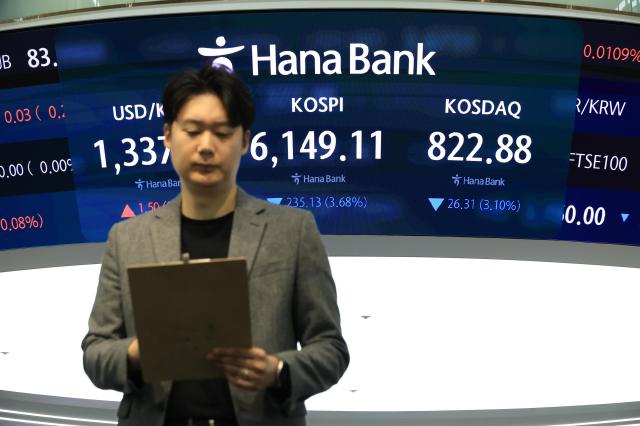
Concerns over technological advances by China’s ChangXin Memory Technologies and broader doubts about the durability of AI-related semiconductor investment triggered another sharp selloff in Korean chip shares. A temporary curb on program selling, known locally as a sidecar, was activated during the session.
The won closed at 1,345.1 per dollar, weakening by 10 won and reversing part of its recent gains.
The move does not establish how much further the currency might have fallen without exporter conversions. Nor do foreign equity sales translate one-for-one into dollar demand: investors may retain the won proceeds or reinvest them in other Korean assets.
One dealer pointed to signals that could show the balance beginning to shift.
One would be a decisive move in offshore non-deliverable forward positioning from bets on won appreciation toward depreciation. Another would be sustained foreign selling of semiconductor shares accompanied by conversion of the proceeds into dollars and overseas remittances.
For now, the dealer said, those signals remain limited, while semiconductor exporters’ dollar selling continues to show solid momentum.
The KOSPI’s retreat is a warning about confidence in future earnings. Whether it becomes a warning for the won depends in part on how long the chip dollars keep flowing.
AJP Takeaways
- Chip dollars provide a steady currency cushion. Semiconductor exporters are converting proceeds throughout the month, adding persistent dollar supply as foreign investors sell Korean shares.
- The cushion is being tested. The won weakened by 10 won to 1,345.1 per dollar Tuesday as foreign investors sold more than 4 trillion won in KOSPI shares.
- A chip downturn could exert pressure from both directions. Weaker exports could reduce dollar supply while foreign investors converting stock-sale proceeds could increase dollar demand. Exporter conversions and offshore bets against the won are key signals to watch.

Copyright ⓒ Aju Press All rights reserved.