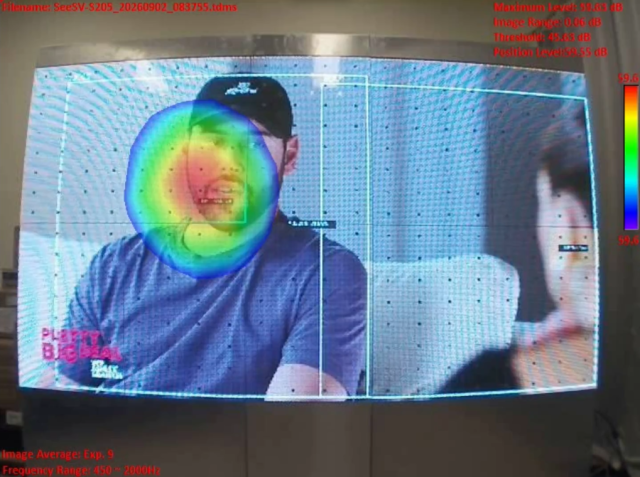
The prototype, measuring about 100 inches, pairs a transparent LED film with an aluminum panel driven by 80 voice coil motors mounted on its back.
Tests showed the display steered sound to the targeted section of the screen with 99.9 percent accuracy.
The system uses an inverse-problem method to calculate a voltage signal for each actuator, setting only the chosen zone in motion.
Vibration in active zones was up to 35 decibels stronger than in silent ones, and an AI model locates sound sources in the video and separates individual sounds in real time.
Speakers on conventional large screens sit apart from the picture, so the sound comes from a different direction than the action and weakens immersion.
The new modules can be joined or separated to fit anything from a living-room TV to a giant outdoor billboard, and several can vibrate together to produce bass similar to a large woofer.
“The modular grid technology matches the position of a sound source on screen with the direction the sound is actually heard from, delivering an immersive audiovisual experience that existing displays have struggled to provide,” said Kim Dong-jun, a senior researcher at the institute’s AX Convergence Research Center.
Kim said the team plans to extend the technology to modular LED tile displays.
AJP Takeaways
- The Korea Institute of Machinery and Materials said on Oct. 15, 2026, that it had developed a speakerless display that plays sound from the exact screen position of the on-screen source.
- Its prototype of about 100 inches, driven by 80 voice coil motors, steered sound to target zones with 99.9 percent accuracy, with up to a 35-decibel vibration gap between active and silent zones.
- The modular design scales from home TVs to large billboards, and the institute plans to extend it to modular LED tile displays.

Copyright ⓒ Aju Press All rights reserved.