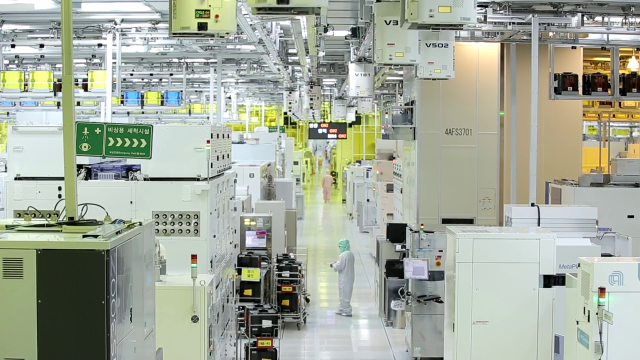
SEOUL, October 23 (AJP) — The extraordinary AI windfall may be strong enough to lift South Korea’s long-term growth potential, suggesting the AI halo over Asia’s fourth-largest economy could be broader and longer-lasting than previously expected.
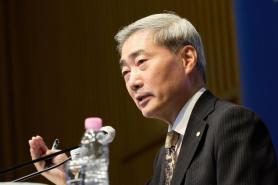
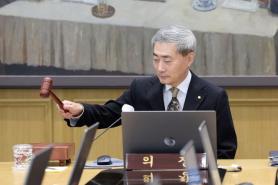
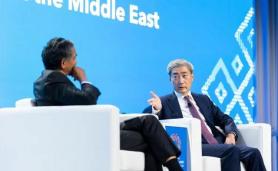
Bank of Korea Governor Shin Hyun-song on Friday suggested the economy could be at an inflection point as the central bank prepares to reassess its underlying growth capacity.
“I think this is a very important turning point,” he said during a parliamentary audit.
The BOK last estimated potential growth at around 2 percent for 2024–2026 and plans to publish an updated estimate before year-end. Before the chip bonanza, expectations had increasingly pointed toward a decline into the 1 percent range.
Potential growth is the pace at which an economy can sustainably expand without generating accelerating inflation. It depends on the supply of labor and capital and how efficiently they are used.
Korea’s rate stood at around 5 percent in the early 2000s before slowing to the mid-3 percent range in the 2010s as contributions from all three weakened.
The BOK now expects actual growth this year and next to run “well above” its August forecasts of 3.3 percent and 2.9 percent, respectively. A prolonged expansion could strengthen the case for a higher potential-growth estimate if the windfall translates into lasting investment and productivity gains.
The distinction is between an economy enjoying a powerful upswing and one becoming capable of sustaining faster growth.
The central bank said in May that the impact would depend on whether the semiconductor boom represented a permanent change or remained part of a cyclical upswing. The latter would have a much more limited effect on potential growth.
“Historically, structural changes often become apparent only in hindsight,” said Lee Ji-ho, now a BOK deputy governor and then head of its Research Department. He cautioned that it was too early to conclude that the expansion represented such a shift.
International estimates already suggest different trajectories.
The Organization for Economic Co-operation and Development (OECD) estimated in June that Korea’s potential growth would decline from 1.85 percent in 2025 to 1.66 percent in 2026 and 1.52 percent in 2027.
Calculations based on real GDP and output-gap forecasts in the International Monetary Fund’s (IMF) October World Economic Outlook, however, imply potential growth of about 1.94 percent in 2025, 2.14 percent in 2026 and 2.20 percent in 2027.
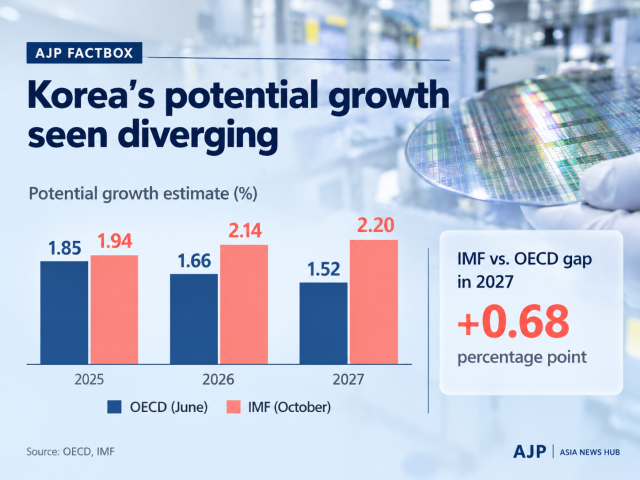
Timing also matters: the IMF’s October outlook incorporates a much stronger semiconductor cycle than the OECD’s June projections.
The BOK combines several methods, including models of productive capacity and statistical estimates of underlying trends, rather than relying on a single measure.
For Shin, productivity will ultimately determine whether the investment boom changes Korea’s long-term trajectory.
“Total factor productivity itself may rise, but sustaining a higher growth rate requires further gains through innovation,” he told lawmakers.
That remains an unfinished transition.
A June BOK study found that generative AI reduced working time by an average of 3.8 percent, or about 1.5 hours a week. It estimated a potential productivity gain of around 1 percent if all the saved time were redirected toward productive activity.
Yet the study found essentially no relationship between time saved and actual output growth. Researchers concluded that AI had reached an “efficiency stage” but not yet a “productivity stage.” Broader gains would require changes in workflows, organizational structures, task allocation and incentives.
Such gains could help counter the demographic forces weighing on Korea’s growth capacity.
IMF economists led by Korea mission chief Rahul Anand estimated that population aging could reduce average annual potential growth by 0.67 percentage point between 2023 and 2050, while broader AI adoption could raise it by as much as 0.44 percentage point.
“Accelerating structural reforms remains crucial to boost Korea’s potential growth,” Anand said in an IMF statement last year. He called for a narrower productivity gap between large companies and smaller firms and greater use of innovation and AI.
More efficient allocation of labor and capital could add another 0.22 percentage point, while greater participation by women and older workers could offset about one-fifth of the drag from aging.
The BOK’s long-term simulations similarly point to productivity as the strongest lever. Higher total factor productivity growth could lift potential growth in the late 2040s by around 0.7 percentage point, compared with 0.1 to 0.2 percentage point from higher fertility.
Taiwan offers an illustration of how AI demand can spread beyond export earnings.
Its statistics agency expects growth of 11.05 percent in 2026 and 6.04 percent in 2027. Real private fixed capital formation is projected to rise 11.58 percent this year as AI demand drives capacity expansion across the semiconductor supply chain.
The island’s central bank forecasts growth of 11.48 percent this year and 5.82 percent in 2027, with AI and high-performance computing demand supporting exports and investment while stronger wages and domestic activity underpin consumption.
Those forecasts do not establish a permanent increase in potential growth. They do, however, illustrate how an export windfall can spread through investment, supply chains and household spending.
For Korea, the durability of the chip halo will depend on how far those gains reach.
Productivity improvements across manufacturing and services could help pull the economy away from a sub-2 percent potential-growth path. Gains concentrated in chip prices, factory utilization and a handful of large exporters would leave it more exposed when the cycle turns.
The BOK’s year-end estimate will offer an official assessment of whether the boom has simply made Korea grow faster for a time — or begun to raise the speed it can sustain.
Copyright ⓒ Aju Press All rights reserved.