*Updated with Bank of Korea comments and market response
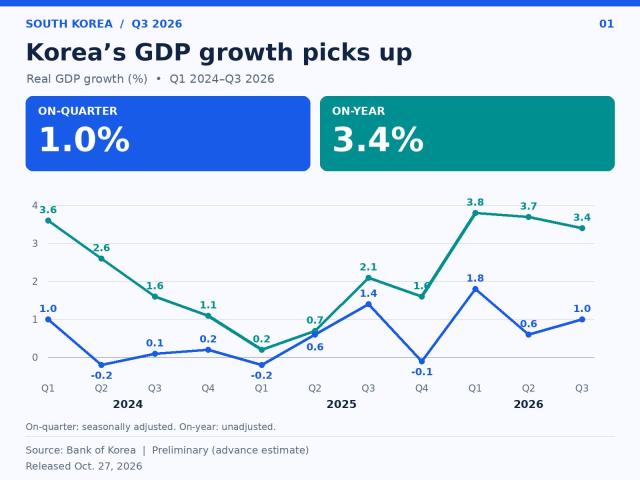
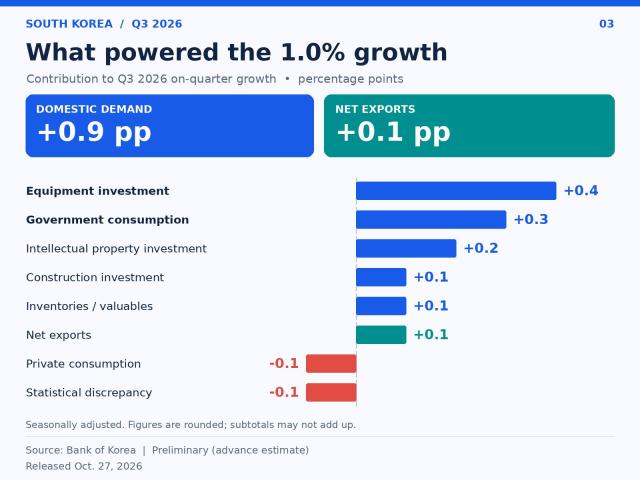
SEOUL, October 27 (AJP) —South Korea’s economy grew a stronger-than-expected 1.0 percent on quarter and 3.7 percent on year in the July–September period, putting annual growth close to 4 percent within reach on exceptional chip demand, according to the central bank.
“Cumulative growth through the third quarter stands at 3.6 percent from a year earlier. If fourth-quarter growth is 0.0 percent on quarter, meaning the economy stays at its third-quarter level, annual growth would mathematically come to 3.6 percent,” said Lee Dong-won, director general of the Bank of Korea’s Economic Statistics Department, at a briefing Tuesday.
“If fourth-quarter growth reaches 1.4 percent or more on quarter, annual growth of 4 percent would also be mathematically possible.”
Growth near 4 percent would put the economy on a pace last seen in the early 2010s, apart from its 4.1 percent-rebound in 2021 from pandemic-hit recession year. South Korea grew 3.7 percent in 2011 and 6.8 percent in 2010 amid stimulus following the global financial crisis.
The latest figures, however, underscored how heavily the economy relies on external demand and investment around microchips powering the global AI transitions, amid stubbornly lethargic consumption.
“Computer, electronic and optical products, which include semiconductors, appear to account for about 60 percent of year-on-year growth. We estimate that semiconductors alone account for about half,” Lee said.
Markets celebrated the chip-powered economy. The KOSPI rose more than 4 percent as foreign and institutional investors bought chip bellwethers. SK hynix jumped 7.5 percent and Samsung Electronics gained 4.8 percent as of 10:30 a.m. The won strengthened to 1,325.1 per dollar, while the 10-year government bond yield fell 0.6 basis point to 4.069 percent.
Exports rose 2.3 percent from the previous quarter, led by semiconductors, machinery and electrical equipment, accelerating from a 1.3 percent increase in the second quarter.
Facilities investment jumped 4.1 percent on quarter and 9.4 percent on year as chipmakers expanded capacity. Investment in intellectual property products also benefited from stronger corporate earnings.
“As companies’ operating profits have increased, facilities investment, investment in intellectual property products and research and development investment have also been rising since the first quarter,” Lee said.
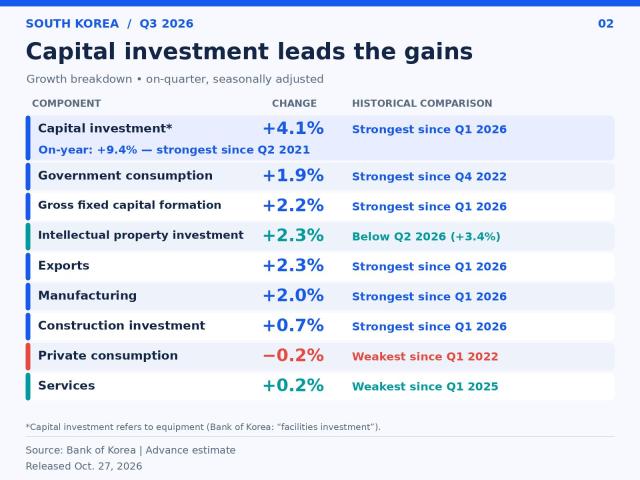
Government consumption rose 1.9 percent and construction investment gained 0.7 percent. Private consumption, however, fell 0.2 percent as spending declined on both goods, including vehicles and home appliances, and services such as finance and food services. The decline reversed a 0.4 percent gain in the previous quarter.
The BOK expects some of the benefits from stronger corporate earnings and government spending to reach households with a lag.
“Some effects will emerge through dividend payments in the second half of this year, while the effects of bonus payments will appear in the first quarter of next year,” Lee said. “Government transfer payments beginning in the first quarter of next year are also expected to boost private consumption.”
The figures showed that the semiconductor boom continued to power headline growth but had yet to translate into equally strong household demand. A separate BOK survey released Tuesday showed consumer sentiment weakened in October, with expectations for both the economy and employment declining despite strong exports.
The third-quarter figures exposed both the strength and weakness of the economy powered by AI chip demand. ere
Lee said semiconductors continued to account for roughly half of growth, while the industry’s earnings boom remained strongly influenced by prices.
“Volumes are increasing gradually, but prices are fundamentally a major factor,” he said.
The BOK expects chip production to gather pace next year as additional output of high-bandwidth memory used in AI computing comes through - albeit on moderated price gains.
"We expect semiconductor production volumes to increase somewhat more next year as the effects of HBM production emerge. We will have to wait and see how large the increase will be, but we expect volume growth to be higher than this year,” Lee said. “Semiconductor prices are also expected to continue rising, but the rate of increase will likely slow somewhat from this year.”
Real gross domestic income, which reflects changes in purchasing power arising from the terms of trade, increased 3.4 percent from the previous quarter, well above the GDP growth rate. It surged 18.8 percent from a year earlier.
The annual GDI increase was the strongest since the fourth quarter of 1977, when it rose 19.0 percent, underscoring the scale of the income gains that have yet to feed fully into household spending.
*Ryu Yuna of AJP contributed to this article.

Kim Yeon-jae is a journalist at AJU Press (AJP's English platform),
covering macroeconomics, international finance, and geopolitics.
He closely tracks central bank monetary policies, global energy supply chains,
and the Korean defense industry.
Copyright ⓒ Aju Press All rights reserved.