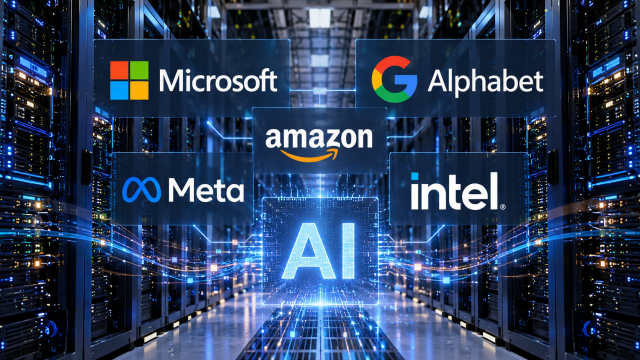
The latest earnings from the three cloud providers, alongside Meta Platforms and chipmaker Intel, show how the AI boom is reshaping the technology industry. Demand for computing power is translating into stronger revenue growth, but the cost of building data centers and expanding computing capacity is putting pressure on cash flow.
For South Korea's semiconductor industry, the results offer further evidence of robust demand for high-bandwidth memory (HBM) and server DRAM, which have fueled record earnings at Samsung Electronics and SK hynix.
Microsoft posted revenue of US$92.3 billion for its fiscal first quarter ended September, up 19 percent from a year earlier, while operating income rose 21 percent to $45.9 billion.
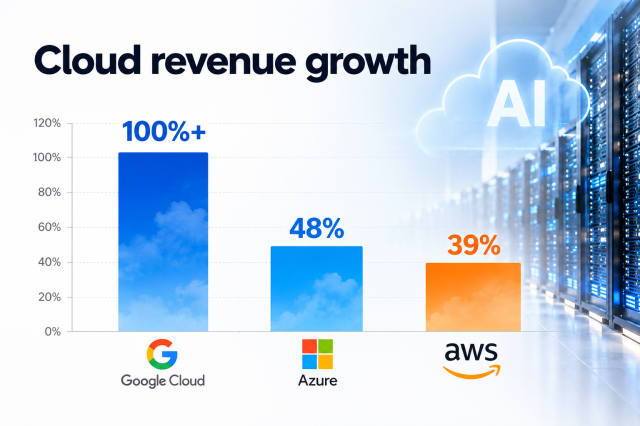
Its Azure cloud business grew 48 percent, while overall Microsoft Cloud revenue climbed 30 percent to $63.9 billion, reflecting continued demand for cloud infrastructure and AI services.
Alphabet, Google's parent company, reported $127.58 billion in revenue for the third quarter, up 25 percent from a year earlier. Operating income also rose 30 percent to $40.58 billion.
Google Cloud revenue more than doubled to $30.7 billion, driven by demand for AI infrastructure, enterprise services and Google's custom computing chips.
The growth, however, came with substantial costs. Alphabet spent $51.36 billion on property and equipment during the quarter, exceeding the $42.29 billion generated from operating activities and leaving quarterly free cash flow negative at $9.07 billion.
Amazon also reported strong demand for its cloud services when it released its earnings results in the U.S. on Thursday.
The company posted third-quarter revenue of $201.94 billion, up 12 percent from a year earlier, while operating income climbed to $28.08 billion from $17.42 billion.
Amazon Web Services recorded revenue of $45.98 billion, a 39 percent increase and its fastest growth in nearly five years. AWS operating income rose to $17.77 billion from $11.43 billion.
Amazon expects approximately $220 billion in cash capital expenditures this year as it expands its AI and cloud infrastructure.
The heavy spending has also put pressure on cash flow. Amazon reported negative free cash flow of $42.4 billion for the 12 months through September, compared with positive free cash flow of $14.8 billion a year earlier, largely due to increased spending on infrastructure.
Meta, which reported earnings earlier this month, is also accelerating investment in AI despite mounting costs.
The Facebook and Instagram parent reported third-quarter revenue of $64.6 billion, up 26 percent year on year, supported by improvements in its advertising business.
Operating income fell 37 percent to $12.99 billion, reflecting higher expenses that included a $9.89 billion charge related to a legal settlement.
Meta's quarterly capital expenditures, including principal payments on finance leases, reached $34.91 billion. The company expects full-year spending of between $135 billion and $145 billion as it continues expanding its AI infrastructure.
Its quarterly free cash flow was negative $2.12 billion.
Together, the results highlight a growing tension in the AI industry: demand for computing power is generating substantial revenue growth, but companies are spending heavily to build capacity ahead of future demand.
That investment cycle is also benefiting semiconductor suppliers.
Intel reported third-quarter revenue of $16.5 billion, up 21 percent from a year earlier, as demand for server processors strengthened.
Its Data Center and AI division posted revenue of $7.3 billion, a 78 percent increase, underscoring demand for computing infrastructure beyond AI accelerators.
The U.S. chipmaker's foundry business, however, remained unprofitable, posting an operating loss of $1.9 billion despite revenue rising to $6.7 billion.
Intel forecast fourth-quarter revenue of $15 billion to $16 billion, below its third-quarter level, highlighting the uneven pace of recovery across its businesses.
The contrasting results illustrate how the AI boom is creating opportunities across the semiconductor supply chain while leaving companies exposed to different financial and operational challenges.
For memory chipmakers, continued investment by major cloud providers remains a crucial source of demand.
AI servers require HBM alongside advanced processors, while conventional DRAM is widely used across server systems. Expanding data center capacity therefore supports demand for both specialized AI memory and broader server memory products.
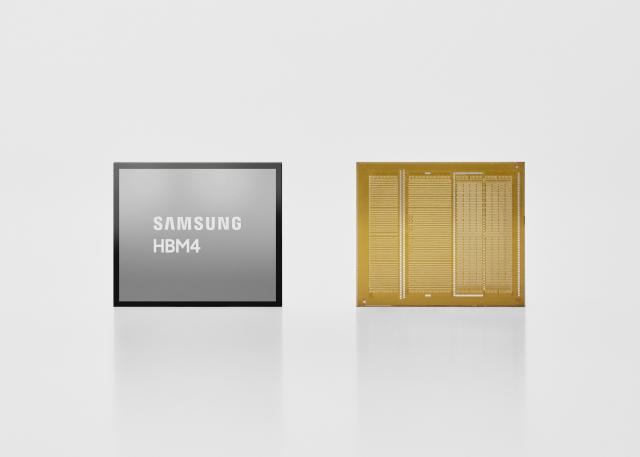
Samsung Electronics reported record third-quarter operating profit of 107.4 trillion won Thursday, with its semiconductor division accounting for the overwhelming majority of earnings as memory prices rose and HBM shipments expanded.
SK hynix, which reported results a day earlier, posted quarterly operating profit of 83.33 trillion won, supported by strong AI memory demand and tight supply conditions.
Both companies are expanding next-generation HBM production and pursuing longer-term supply agreements as customers seek to secure memory capacity amid the AI infrastructure buildout.
Lee Jong-hwan, a professor of system semiconductor engineering at Sangmyung University, said elevated memory prices have reduced the incentive for chipmakers to accelerate capacity expansion beyond their immediate needs.
"With market conditions this favorable, there's little need for them to rush into expanding capacity," Lee told AJP.
The dynamic highlights a contrast in the AI supply chain: technology giants are committing unprecedented sums to securing computing capacity, while memory suppliers have reason to be more measured in expanding production.
Yet the latest U.S. earnings also underscore a potential vulnerability in the semiconductor boom.
While cloud revenue is accelerating, the enormous capital commitments required to sustain that growth are weighing on cash flow, raising questions about whether the current pace of infrastructure investment can be maintained indefinitely.
For Samsung and SK hynix, the immediate outlook remains supported by strong demand and constrained supply. Over the longer term, however, the durability of the memory boom will depend partly on whether their largest customers can turn today's record AI spending into sustained financial returns.

Copyright ⓒ Aju Press All rights reserved.