
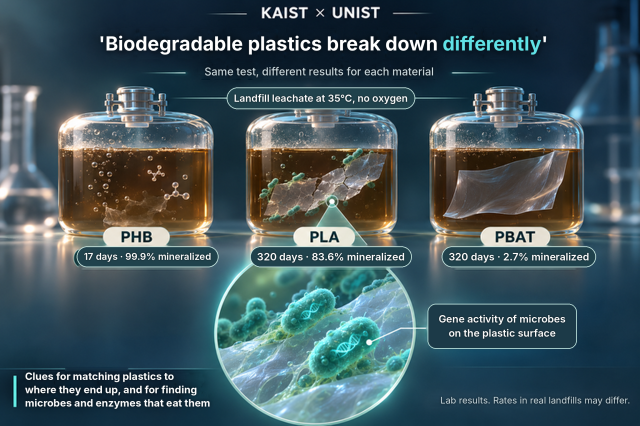
SEOUL, November 10 (AJP) - Plastics sold as biodegradable do not all break down the same way once they are buried in a landfill, a South Korean study found. One type was almost gone within weeks, while another barely changed after nearly a year.
Researchers from KAIST and Ulsan National Institute of Science and Technology found that polyhydroxybutyrate (PHB) broke down almost completely in 17 days. Polybutylene adipate terephthalate (PBAT), widely used in compostable bags, lost only 2.7 percent of its carbon after 320 days, close to the result for ordinary polyethylene in the same test.
The study was published in Nature Communications on Oct. 20, and KAIST announced the findings Tuesday.
Biodegradable plastics are designed to be broken down by microbes and are promoted as a way to reduce plastic waste. How fast that happens depends on the material, the temperature, whether oxygen is present and which microbes are nearby. A plastic that breaks down readily in a hot industrial composting plant can persist for years in a landfill.
Where separate collection systems are lacking, biodegradable plastics often end up in landfills with ordinary trash. Deep inside a landfill, there is little oxygen, and scientists know relatively little about how these materials behave there or which microbes act on them.
The team was led by Myung Jae-wook, a professor in KAIST's Department of Civil and Environmental Engineering, and Lee Chang-soo, a professor at Ulsan National Institute of Science and Technology (UNIST). They placed PHB, PBAT and a third material, polylactic acid (PLA), in leachate from a landfill that has operated since 1997. Leachate is the liquid that seeps through buried waste, carrying dissolved substances and microbes with it.
The samples were kept at 35 degrees Celsius without oxygen for up to 320 days. Low-density polyethylene, a common conventional plastic, was tested alongside them for comparison.
The researchers measured breakdown by mineralization, the share of a plastic's carbon that microbes convert into gases such as methane and carbon dioxide. The measure separates real biological breakdown from plastic that has only changed shape or crumbled into smaller pieces.
PHB reached 99.9 percent mineralization within 17 days. PLA showed little change for about the first 20 days, then broke down steadily to reach 83.6 percent after 320 days. Over the same period, PBAT reached 2.7 percent and polyethylene 0.4 percent.
The PLA result ran against expectations. PLA, used in disposable cups and food packaging, has been reported to break down efficiently mainly in industrial composting, because its polymer chains break apart slowly below about 58 degrees Celsius. Earlier studies found limited breakdown in soil, fresh water and seawater at ordinary temperatures.
Under an electron microscope, the PLA samples showed cracks and damaged areas covered by biofilm, a thin layer that forms when microbes cluster on a surface.
To see what those microbes were doing, the team analyzed both their DNA, which shows which genes a microbe carries, and their RNA, which shows which of those genes it is actually using.
Of the 238 microbial genomes the team reconstructed, 118 contained candidate genes for enzymes that break down PHB or PLA. Only 49 showed signs that those genes were active.
That activity was higher in the biofilm on the plastic surface than in the surrounding leachate. The researchers said this makes what the attached microbes are doing a key clue to how the plastics break down, beyond simply which microbes are present.
Of the 49 active genomes, 37 belonged to microbial lineages that have received little scientific study. The team said this points to possible new plastic-degrading microbes and enzymes.
The researchers cautioned that gene activity alone does not prove a microbe or enzyme breaks down plastic, and that follow-up experiments are needed to confirm it. The results also came from laboratory conditions at 35 degrees Celsius. Real landfills differ in temperature, waste composition, oxygen and nutrients, and the team said the same breakdown rates cannot be assumed there.
"Even biodegradable plastics break down to very different degrees depending on where they are thrown away and which microbes are active," Myung said. He said he hoped the work would help set biodegradability standards suited to where plastics are discarded.
Choe Shin-hyeong, a KAIST graduate now doing postdoctoral research at the Swiss Federal Institute of Aquatic Science and Technology, and Choi Hyung-min, a UNIST graduate now doing postdoctoral research at Hokkaido University, were co-first authors of the paper.
Copyright ⓒ Aju Press All rights reserved.


