

Q1. What makes Kimjang more than just making kimchi?
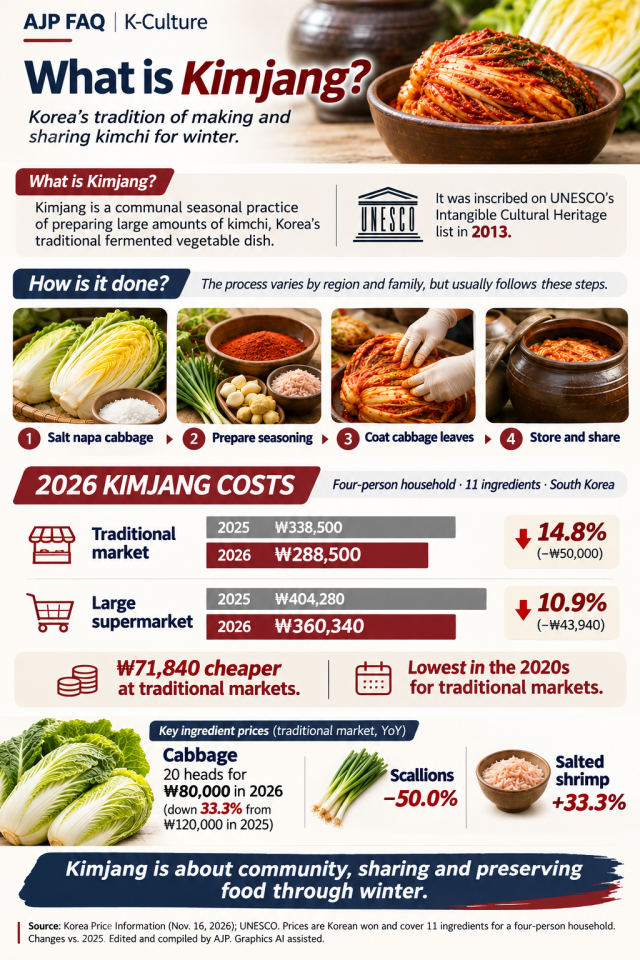
Kimjang is a centuries-old Korean tradition in which families, relatives and neighbors gather in late autumn to prepare large quantities of kimchi for winter. The process involves salting napa cabbage, preparing seasoning, coating the cabbage leaves and storing the finished kimchi for fermentation. Beyond preserving food, Kimjang is about cooperation, sharing and passing down recipes and traditions across generations. In 2013, UNESCO recognized Kimjang as an Intangible Cultural Heritage of Humanity.
Q2. How much does Kimjang cost in 2026?
According to Korea Price Information, preparing kimchi for a family of four using 11 ingredients costs an estimated 288,500 won at traditional markets and 360,340 won at large supermarkets. That represents a decline of 14.8 percent and 10.9 percent, respectively, from 2025. Traditional markets are ₩71,840 cheaper than supermarkets, with Kimjang costs falling to their lowest level of the 2020s at traditional markets. The figures reflect the cost of purchasing ingredients, rather than ready-made kimchi.
Q3. Why is Kimjang cheaper this year?
Favorable autumn weather improved harvests of key vegetables, increasing supplies and lowering prices across South Korea. At traditional markets, the price of 20 napa cabbages fell 33.3 percent from ₩120,000 to ₩80,000, while scallion prices dropped 50 percent from a year earlier. However, not all ingredients became cheaper, with salted shrimp prices rising 33.3 percent and sea salt increasing 16.7 percent. Despite these increases, lower vegetable prices helped bring overall Kimjang costs down to their lowest levels in several years.

Joonha Yoo is a bilingual journalist at AJU Press (AJP), covering music, culture, entertainment and Korea’s automotive industry.
Raised in Fort Collins, Colorado, he often writes from the scene, bringing firsthand detail to stories ranging
from BTS comeback concerts to unique cultural events that catch the world's eye.
Copyright ⓒ Aju Press All rights reserved.
