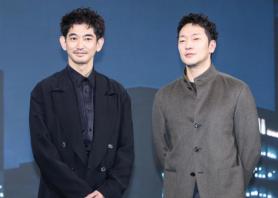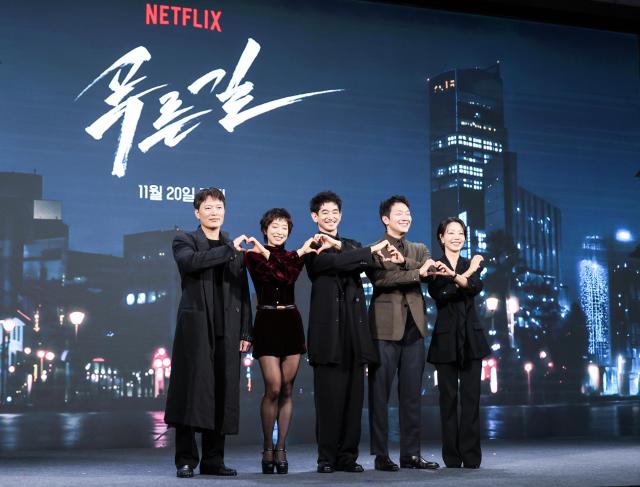
SEOUL, November 17 (AJP) - Japanese actor Eita Nagayama sees no fundamental divide between Korean and Japanese filmmaking, a perspective reflected in Netflix's upcoming cross-border crime thriller "The Blue Road," where even a character's accent was deliberately kept from fitting a national stereotype.
Speaking at a press conference in Seoul on Tuesday, Nagayama rejected the idea that working on a Korean production necessarily meant adapting to a different national style.
"Even within Japan, filming styles differ depending on the director and whether the production is a film, drama or stage play," he said through an interpreter. "I didn't feel any major differences simply because one production was Korean and the other Japanese."
His remarks offered a different perspective on the eight-part series, which follows a Korean detective played by Son Suk-ku and a Japanese detective played by Nagayama as they investigate a series of gruesome murders across national borders.
Directed by Han Jun-hee of Netflix's "D.P.," the thriller is set in 2002 and moves between South Korea, Japan and other locations in Asia. It premieres on Nov. 20.

The question of how national identity shapes a character became particularly important for actress Kim Shin-rock, who portrays Li Yoon-ok, a Zainichi Korean businesswoman operating in Japan's pachinko industry.
Kim said the production assigned three Zainichi Korean language instructors to help her prepare for the role. What surprised her was how differently each of them spoke.
"I found it fascinating that there wasn't one single category of Zainichi Korean speech. Each person had their own language," she said.
Kim initially considered adopting a recognizable pattern of speech associated with ethnic Koreans living in Japan. But discussions with Han led her away from reproducing a generalized accent.
She said the personal histories of Zainichi Koreans were intertwined with the history of their times, making it difficult to represent such diverse experiences through a single linguistic style.
Rather than trying to sound like a representative of an entire community, she focused on developing the particular voice Li Yoon-ok might have acquired through her own experiences.
The challenge of portraying characters across languages extended to the two leading actors.
But his priority was to make the language a means of conveying his character's intentions rather than merely reproducing memorized sounds.
Nagayama, who also delivers Korean dialogue, said the two actors relied heavily on their responses to each other instead of deciding every gesture and reaction beforehand.
That flexibility was encouraged by Han, who described scripts and storyboards as the minimum starting point for a scene rather than fixed instructions that actors had to follow.
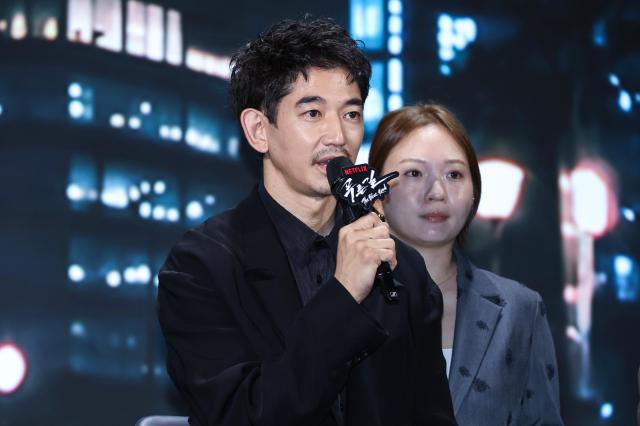
Han applied a similar approach to the story's central partnership.
He said conventional buddy dramas often place a protagonist alongside a supporting partner, but he wanted two detectives who could each carry a story independently.
Although the characters initially appear to have opposite personalities, their traits gradually become intertwined as the investigation progresses.
The approach also reflects the director's interest in moving beyond straightforward character categories. Kim's businesswoman, for instance, is neither simply an outsider nor a conventional supporting figure, but someone whose personal history and concealed motives help shape the investigation.
For a series built around crimes that cross borders, the distinction matters. The actors described a production in which national identity influences language and experience without necessarily determining how a person behaves or speaks.
As "The Blue Road" prepares for its global release, its creative approach suggests that the challenge of telling a story across cultures lies not simply in translating dialogue, but in allowing characters to retain the individuality that translation alone cannot convey.

Joonha Yoo
Joonha Yoo is a bilingual journalist at AJU Press (AJP), covering music, culture, entertainment and Korea’s automotive industry.
Raised in Fort Collins, Colorado, he often writes from the scene, bringing firsthand detail to stories ranging
from BTS comeback concerts to unique cultural events that catch the world's eye.
Copyright ⓒ Aju Press All rights reserved.