SEOUL, November 17 (AJP) — South Korea’s economy is projected to grow nearly 4 percent this year and maintain a pace above 3 percent in 2027, but whether the chip riches will spread far enough to strengthen household finances and wages remains uncertain.
The International Monetary Fund on Tuesday raised its forecast for South Korea’s economic growth to 3.9 percent this year from 3.3 percent in October and 2.6 percent in July, following its regular review in Seoul. That would mark a sharp acceleration from 1.1 percent growth in 2025. It also lifted its 2027 forecast to 3.3 percent from 2.8 percent.
Bloomberg Economics was even more bullish, projecting growth of 3.6 percent next year, with an upside scenario of 4.6 percent if chip production expands faster than expected.
Under its baseline scenario, a 10 percent increase in real value added by chipmakers would contribute about 2 percentage points to overall growth, accounting for roughly 56 percent of the projected expansion. The rest of the economy would grow about 2 percent, contributing another 1.6 percentage points.
The unusually large contribution reflects how soaring chip prices are increasing the industry’s weight in South Korea’s economic output.
Bloomberg estimated that the industry’s share of nominal gross domestic product could approach 20 percent this year, up from 6 percent in 2025. Under the country’s chain-weighted GDP calculation, that greater weight would amplify the contribution of chip production to next year’s real growth.
The gap between the national windfall and household spending is already visible in official data.
Real GDP expanded 3.4 percent from a year earlier in the third quarter, while real gross domestic income surged 18.8 percent as improved terms of trade boosted the economy’s purchasing power, according to the Bank of Korea (BOK).
Yet private consumption fell 0.2 percent from the previous quarter, partly reflecting disruptions to automobile deliveries and weaker financial services spending.
The figures measure different aspects of the economy over different comparison periods. Even so, they illustrate how a sharp increase in the country’s purchasing power can coexist with weak household spending.
A delayed boost to consumption
The benefits of the chip boom may become more visible in household spending next year.
“There is inevitably a lag before corporate income feeds through to government and household income,” Lee Dong-won, director general of the BOK’s Economic Statistics Department II, said at an October 27 briefing.
He pointed to dividend payments beginning in late 2026, employee bonuses in early 2027 and increased government transfers as channels through which higher corporate income could support consumption.
A Korea Development Institute (KDI) analysis published on November 12 also suggested that the consumption benefits of higher chip prices would take time to emerge.
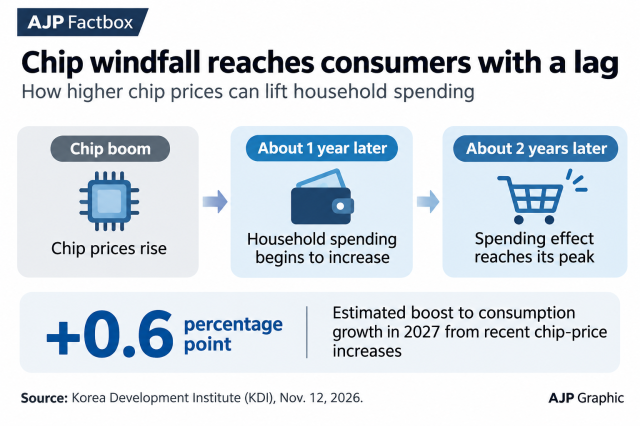
The institute estimated that recent chip-price shocks could raise private consumption growth by about 0.6 percentage point in 2027, while earlier oil-price shocks could reduce it by about 0.2 percentage point.
Its model found that the positive effects of a chip-price shock generally begin about four quarters later and peak after seven to eight quarters before gradually fading.
But the projected boost does not establish how widely that additional income will be distributed or whether it will translate into sustained wage increases outside the chip industry.
Productivity gap weighs on wages
A separate KDI report released Monday identified a more persistent constraint on household purchasing power: weak productivity growth across much of the non-chip economy.
Average inflation-adjusted wages rose just 0.3 percent in the first half of 2026, while real regular pay, excluding bonuses and other special payments, declined 0.3 percent.
Industries in which average real wages fell accounted for 53.2 percent of total employment. That does not mean every worker in those industries suffered a pay cut, but it indicates the breadth of the weakness.
The problem predates this year’s inflation pressures.
Between 2021 and 2025, revenue-based productivity in chip manufacturing increased an average of 8.5 percent annually, while productivity across other industries declined 0.4 percent a year, KDI found.
The measure captures firms’ ability to generate value from labor and capital. It reflects selling prices and demand conditions as well as technological efficiency.
KDI estimated that productivity differences explained roughly one-third of the gap in real regular-pay growth between electronics manufacturing, which includes chips, and other industries over the same period.
Even the most productive third of non-chip firms recorded cumulative productivity growth of just 0.8 percent between 2021 and 2025. The bottom third suffered a 9.7 percent decline.
The findings suggest that chip-related bonuses and dividends could lift consumption next year without reversing the longer-running weakness in regular wages across much of the economy.
“If productivity does not improve in the non-chip sector, wage gaps could widen,” said Chung Su-hwan, a KDI research fellow.
KDI called for efforts to raise productivity beyond chips, including restructuring weaker industries, developing higher-value products and creating conditions that allow more productive businesses to expand.
The policy challenge therefore extends beyond supporting consumer spending during the current boom.
Bonuses, dividends and government transfers could help households share in the chip windfall. A durable recovery in purchasing power, however, would require businesses outside the industry to generate enough additional value to sustain regular pay increases.
That distinction will become more important if chip demand moderates.
Korea’s next growth surge may eventually reach household budgets. Whether the improvement lasts will depend on how far productivity and wage gains spread beyond the chip industry.

Kim Yeon-jae
Kim Yeon-jae is a journalist at AJU Press (AJP's English platform),
covering macroeconomics, international finance, and geopolitics.
He closely tracks central bank monetary policies, global energy supply chains,
and the Korean defense industry.
Copyright ⓒ Aju Press All rights reserved.