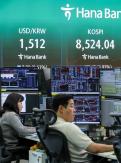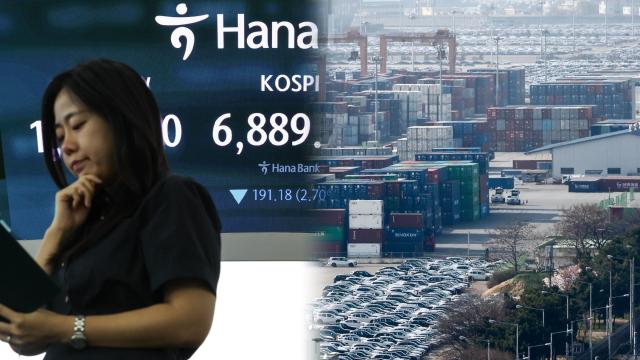
The country's net international investment position, which measures the value of financial assets owned by Korean residents abroad minus those held by foreigners in Korea, stretched to $344.8 billion at the end of September from $64.0 billion three months earlier, according to the Bank of Korea on Thursday.
Overseas financial assets rose $137.9 billion to $3.22 trillion, supported by export earnings and increased purchases of foreign securities. Meanwhile, foreign holdings in Korea shrank $142.9 billion to $2.88 trillion, largely reflecting the KOSPI's 19.3 percent decline.
Of the record net gain, $143.0 billion came from market valuation and exchange-rate changes, while $137.7 billion reflected actual transactions.
Korea's external financial resilience also improved, with net external debt assets rising to $416.8 billion and the ratio of short-term external debt to foreign reserves falling to 42.9 percent. The headline rebound, however, remains vulnerable to stock market swings, with net overseas assets still well below the $1.04 trillion recorded a year earlier.
The value of foreign-held Korean stocks dropped $188.8 billion as the KOSPI fell 19.3 percent during the quarter, with price changes accounting for $180.5 billion of the decline.
Foreign investors' net selling of Korean stocks eased to $8.2 billion from $63.9 billion in the second quarter.
Price and exchange-rate changes accounted for $143.0 billion of the rise in the net position, according to the BOK.
The remaining $137.7 billion came from actual transactions, much of it tied to Korea's export boom.
Korea's investment abroad rose $137.9 billion to $3.22 trillion.
Loans extended overseas rose $16.9 billion, trade credit $14.8 billion and deposits held abroad $13.9 billion, which the central bank attributed to strong exports.
Residents also stepped up purchases of overseas stocks to $32.4 billion from $21.0 billion and turned net buyers of foreign bonds.
Korea's exports are on track to top $1 trillion this year for the first time, with January-October shipments up 60.6 percent from a year earlier to $930 billion.
Net external assets in debt instruments, which exclude stocks and other equity, rose a record $49.0 billion to $416.8 billion, the highest since the first quarter of 2022.
The ratio of short-term external debt to reserve assets fell 3.5 percentage points to 42.9 percent, as short-term borrowing and won deposits at local brokerages declined while reserves grew.
Short-term debt's share of total external debt fell 1.7 percentage points to 22.8 percent.
The rebound reversed part of a second-quarter plunge, when a stock rally pushed the net position down from $753.6 billion at the end of March.
The figure remains about a third of the $1.04 trillion recorded a year earlier.
The lower short-term debt ratio, a gauge of Korea's ability to meet near-term foreign obligations, gives the country more room to absorb capital outflows if market turbulence returns.

Kim Yeon-jae
Kim Yeon-jae is a journalist at AJU Press (AJP's English platform),
covering macroeconomics, international finance, and geopolitics.
He closely tracks central bank monetary policies, global energy supply chains,
and the Korean defense industry.
Copyright ⓒ Aju Press All rights reserved.