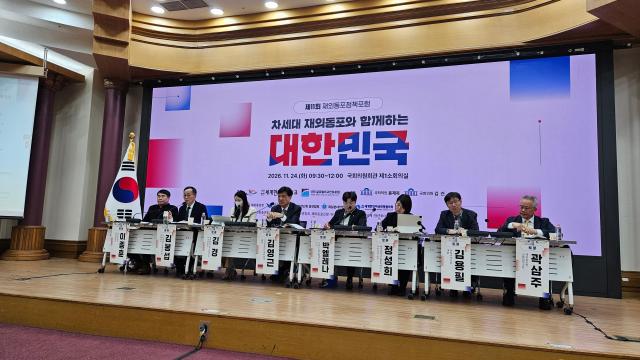
The forum, now in its 11th year, was co-hosted by the National Assembly's Global Diplomacy and Security Forum and the World Korean Network, with Reps. Kim Gunn and Yoon Jae-ok of the main opposition People Power Party (PPP) organizing the event.
"As a diplomat and a lawmaker, I have met ethnic Koreans in many countries around the world. One thing they had in common was that, even far from South Korea, they retained their affection for this country and their pride in it," Kim said in welcoming remarks. "I have met young Koreans abroad who were struggling with their identity."
Yoon said he hoped younger generations would come to see South Korea as a country where they could pursue their own dreams as well as the homeland of their parents and ancestors.
Rep. Kim Seok-ki, who chairs the party's committee on overseas ethnic Koreans, recalled asking ethnic Koreans in Japan why they had pooled their money to buy land and build diplomatic missions for South Korea after the two countries established diplomatic relations in 1965. South Korea had little money at the time, he said, and the donors gave the properties to the government. What they wanted, he said, was to see the South Korean flag flying over the buildings.
Koreans abroad still do work in their communities that Seoul cannot do on its own, Kim Seok-ki said. The Overseas Koreans Agency estimates that just over 7 million Koreans lived in 181 countries outside South Korea at the end of 2024, including about 961,000 in Japan. Rep. Song Seok-jun, chair of the Assembly's Foreign Affairs and Unification Committee, and Rep. Kang Sun-young also attended.
Lee Jong-hoon, the political analyst, put the number of young people from the Korean diaspora living in South Korea at roughly 240,000 to 290,000 and said the true figure could be higher. There is no official count for that group. The Justice Ministry counted 864,245 people of Korean descent with foreign citizenship living in South Korea at the end of 2024 and 860,081 a year later. Those figures cover all ages.
A young person's age, citizenship and residency status determine which rules apply, Lee said. Attending a Korean school can help students qualify under immigration rules, but those who arrive late in high school or are out of school can miss out. As students graduate and reach adulthood, responsibility shifts between ministries, leaving them to navigate residency paperwork with little help.
A bill introduced in March would allow national and local authorities to offer scholarships, employment assistance and housing support to eligible overseas Koreans ages 18 to 39. Lee said it would still leave out children under 18 and do little for applicants who struggle to produce the required documents.
Lee called for amending the Framework Act on Overseas Koreans to give agencies an explicit mandate to support young people from the diaspora living in South Korea. He proposed that ministries coordinate assistance from childhood into adulthood, giving priority to those out of school, those who arrive as teenagers and those who cannot document their eligibility.
Kim Bong-seop, a visiting professor at Inha University, said the government first needed to agree on whom it meant by the "next generation" and plan for parents and children together. South Korea's working-age population is shrinking, he said, even as the popularity of Korean culture and the country's growing international standing give more families abroad a reason to consider living here.
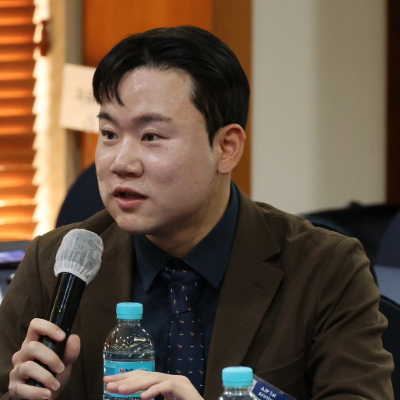
Lee Jung-woo
I studied philosophy in college, and sociology and journalism in graduate school. I cover North Korea, South Korean politics, foreign affairs and films. I enjoy Nordic cinema, Indian cuisine and Japanese detective novels. I have a cat and like bright, acidic coffee.
Copyright ⓒ Aju Press All rights reserved.