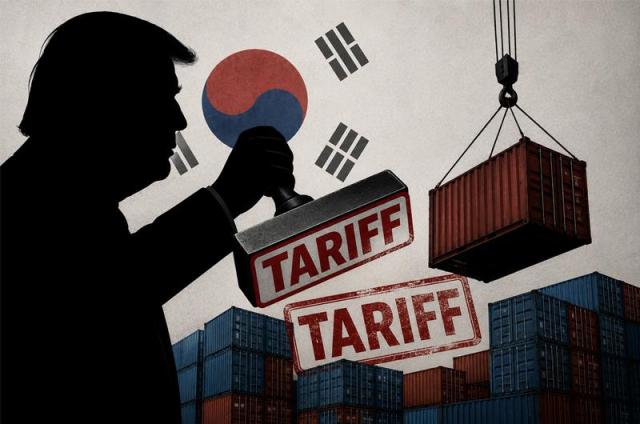
SEOUL, November 25 (AJP) — Washington’s coming tariffs on industrial overcapacity look set to put a new label on the same old policy as South Korea counts on its diplomatic campaign and $350 billion investment pledge to hold the line at 15 percent.
The U.S. Trade Representative is expected to unveil levies targeting alleged industrial overcapacity in South Korea and 15 other economies as early as Wednesday, U.S. time, following a Section 301 investigation launched in March.
The decision would fill in a key piece of the tariff framework Washington has rebuilt under Section 301 since the U.S. Supreme Court ruled in February that emergency powers did not authorize the president’s earlier tariffs.
For Korea, the question is less the headline rate than how it compares with rivals — and whether the 15 percent ceiling survives future actions.
Korea, Japan and the European Union are likely to face combined rates of 15 percent or less under their existing trade deals, while China, criticized for heavy industrial subsidies, could face higher duties, according to The Wall Street Journal.
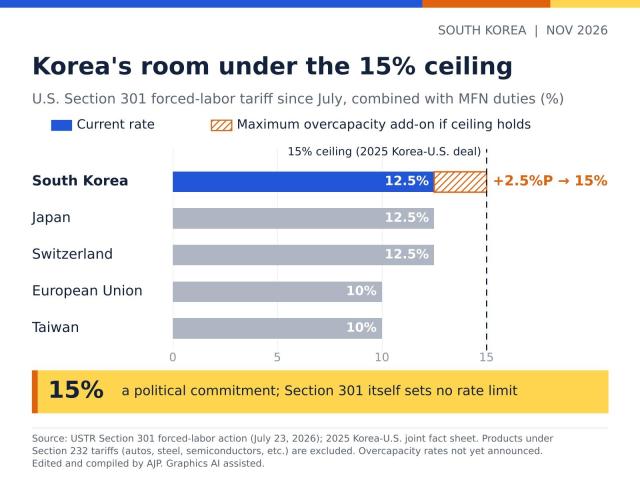
Korean goods covered by a separate Section 301 action over forced-labor import bans already face a combined 12.5 percent tariff, including most-favored-nation duties.
If the ceiling holds, the overall rate on those goods would rise to 15 percent from 12.5 percent, restoring the level agreed in last year’s trade deal.
U.S. Trade Representative Jamieson Greer told Bloomberg Television on Nov. 20 that the overcapacity investigation would “certainly” be completed by the end of this year.
Industry Minister Kim Jung-kwan said in August that Seoul was working to keep Section 301 tariffs, including any over overcapacity, within the agreed 15 percent, adding that trade authorities on both sides had reached “a degree of consensus.”
“Fifteen percent is not the ultimate goal,” Kim said at a Kwanhun Club debate in Seoul on Aug. 6. “The goal is a level that is not disadvantageous compared with competing countries.”
Korea’s standing against rivals has already slipped once. Korea, Japan and Switzerland were capped at 12.5 percent in July’s forced-labor action, while the European Union and Taiwan were held to 10 percent.
USTR grouped Korea with economies it said had neither enacted nor effectively enforced a ban on imports of goods made with forced labor.
Seoul’s earlier objections gained little ground. USTR finalized the forced-labor duties largely as proposed despite Korea calling them “unwarranted” and “disproportionate,” according to the Korea International Trade Association’s Institute for International Trade.
Seoul made a similar case in the overcapacity probe in April, arguing that its manufacturing sector operates on market principles, that voluntary restructuring is under way and that Korean and U.S. supply chains are interdependent.
USTR argues that capacity exceeding domestic and global demand manifests itself in large or persistent trade surpluses.
In launching the probe, it cited Korea’s swing to a $52 billion global goods surplus in 2024 from a $10 billion deficit a year earlier, alongside a $56 billion goods and services surplus with the United States.
It listed electronic equipment, automobiles and auto parts, machinery, steel, and ships and marine vessels as Korea’s leading export sectors. Its section on Korea, however, tied only petrochemicals directly to excess capacity, noting that the government “has acknowledged the need to cut capacity” in the industry.
Products already subject to Section 232 national security tariffs, including automobiles, steel and semiconductors, were excluded from July’s forced-labor duties to avoid stacking tariffs.
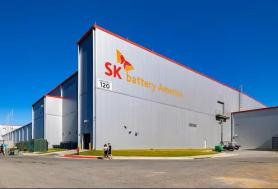
The Journal reported that similar carve-outs are expected this time, leaving sectors such as petrochemicals, machinery, many home appliances and batteries most exposed.
Section 232 auto tariffs covered about $44.7 billion, or 36 percent, of U.S. imports from Korea in 2025, while the forced-labor duties applied to about $26 billion, according to an analysis by the Korea Economic Institute of America (KEI).
Assuming the same product coverage, an additional 2.5 percentage points would generate roughly $650 million a year in duties on U.S. imports from Korea — equivalent to about 0.5 percent of the $122.9 billion Korea shipped to the United States last year, based on AJP calculations.
The bigger risk lies in the ceiling itself. It rests on a political commitment rather than a statutory cap, as Section 301 sets no limit on tariff rates.
A joint fact sheet released with last year’s trade deal set a 15 percent rate for reciprocal and auto tariffs but did not address future Section 301 duties.
“The investigation could ultimately lead to additional tariffs on top of the existing Section 301 tariffs,” KEI wrote in a September analysis.
The findings could also include a provision allowing higher tariffs if overcapacity worsens or policies remain unchanged, the Journal reported.
Another potential dispute is already taking shape. Washington is separately weighing a Section 301 investigation into digital regulations in Korea, the European Union and Australia, Politico reported.
Washington has objected to an online platform bill pending in the National Assembly, network usage fees and limits on cross-border data transfers. It has also accused Seoul of treating U.S.-listed e-commerce company Coupang unfairly.
The same trade fact sheet committed Seoul to ensuring that U.S. companies face no discrimination in digital policies, including network usage fees and online platform rules — a pledge Washington could cite in pressing its case.
Seoul has denied that its rules discriminate against U.S. firms.
Past cases suggest there is room to negotiate. Five of the 10 Section 301 investigations completed since 2017 ended with tariffs deferred or dropped through talks, while duties were imposed mainly on economies with less room to negotiate, such as China, Brazil and Nicaragua, according to the Institute for International Trade.
Seoul’s main leverage lies in the $350 billion U.S. investment package pledged last year in exchange for the 15 percent rate, along with its shipbuilding cooperation project known as MASGA, the institute said.
If the ceiling holds, the overcapacity duty would amount to a modest increase for most affected Korean goods. The larger test is whether the 15 percent bargain holds each time Washington finds a new reason to impose tariffs.
Kim Yeon-jae
Kim Yeon-jae is a journalist at AJU Press (AJP's English platform),
covering macroeconomics, international finance, and geopolitics.
He closely tracks central bank monetary policies, global energy supply chains,
and the Korean defense industry.
Copyright ⓒ Aju Press All rights reserved.