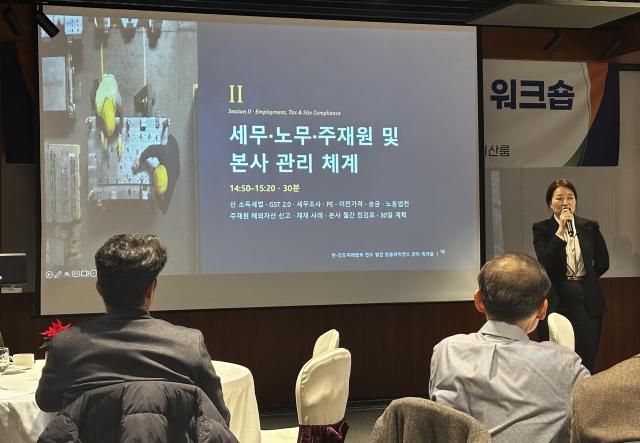
Legal experts and corporate executives gathered at the Seoul Club on Friday for a workshop hosted by the Korea-India Future Association (KIFA) to discuss regulatory risks and difficulties Korean companies face in their Indian operations.
The event followed up on South Korea's Ministry of Foreign Affairs' meeting with major Korean companies, including Hyundai Motor, Samsung Electronics and POSCO, on business challenges in India.
India has introduced three major regulatory reforms since September last year, overhauling its goods and services tax (GST) system and labor laws, and introducing a new income tax law in April this year.
Unlike South Korea, which applies a standard value-added tax rate of 10 percent, India has multiple GST rates, with most business-to-business manufacturing and service transactions subject to an 18 percent rate and certain products taxed at up to 40 percent.
"In South Korea, the value-added tax rate is 10 percent, whereas in India it is generally 18 percent," a director at Daeyoung ONE, a Korean automotive parts manufacturer that supplies headlamp components to Hyundai Motor and Kia who attended the workshop, told AJP.
Depending on the type of transaction, businesses may also face additional taxes and charges, including the Social Welfare Surcharge, Agriculture Infrastructure and Development Cess, and stamp duty.
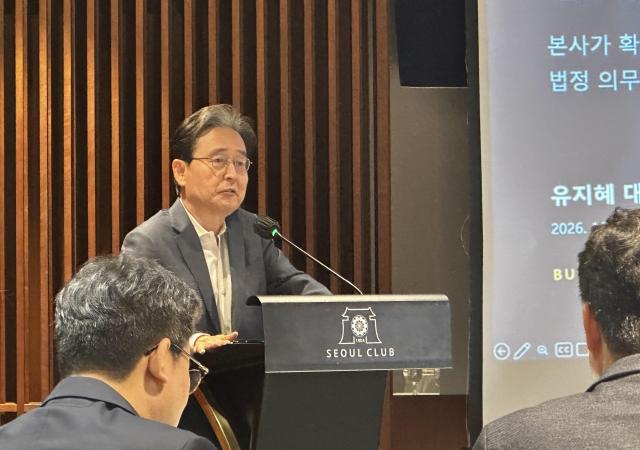
Yoo Ji-hye, managing partner at Buddtree Management Group, a consulting firm specializing in Korean investment in India, said unpaid taxes, penalties and interest can accumulate over several years, while GST-related litigation can take between three and 10 years.
"In many cases, tax assessments arise because companies have failed to properly understand or comply with Indian laws," Yoo said.
Another major concern is India's labor reform, which consolidated 29 existing labor laws into four codes in November last year.
The changes could increase mandatory employment-related costs by 3 to 15 percent, depending on companies' existing pay structures, according to Buddtree. This is largely due to changes in how wages are calculated for retirement benefits and social security contributions.
The new rules also restrict the use of outsourced workers in core business activities, posing a challenge for manufacturers that rely heavily on such labor.
"In some factories, contract workers account for as much as 90 percent of the workforce," Yoo said.
Korean companies are also facing tax disputes over employees dispatched from their headquarters. Indian authorities have sought to impose an 18 percent GST on certain personnel arrangements, viewing them as services provided by overseas parent companies rather than ordinary employment.
For example, a company with five expatriates each earning an annual salary of 100 million won could face an additional tax bill of 90 million won a year, excluding penalties and interest, Yoo explained.
Others are restructuring their employment arrangements, increasingly hiring personnel directly through their Indian subsidiaries rather than dispatching them from Korean headquarters, according to Yoo.

Jang Jae-won, managing partner at Buddtree, said Korean companies have increasingly pursued joint ventures with Indian partners over the past decade, combining Korean technology with Indian capital, manufacturing facilities and distribution networks.
Competition among Indian states to attract Korean investment is also intensifying. Tamil Nadu, home to major manufacturing facilities operated by Hyundai Motor and Samsung Electronics, recently established a dedicated Korea desk within its investment promotion agency, according to Jang.
Yoo advised Korean companies to address tax disputes at the earliest possible stage, before they escalate into lengthy legal battles.
She warned that as Indian government agencies share more information, a corporate tax issue could lead to further investigations into GST and foreign exchange transactions.
She also urged Korean headquarters to conduct monthly compliance checks on their Indian subsidiaries and maintain detailed records of transactions, even when local managers or expatriate employees are replaced.
"Tax authorities may ask you to submit 20 documents within three days. If you haven't prepared them in advance, it is nearly impossible to put them together within that time," Yoo said.

Kim Hee-su
Kim Hee-su is a bilingual reporter at AJU Press, covering defense and foreign affairs. Before joining AJP in 2025, she worked at The Korea Times, where she wrote interview stories, including a profile of North Korean defector Kim Gum-hyok, and produced digital content. She also previously worked as a researcher for KBS News 9’s International News Department, supporting correspondents in 10 countries around the world. She graduated from the University of Toronto in Canada with a double major in Book and Media Studies and East Asian Studies.
Copyright ⓒ Aju Press All rights reserved.