
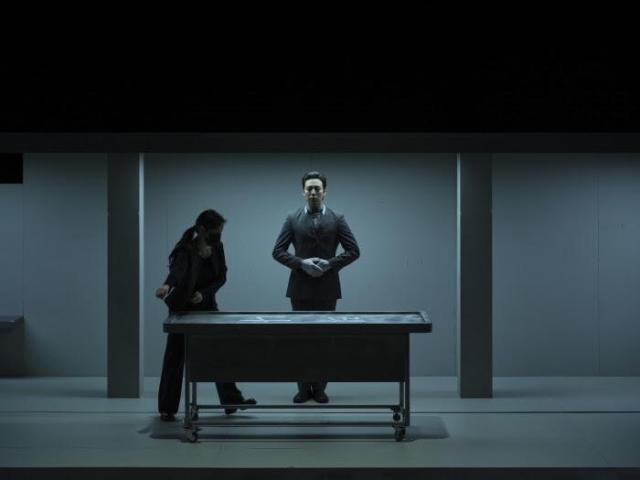
“I will do my utmost to see you on your final journey.”
The central figure in the play 'Record of Bones' is a funeral director robot named Robis. His service is flawless. In the way he handles the dead, he shows a calm, craftsmanlike precision. His gestures are delicate, his gaze steady. Robis carries out standardized procedures without a fraction of error — no mistakes, no hesitation, no complaints. Within a fixed system, his work can seem like the ideal.
What changes is the body before him: a man in his 80s, a woman in her 20s, a 9-year-old child. Different lives leave different “records” in bone. Robis reads them evenly. A twisted ankle, head trauma — such traces intersect with a family’s memories and become grief. But for Robis, death is an area he cannot interpret — until the death of his only friend, Momi, a cleaner at the funeral home.
The production has been described as a story of a robot “more human than humans,” echoing the robots in the Korean original musical 'Maybe Happy Ending,' which found success on Broadway. The play asks why audiences sense humanity in machines like Robis.
Momi is human — and incomplete. Unable to speak, he communicates in sign language. He is not orderly. He likes to stare at a wall because its patterns have no obvious logic. What looks like the same wall and the same butterfly to Robis appears as different shapes to Momi.
Unlike a machine that can mimic warmth through empathy-coded language, humans are full of contradictions: jealousy, guilt that keeps them awake, and feelings they cannot always explain even to themselves. Each person carries a distinct pattern.
That is why the audience feels something human when Robis, who always stood in the same spot in the cold morgue, suddenly runs out the front door. He does more than read the record of bones: he remembers that Momi disliked hot things, and he misses Momi’s smile. In that moment, Robis breaks from strict procedure and the frame built for him.
Devotion, the play suggests, comes from sincere communication and time spent together — something Robis demonstrates as he sees his friend off on his final journey.
The show runs through May 10 at the Jayu Small Theater in the Opera House at the Seoul Arts Center.
* This article has been translated by AI.
Copyright ⓒ Aju Press All rights reserved.