Lee Jae-myung's Government Relies Heavily on Bank of Korea Loans in First Year
by Jang SunaPosted : June 1, 2026, 15:36Updated : June 1, 2026, 15:36
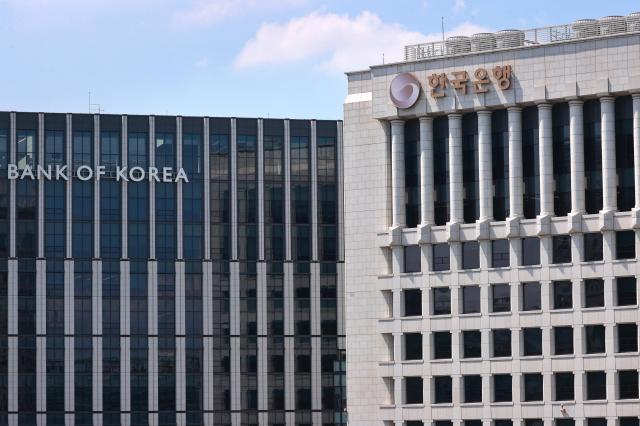
View of the Bank of Korea in Jung-gu, Seoul [Photo: Yonhap News]
In the first year of Lee Jae-myung's administration, the amount of temporary loans from the Bank of Korea exceeded 120 trillion won, marking the highest level recorded among past administrations. Despite expectations of improved tax revenue from a semiconductor supercycle, the government has repeatedly relied on these loans, which do not appear in national debt statistics, raising concerns about fiscal health.
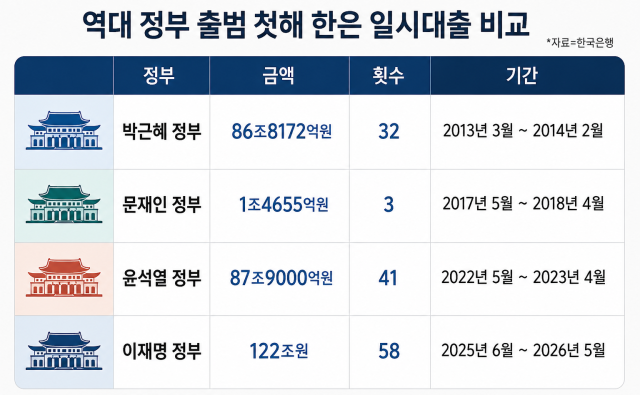
According to a comprehensive report by Ajou Economics on June 1, from June of last year to May of this year, the government borrowed a total of 122 trillion won from the Bank of Korea, with 58 borrowing instances during this period. This is the largest amount recorded in the first year of any administration since statistics began in 2011.
The Bank of Korea's temporary loan system is designed to fill short-term funding gaps that arise from timing differences between government revenue and expenditures. The government borrows funds from the Bank as needed and repays them, effectively functioning as a financial negative balance.
Since taking office, the government has heavily depended on these temporary loans. It began borrowing 17.9 trillion won in June last year, followed by 25.3 trillion won in July and 31.6 trillion won in August. Additional borrowings included 14 trillion won in September and 5 trillion won in December, with further loans of 17 trillion won in March and 11.2 trillion won in April of this year. No additional borrowing occurred in May.
This trend is particularly notable compared to previous administrations. The government of Yoon Suk Yeol, which had the highest borrowing among past administrations, borrowed a total of 87.9 trillion won from May 2022 to April 2023, with 41 instances of borrowing. The Park Geun-hye administration borrowed 86.8 trillion won in its first year, with 32 instances, while the Moon Jae-in administration borrowed only 1.5 trillion won in the same timeframe, with just three instances.
As of now, the government has no outstanding balance, but the interest burden has approached 100 billion won. Since July of last year, the cumulative interest paid to the Bank of Korea has reached 96.85 billion won.
This year, despite expectations of significant excess tax revenue due to a booming semiconductor market, the continued borrowing from the Bank of Korea has drawn attention to the government's fiscal management capabilities.
Kim Jeong-sik, an emeritus professor of economics at Yonsei University, explained, "Issuing government bonds can lead to increases in market interest rates and bond yields, so the government is utilizing the relatively less burdensome temporary loans from the Bank of Korea. The need for economic stimulus at the beginning of the administration likely influenced this decision as well."
He added, "The Lee Jae-myung administration believes that expanding fiscal spending can revive the economy and ultimately increase tax revenue. If tax revenues increase in the future, there is a possibility that the scale of borrowing from the Bank of Korea may grow under the assumption that the loans can be repaid."
It is also noteworthy that temporary loans from the Bank of Korea do not directly affect national debt statistics. Generally, when the government issues bonds to raise funds, national debt increases, but temporary loans from the Bank of Korea are not included in national debt statistics. This raises concerns that relying on these loans instead of issuing bonds makes it difficult to fully assess the government's funding situation based solely on national debt indicators.
Professor Kim cautioned, "If fiscal expenditures increase rapidly, it could expand market liquidity and lead to inflationary pressures, so careful management of fiscal operations is necessary."