
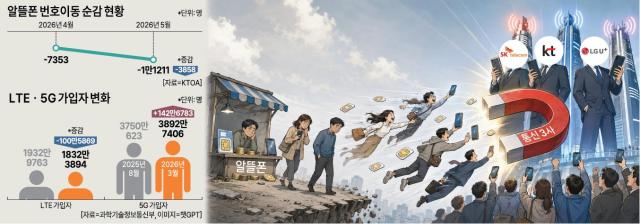
The budget mobile provider (MVNO) market has recorded subscriber losses for the second consecutive month. After experiencing growth through the first quarter of the year, MVNOs shifted to a decline in April, which worsened in May.
According to data from the Korea Telecommunications Operators Association (KTOA) released on June 2, the net loss of MVNO subscribers in May totaled 11,211. This marks an increase of 3,858 from the 7,353 subscribers lost in April.
This is the first time MVNOs have seen two consecutive months of subscriber losses since the SK Telecom (SKT) SIM card hacking incident in August and September of last year.
However, analysts note that this decline is occurring amid intensified competition among the three major telecom companies—SKT, KT, and LG Uplus—to attract subscribers. Following the repeal of the Mobile Device Distribution Improvement Act, competition over subsidies has intensified, particularly with the recent launch of the Galaxy S26 series, which has accelerated the departure of MVNO users.
Forecasts suggest that the exodus from the MVNO market may worsen. LG Uplus has introduced an integrated pricing plan that includes a 5G option starting this month, while SKT and KT are set to launch mid-range pricing plans on July 1. This raises concerns that the appeal of low-cost plans, which have been a key competitive advantage for MVNOs, may diminish.
The mobile telecommunications market is rapidly transitioning from LTE to 5G. According to data from the Ministry of Science and ICT released on May 21, LTE subscribers decreased from 19,329,763 in August of last year to 18,323,894 in March, a drop of 1,005,869. In contrast, 5G subscribers increased from 37,506,623 to 38,927,406 during the same period, a rise of 1,426,783.
A significant issue for the MVNO market is its continued reliance on LTE. As of March, LTE subscribers accounted for 93% of all MVNO users, totaling 9,713,009, while only 584,315 were 5G subscribers, representing just 5.6%.
Industry experts express concern that if the three major telecom companies expand integrated pricing plans that combine LTE rates with 5G services and data assurance options, the demand for low-cost LTE plans—MVNOs' core competitive edge—could diminish. The ongoing subscriber losses for MVNOs are seen as closely linked to these market changes.
Some analysts argue that the government's policies aimed at reducing communication costs may conflict with efforts to support the MVNO sector. While the government has previously supported MVNOs to foster competition in the telecom market, the recent push for mid-range 5G pricing plans from major carriers may inadvertently weaken MVNOs' price competitiveness.
One industry expert noted, "In a market where MVNOs exist, directly lowering the prices of telecom companies can ultimately narrow the space for MVNO operators. If the goal is to alleviate the burden of communication costs, it would be more effective to lower wholesale prices for MVNOs rather than adjusting retail prices for telecom companies."
* This article has been translated by AI.
Copyright ⓒ Aju Press All rights reserved.