
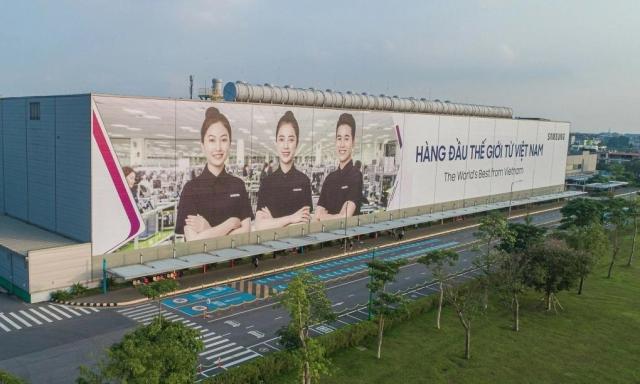
On June 1, local media outlet VnExpress reported that the National Power System and Market Operation Organization (NSMO) announced that Samsung Thai Nguyen and the TTC Duc Hue 2 solar power plant had completed the necessary technical and legal procedures and officially commenced operations under the DPPA system.
In this agreement, Samsung Thai Nguyen acts as the power buyer, while TTC Duc Hue 2 serves as the power seller. This marks the first instance of direct trading between renewable energy producers and large electricity consumers since the implementation of Decree 57/2025 in early March of last year.
With this contract, Samsung's production facility is expected to receive approximately 70GWh of renewable energy annually, equivalent to the electricity consumption of about 17,000 households in Vietnam. This is also anticipated to reduce carbon dioxide emissions by approximately 46,000 tons each year.
The TTC Duc Hue 2 solar power plant, located in Tay Ninh Province, is invested in by TTC Duc Hue-Long An Power Joint Stock Company. It has a designed capacity of 49MWp and began commercial operations on May 19. The plant is equipped with a battery energy storage system (BESS) and has been participating in Vietnam's competitive wholesale electricity market since early this month.
The DPPA system has been a policy that foreign direct investment (FDI) companies in Vietnam have requested for early implementation. These companies have previously expressed expectations that the system would enhance competition in the energy sector. Five years ago, Samsung was among the companies that indicated interest during policy discussions. A survey by the Ministry of Industry and Trade at the end of 2023 revealed that about 20 large corporations expressed intentions to directly purchase nearly 1,000MW of electricity, with 24 renewable energy projects totaling 1,773MW indicating interest in selling. Additionally, 17 projects totaling 2,836MW are under consideration for participation.
Samsung is the largest foreign investor in Vietnam, with accumulated registered capital amounting to tens of billions of dollars. In recent years, the company has aimed to increase the share of clean energy used in its global production facilities, and this contract is part of its commitment to reducing carbon emissions.
◆ Online Reactions: Support for Clean Energy Expansion vs. Questions on Transmission Costs
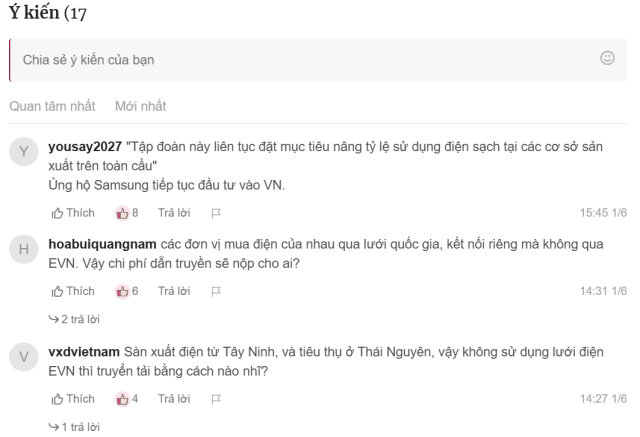
Following the announcement, various reactions emerged online. One user expressed support for Samsung's continued investment in Vietnam. However, questions were raised regarding the use of the national grid and who would bear the transmission costs. One commenter asked, "If power is traded through the national grid, who pays for the transmission costs?" Another user noted, "Electricity is produced in Tay Ninh and consumed in Thai Nguyen, so how will it be transmitted without using the EVN grid?" They further questioned, "Ultimately, transmission must go through EVN, and infrastructure rental costs are high; has it become cheaper now?"
Another user remarked, "I have a 5x15m rooftop, so if they install solar equipment, I will pay for the electricity," indicating hopes for the expansion of residential solar energy. Additionally, there were calls for more models like this to promote green power production and lower energy costs through direct connections.
Meanwhile, the launch of the DPPA signifies a significant step in realizing direct trading between renewable energy producers and large electricity consumers within a regulated framework. At the same time, public interest in the use of the national grid and the cost burden structure is also increasing.
* This article has been translated by AI.
Copyright ⓒ Aju Press All rights reserved.