
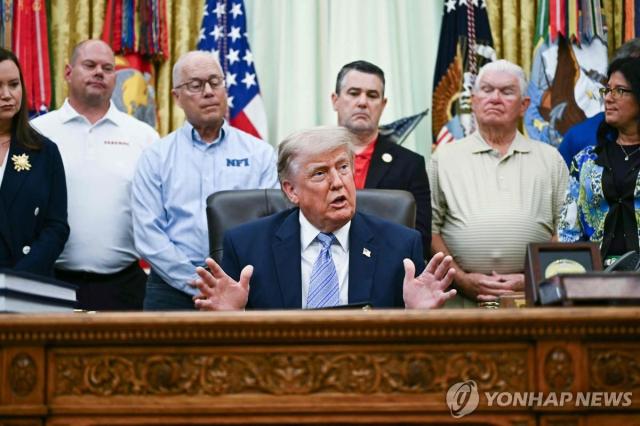
President Donald Trump has once again wielded tariffs as a tool of industrial policy. This time, it is not merely about raising tariffs; it involves a so-called 'tariff carrot policy' that offers tariff benefits to companies using a certain percentage of American-made steel and aluminum. Foreign equipment and machinery that use more than 85% American steel and aluminum will receive a 10% preferential tariff, while tariffs on agricultural machinery and some industrial equipment will be temporarily reduced.
On the surface, this appears to be a tariff reduction policy. However, the essence is different. Benefits are provided for using American raw materials, while existing tariff burdens remain for those who do not. This approach is more about building a U.S.-centric supply chain than expanding free trade.
The Trump administration's policies have a consistent direction: reviving U.S. manufacturing and restructuring supply chains around America. While past tariff policies served as a defensive barrier against foreign products, this new measure actively encourages foreign companies to use American raw materials and components.
It is noteworthy that U.S. industrial policy is becoming increasingly sophisticated. It aims not just to raise tariffs to curb imports but to change companies' investment and purchasing decisions. The message to global companies is clear: to access the U.S. market, they must use American raw materials and integrate into the U.S. supply chain.
In fact, the U.S. is pushing for supply chain restructuring across strategic industries, including semiconductors, batteries, electric vehicles, steel, and rare earths. By simultaneously utilizing tariffs, subsidies, and tax incentives, it is steering corporate decision-making toward a U.S.-centric model. We are transitioning from an era driven solely by market principles to one where national strategy dictates the direction of industries.
South Korean companies must respond sensitively to these changes. The U.S. is one of South Korea's largest export markets, with key industries such as automobiles, machinery, steel, batteries, and semiconductors closely linked to the U.S. market. If the U.S. alters its supply chain standards, South Korean companies cannot escape the impact.
This move is not limited to the steel and aluminum industries. In the future, factors such as origin, production location, and the ratio of raw materials used are likely to become critical elements of corporate competitiveness. A new era is approaching where tariffs and market accessibility will vary based on the country of origin of materials used in the same product.
A more significant concern is that this trend is unlikely to be a temporary phenomenon. The supply chain-centered industrial policy initiated by the Trump administration has garnered support across the political spectrum in the U.S., regardless of changes in administration. Both Democrats and Republicans recognize the need for manufacturing revival and supply chain stability. While the methods of American first policies may change, the overall direction is unlikely to shift significantly.
Ultimately, South Korea needs a new perspective. It is becoming increasingly difficult to maintain competitiveness solely through cheap production and export expansion as in the past. Now, supply chain strategy is synonymous with industrial strategy, and national strategy. Decisions about which markets to connect with, what raw materials to use, and which countries to collaborate with will determine corporate survival.
Trump's recent tariff incentive policy is an extension of the U.S. manufacturing protection policy. However, what is more crucial for South Korea is the signal this policy sends. The global economy is transitioning from an era of free trade to one of strategic supply chain competition. Both South Korean companies and the government must redesign their industrial policies and trade strategies to align with these changes, as the era where the country that dominates the supply chain controls industrial competitiveness has already begun.
On the surface, this appears to be a tariff reduction policy. However, the essence is different. Benefits are provided for using American raw materials, while existing tariff burdens remain for those who do not. This approach is more about building a U.S.-centric supply chain than expanding free trade.
The Trump administration's policies have a consistent direction: reviving U.S. manufacturing and restructuring supply chains around America. While past tariff policies served as a defensive barrier against foreign products, this new measure actively encourages foreign companies to use American raw materials and components.
It is noteworthy that U.S. industrial policy is becoming increasingly sophisticated. It aims not just to raise tariffs to curb imports but to change companies' investment and purchasing decisions. The message to global companies is clear: to access the U.S. market, they must use American raw materials and integrate into the U.S. supply chain.
In fact, the U.S. is pushing for supply chain restructuring across strategic industries, including semiconductors, batteries, electric vehicles, steel, and rare earths. By simultaneously utilizing tariffs, subsidies, and tax incentives, it is steering corporate decision-making toward a U.S.-centric model. We are transitioning from an era driven solely by market principles to one where national strategy dictates the direction of industries.
South Korean companies must respond sensitively to these changes. The U.S. is one of South Korea's largest export markets, with key industries such as automobiles, machinery, steel, batteries, and semiconductors closely linked to the U.S. market. If the U.S. alters its supply chain standards, South Korean companies cannot escape the impact.
This move is not limited to the steel and aluminum industries. In the future, factors such as origin, production location, and the ratio of raw materials used are likely to become critical elements of corporate competitiveness. A new era is approaching where tariffs and market accessibility will vary based on the country of origin of materials used in the same product.
A more significant concern is that this trend is unlikely to be a temporary phenomenon. The supply chain-centered industrial policy initiated by the Trump administration has garnered support across the political spectrum in the U.S., regardless of changes in administration. Both Democrats and Republicans recognize the need for manufacturing revival and supply chain stability. While the methods of American first policies may change, the overall direction is unlikely to shift significantly.
Ultimately, South Korea needs a new perspective. It is becoming increasingly difficult to maintain competitiveness solely through cheap production and export expansion as in the past. Now, supply chain strategy is synonymous with industrial strategy, and national strategy. Decisions about which markets to connect with, what raw materials to use, and which countries to collaborate with will determine corporate survival.
Trump's recent tariff incentive policy is an extension of the U.S. manufacturing protection policy. However, what is more crucial for South Korea is the signal this policy sends. The global economy is transitioning from an era of free trade to one of strategic supply chain competition. Both South Korean companies and the government must redesign their industrial policies and trade strategies to align with these changes, as the era where the country that dominates the supply chain controls industrial competitiveness has already begun.
* This article has been translated by AI.
Copyright ⓒ Aju Press All rights reserved.