
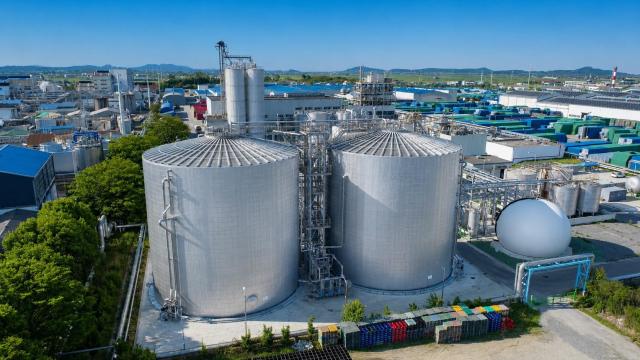
Lotte Chilsung Beverage announced on June 4 that it reduced its greenhouse gas emissions by approximately 6,400 tons last year through the expansion of renewable energy and improvements in facilities.
To achieve its declared goal of carbon neutrality by 2040, Lotte Chilsung Beverage has been implementing various eco-friendly initiatives, including the expansion of renewable energy, fuel conversion, and the introduction of electric vehicles. As a result, the company successfully decreased its greenhouse gas emissions by about 7% compared to the previous year and by approximately 17% compared to 2018.
The largest contributor to the reduction in greenhouse gas emissions was the expansion of renewable energy projects. Lotte Chilsung Beverage operates a biogas power generation facility that utilizes byproducts from the production of ethanol, a key ingredient in its beverages, to generate electricity and steam. This facility, located at the Gunsan plant, helped reduce greenhouse gas emissions by around 5,000 tons last year.
The biogas power generation at the Gunsan plant produced approximately 9 GWh (gigawatt-hours) of energy, which accounts for about half of the plant's total electricity consumption. This amount is equivalent to the annual electricity usage of about 2,500 households in Seoul.
Solar power generation facilities also contributed to the reduction of greenhouse gases. Since 2018, Lotte Chilsung Beverage has installed solar energy systems at five major sites, including the Chungju 2 Plant, Anseong Plant, Yangsan Plant, and Gangneung logistics center (RDC), resulting in a reduction of about 460 tons of greenhouse gases last year.
In terms of fuel conversion, the company is collaborating with Daejeon City and CNCITY Energy to replace existing LNG fuel with landfill gas (LFG). This initiative led to a reduction of approximately 380 tons of greenhouse gas emissions last year. LFG is a renewable energy source captured from waste landfills, which Lotte Chilsung Beverage uses as boiler fuel to produce steam necessary for its manufacturing processes.
The transition to eco-friendly vehicles has also yielded positive results. By the end of last year, Lotte Chilsung Beverage had introduced a total of 630 electric vehicles, resulting in a reduction of about 550 tons of greenhouse gases. The company aims to cut greenhouse gas emissions by over 10,000 tons this year.
A representative from Lotte Chilsung Beverage stated, "As a comprehensive beverage company in Korea, we are committed to fulfilling our social responsibility by continuing to invest in and innovate for carbon neutrality. We will strengthen our environmental, social, and governance (ESG) management to set an example in the industry and leave a better environment for future generations."
Meanwhile, reducing greenhouse gas emissions has become a key challenge for corporate management. According to the Intergovernmental Panel on Climate Change (IPCC), the global average temperature has risen by about 1.09°C due to increased greenhouse gas emissions since industrialization, leading to more frequent extreme weather events such as heatwaves. In response, South Korea has declared its goal of achieving carbon neutrality by 2050 and aims to reduce greenhouse gas emissions by 40% by 2030 compared to 2018 levels.
* This article has been translated by AI.
Copyright ⓒ Aju Press All rights reserved.