

"We cannot wait for readers to come to us; we must go to them."
On June 3, the 77th World News Media Congress (WNMC) in Marseille, France, attracted over 1,000 journalists and media executives from more than 60 countries. Among the attendees were A.G. Sulzberger, chairman and publisher of The New York Times, and Katharine Viner, editor-in-chief of The Guardian, who gathered to discuss survival strategies for journalism in the age of AI.
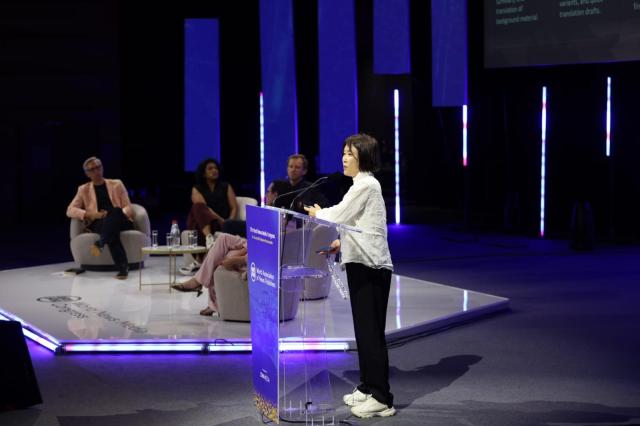
Seo Hye-seung, editor-in-chief of Aju Media Group's English news agency AJP, was the only speaker from South Korea. With AI emerging as a central theme at this year's congress, AJP's presentation highlighted new possibilities for journalism in the AI era.
During the session titled "How AI Is Transforming the News Experience," Seo introduced AJP's multilingual news production and global audience expansion strategies.
He defined AJP's identity as "Asian Substance in English," proposing a new role for English-language news agencies in the AI era. "We have discovered our role as a news agency that conveys Asian stories in the language that AI understands best," he said.
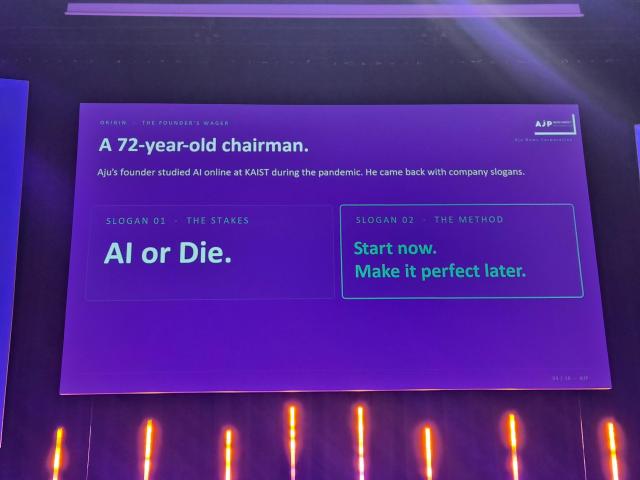
Aju Media Group publishes content in five languages: Korean, English, Chinese, Japanese, and Vietnamese. AJP serves as the English-language news agency at the center of this multilingual strategy.
Seo explained that AJP has utilized AI as a starting point for designing its news production and distribution systems. In an environment where generative AI is transforming news production and distribution, AJP is differentiating itself by using AI not just as a translation tool but as a content expansion platform.
"Our goal is not to be journalists who use AI well, but to be journalists that AI can learn from and follow," he said, adding that as technology advances, the role of journalists in reporting from the field and interpreting context becomes even more crucial.
This aligns with the message delivered by Sulzberger during his keynote address on the first day of the congress.
Sulzberger emphasized that "the important facts that people know ultimately come from journalism's unique reporting," asserting that even as generative AI advances, the role of journalism in uncovering new facts cannot be replaced.
He criticized AI companies for using journalistic content as training data without providing fair compensation, stating, "AI operates on information produced by journalism."
One of the most frequently mentioned concepts at this congress was 'Liquid Content.' This model involves reconfiguring a single reporting outcome into various forms such as articles, videos, audio, and summaries, tailored to meet readers' situations and needs. News is evolving to be provided in diverse formats that cater to readers' needs rather than waiting for them to seek it out.
In fact, major global news organizations are leveraging AI not just as a tool for automating tasks but as a means to redesign reader experiences. Experiments are ongoing to offer personalized news recommendations, transform article archives into interactive services, and reprocess a single article into multiple formats for consumption in ways that readers prefer.
While technology is rapidly changing, what readers seek remains reliable information and facts uncovered directly by journalists. Although AI can change how news is produced, it cannot replace the fundamental reasons for the existence of journalism.
The way news is delivered to readers is changing, but the value of journalism in discovering and verifying new facts remains unchanged. This was the overarching message of the congress.
* This article has been translated by AI.

Copyright ⓒ Aju Press All rights reserved.