
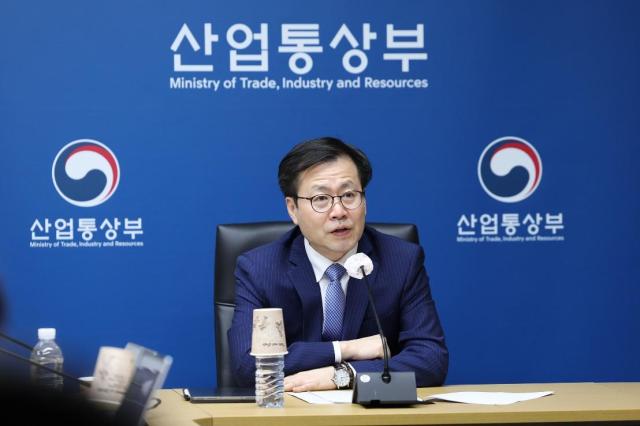
The Ministry reported that Yeo attended the OECD Ministerial Council Meeting (MCM) in Paris on June 3-4, where he held bilateral talks with ministers from major countries to discuss trade matters.
During his meeting with Maroš Šefčovič, the EU's Executive Vice President for Trade and Economic Security, Yeo conveyed the South Korean government's and industry’s concerns regarding the upcoming EU steel measures. He highlighted the critical role of South Korean steel as a key raw material in the European manufacturing supply chain, which includes sectors such as automotive, electronics, and machinery. He requested that sufficient market access be ensured during the implementation of the new regulations.
Yeo also emphasized that South Korea is a key economic partner with the EU, having signed a free trade agreement (FTA), and has actively participated in international cooperation to address global steel overcapacity. He called for favorable consideration for South Korea in the allocation of tariff-free quotas.
This meeting follows Yeo's discussions in Brussels on June 1 regarding the EU's steel measures, occurring just three days later. The government plans to continue high-level consultations to minimize the impact on the South Korean steel industry and secure market access before the new EU regulations take effect.
While at the OECD, Yeo also attended an informal WTO trade ministers' meeting, where he stressed the need for WTO reforms. He stated, "The WTO is facing a crisis where it cannot make meaningful decisions," and called for reforms to the decision-making structure and the restoration of its normative functions to adapt to the changing trade environment.
He proposed expanding the use of plurilateral agreements to address new trade issues such as digital trade and artificial intelligence (AI), as well as making the practice of duty-free electronic transmissions permanent and expediting the implementation of the Investment Facilitation for Development Agreement (IFDA). He also suggested the necessity of holding a ministerial-level interim review meeting ahead of next year's WTO Ministerial Conference.
At the OECD Ministerial Council Meeting, South Korea participated as a vice-chair in celebration of its 30th anniversary of OECD membership. Yeo led discussions in various sessions, including delivering keynote speeches on industrial policy, trade, and investment.
In the industrial policy session, he introduced initiatives on manufacturing AI transformation, energy transition policies, and the regional balanced development strategy known as '5 poles and 3 special zones.' He emphasized that while the importance of industrial policy is growing due to supply chain instability and economic security concerns, it should focus on promoting productivity innovation and technology diffusion rather than replacing markets.
Additionally, Yeo held discussions with key officials from the United States, including USTR's Jamieson Greer, as well as representatives from the UK, France, Finland, Brazil, and Argentina, addressing topics such as steel regulations, critical mineral supply chains, FTA negotiations, and expanding investment cooperation.
* This article has been translated by AI.
Copyright ⓒ Aju Press All rights reserved.