
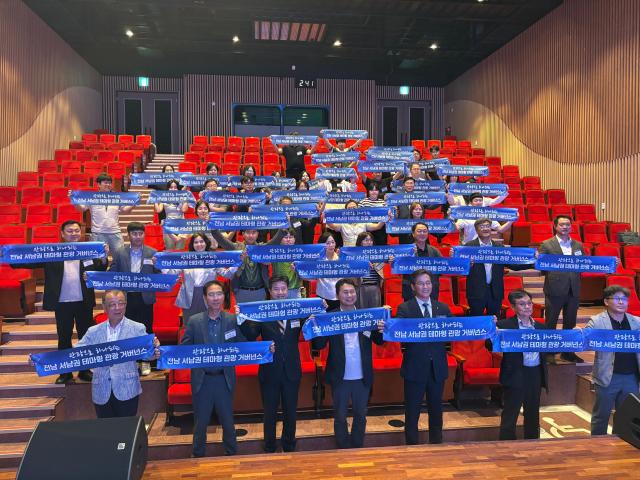
The competition to attract tourists is shifting from individual attractions to regional tourism areas. Despite an increase in foreign visitors, tourism spending remains concentrated in the capital region and a few popular destinations, prompting the need for stay-oriented tourism through regional linkages. The Korea Tourism Organization recently launched a tourism governance body with eight local governments in South Jeolla as part of its strategy to promote regional tourism.
◆ Limitations of Individual Tourist Attraction Competition: Focus Shifts to 'Connection'
Until now, local tourism policies have focused on attracting tourists to individual municipalities, often highlighting specific attractions and festivals. However, it has been noted that tourists frequently travel across administrative boundaries, and relying solely on single attractions limits the duration of their stays.
In response, the government has recently shifted its focus in regional tourism policy to 'connection.' Initiatives such as the Southern Regional Tourism Development Project, digital tourist identification cards, fostering Destination Marketing Organizations (DMOs), and policies to increase local populations are all aimed at enhancing inter-regional linkages and promoting stay-oriented tourism.
The tourism industry also recognizes the need for developing tourism products at the regional level rather than competing solely on individual attractions. Tourists increasingly seek diverse experiences within a single trip, while regions can expand tourism spending through accommodations, dining, and shopping.
◆ 'Ganghaeyoung' and 'Moksinhae': Bundling Adjacent Cities for Themed Packages
In this context, the Korea Tourism Organization's Gwangju-Jeonnam branch launched the 'South Jeolla Themed Tourism Governance Body' on June 18 with eight local governments and related organizations.
The governance body includes the Gangjin Cultural Tourism Foundation, Mokpo Cultural Foundation, Sinan County Tourism Council, Yeongam Cultural Tourism Foundation, Wando Marine Healing Management Corporation, Jangheung Festival Tourism Foundation, Jindo County Tourism Council, and Haenam Cultural Tourism Foundation. They will work together to discover regionally linked tourism content centered on South Jeolla's marine tourism resources and jointly develop and market tourism products.
The operational model also differentiates itself from existing municipality-centered projects. Themed tourism routes will be created, such as 'Ganghaeyoung' connecting Gangjin, Haenam, and Yeongam; 'Haewanjin' linking Haenam, Wando, and Jindo; and 'Moksinhae' connecting Mokpo, Sinan, and Haenam, combining marine tourism with culinary, wellness, and historical-cultural content.
For instance, tourists visiting Mokpo can enjoy island tourism in Sinan, while visitors to Haenam can experience Wando's marine healing programs and Jindo's cultural tourism content, all designed to enhance travel itineraries.
The organization also plans to promote tourism product exhibitions linked to domestic travel platforms in the future.
◆ "Increase Stay Duration": Building a Sustainable Regional Cooperation Model
The organization has recently analyzed that the competitiveness of regional tourism is increasingly influenced by the quality of stay experiences, ease of movement, and diversity of content rather than individual attractions. In fact, there are growing instances of tourists visiting nearby cities as a result of K-pop performances, local festivals, and wellness tourism.
Experts agree that to revitalize local tourism, it is becoming increasingly important to connect multiple regions rather than just attracting tourists to a single area. By organically linking transportation, accommodations, and tourism content, it is expected that the length of stays can be increased and local spending expanded.
Park Jeong-woong, head of the Korea Tourism Organization's National Tourism Division, stated, "To enhance regional tourism, it is crucial to foster organic cooperation and connections between neighboring areas. We will actively collaborate with local governments and related organizations to ensure this governance body establishes a cooperative system that connects regions."
* This article has been translated by AI.
Copyright ⓒ Aju Press All rights reserved.