
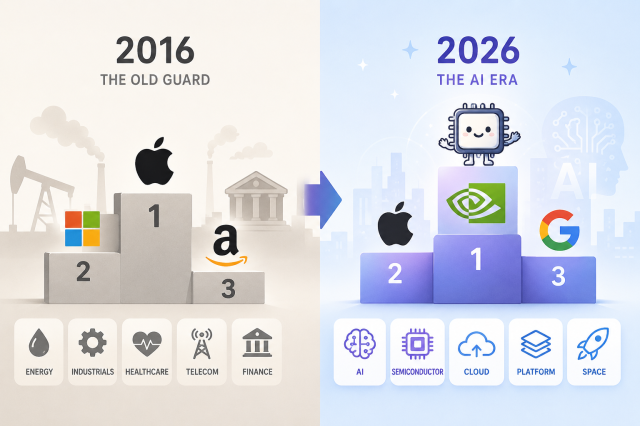
[Editor’s Note] The stock market reflects the economy. The composition of top market capitalization companies reveals the current state of a country's economy and industry. Over the past decade, the top ten market capitalizations in major stock markets, including the U.S., Japan, China, and Taiwan, have undergone dramatic changes. The previous dominance of traditional manufacturing, banking, and energy sectors is being replaced by semiconductor and artificial intelligence (AI) technology companies. We are now in the era of semiconductor and AI unification.
The rankings of the largest companies by market capitalization on the U.S. stock market have changed significantly over the past decade. In 2016, the top companies were primarily in the energy, manufacturing, and financial sectors, with ExxonMobil, General Electric (GE), and JPMorgan Chase leading the way. By 2026, the landscape has transformed dramatically, dominated by AI and semiconductor companies such as Nvidia, Broadcom, Tesla, and Micron. The smartphone industry, led by Apple, disrupted the stronghold of energy and manufacturing, which has now been further challenged by semiconductor and AI firms.
The decline of the energy and manufacturing era
According to CompaniesMarketCap, as of June 24, 2026, the top ten companies by market capitalization in the U.S. are now dominated by the semiconductor and IT sectors. Nvidia ranks first with a market cap of $4.845 trillion, followed by Apple at $4.322 trillion and Alphabet at $4.223 trillion. Microsoft holds the fourth position with a market cap of $2.812 trillion. The fifth to tenth positions are also occupied by companies closely related to AI, including Amazon ($2.564 trillion), SpaceX ($2.254 trillion), Broadcom ($1.898 trillion), Tesla ($1.536 trillion), Meta ($1.452 trillion), and Micron ($1.343 trillion).The rise of the semiconductor and AI age
The U.S. stock market looked different ten years ago. In December 2016, a report from Daishin Securities indicated that Apple was the top company with a market cap of $607.1 billion, followed by Microsoft ($481.8 billion) and Amazon ($369.0 billion). ExxonMobil ($365.2 billion) and Johnson & Johnson ($305.9 billion) were fourth and fifth, respectively. Other notable companies in the top ten included Facebook ($305.4 billion), Alphabet ($287.0 billion), GE ($281.1 billion), AT&T ($280.2 billion), and JPMorgan Chase ($271.2 billion).Nvidia and the top six companies in the semiconductor and AI sector
The most significant change in market capitalization over the past decade has been Nvidia's rise. Currently, Nvidia's market cap of $5.155 trillion exceeds the combined market cap of the top ten U.S. companies in 2016, which was $3.554 trillion. This indicates that Nvidia alone is valued higher than the total of the companies that once dominated the market.While Nvidia has surged, many traditional industrial companies that held top positions in 2016 have fallen out of the rankings. ExxonMobil, Johnson & Johnson, and GE are now outside the top ten. Their places have been filled by companies connected to the semiconductor and AI ecosystem, such as Nvidia, Broadcom, Tesla, and Micron, replacing the previous dominance of energy, healthcare, and industrial sectors with AI semiconductors, electric vehicles, and memory companies.
Nvidia's position as the top company illustrates the shift in industrial leadership. Kim Seok-hwan, a researcher at Mirae Asset Securities, noted, "The change in the top market cap company signifies a shift not just in stock prices but also in the paradigm of the era and the flow of capital. Since the late 1990s, the global stock market has transitioned from a focus on traditional manufacturing and energy to the current era of generative AI." He explained that Nvidia surpassing Apple as the top company reflects the overwhelming value assigned to monopolistic firms amid the generative AI revolution.
Expansion of the AI ecosystem and potential for long-term dominance
Market analysts predict that Nvidia's dominance will continue for the foreseeable future. As the adoption of generative AI and competition for data center investments intensify, demand for AI semiconductors is expected to rise steadily. Nvidia, with its overwhelming share of the GPU market, is seen as the primary beneficiary of expanded investments in AI infrastructure.According to financial investment firm JP Morgan, on June 18, it estimated that investments in AI semiconductors and core hardware will exceed $3 trillion over the next five years. JP Morgan identified Nvidia as the company most likely to benefit from this trend, predicting that its dominance within the AI ecosystem will strengthen further.
* This article has been translated by AI.
Copyright ⓒ Aju Press All rights reserved.