
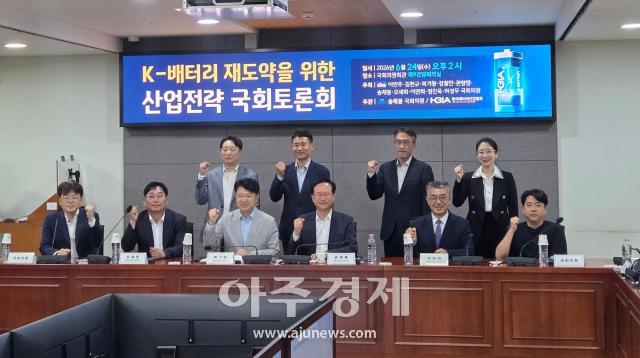
As demand for electric vehicles slows and oversupply from China raises concerns, the K-battery industry is facing significant challenges. A forum titled 'National Assembly Forum on Industrial Strategy for K-Battery Revitalization' was held at the National Assembly.
On June 24, the forum, organized by the Korea Battery Industry Association and Democratic Party lawmaker Song Jae-bong, featured participation from numerous secondary battery companies. They discussed tax improvement measures, including direct refunds for investment tax credits and incentives for domestic production, as well as strategies to enhance the competitiveness of K-batteries.
Industry representatives pointed out the lack of demand policies for the K-battery sector and the absence of clear support measures for the value chain. While most competing countries are boosting their domestic battery industries through cash support, South Korea's policies have primarily focused on loan assistance, highlighting the need for more direct support such as tax incentives. There are also concerns that supply chain policies aimed at countering China are insufficient compared to those of rival nations.
During the discussions, the necessity for tax support and strengthening supply chains in the battery industry was emphasized. Business leaders agreed that, given the declining profitability due to reduced electric vehicle demand and oversupply from China, practical cash support, such as direct refunds for investment tax credits, is essential.
Nam Yong-ho, head of Samsung SDI, described the battery industry as "a critical sector that must not fail and still has opportunities to lead." He stressed the need for South Korea to prepare countermeasures as the U.S. and Europe are raising protective barriers for their domestic industries. He called for direct refunds for R&D tax credits in advanced industries and support for material, equipment, and parts manufacturers.
Kim Nam-ho, executive director at LG Energy Solution, raised concerns about the effectiveness of the tax credit system. He noted that even with high tax credit rates, companies cannot benefit if they continue to incur losses, suggesting that attaching direct refunds to the domestic production incentive is the most realistic alternative. He also pointed out that government support played a crucial role in the growth of China's CATL.
Yoon Young-doo, vice president of SK Innovation, emphasized that the battery industry should be viewed as a foundational sector for environmental transition and future generations. He explained that both electric vehicles and energy storage systems are closely linked to government policies on renewable energy and AI data centers. Yoon mentioned that SK On is undertaking self-rescue efforts, including restructuring and overseas business adjustments, and expressed hope that with additional government support, the company could once again contribute to the national economy.
In the materials sector, there were calls for a government-level policy control tower. Choi Woo-young, head of EcoPro, suggested the establishment of a task force under the Prime Minister to oversee the entire battery industry. He added that investments in overseas minerals and refining should also be included in tax credit eligibility to help material companies lower costs and provide better conditions for cell manufacturers.
The government has indicated it will prioritize including the battery industry in the production tax credit program. Kang Gyu-hyung, head of the Battery and Electronics Division at the Ministry of Trade, Industry and Energy, stated, "This year, we aim to include the battery industry in the production tax credit program," and noted that a budget of 300 billion won for R&D programs is being pursued to support companies and research institutions in a timely manner.
The National Assembly has also pledged legislative support for related measures. Lawmaker Song Jae-bong remarked, "Direct refunds for investment tax credits are the most critical and challenging issue for the industry," and assured that the National Assembly would work to ensure the inclusion of production tax credits and support for stabilizing supply chains.
Notable participants in the forum included Nam Yong-ho of Samsung SDI, Kim Nam-ho of LG Energy Solution, Yoon Young-doo of SK Innovation, Choi Woo-young of EcoPro, Lee Hee-hyup of the Korea Battery Industry Association, Kang Gyu-hyung of the Ministry of Trade, Industry and Energy, and lawmakers Song Jae-bong, Bok Gi-wang, Lee Yeon-hee, along with other industry experts and legal advisors.
* This article has been translated by AI.
Copyright ⓒ Aju Press All rights reserved.