
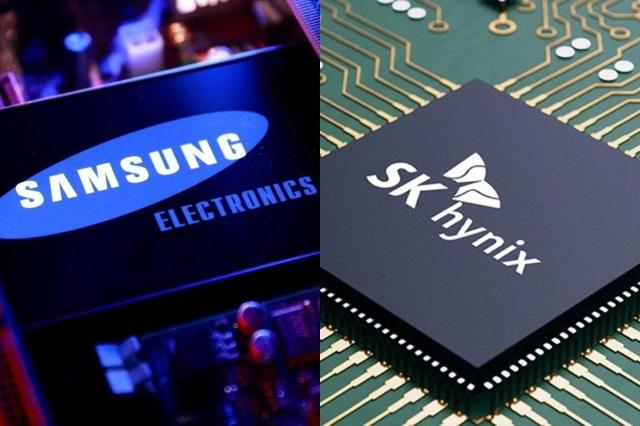
Generative artificial intelligence (AI) is reshaping the semiconductor industry. Just a few years ago, the memory semiconductor market was primarily influenced by the prices of DRAM and NAND. However, with the expansion of AI services and the establishment of data centers, high-bandwidth memory (HBM), advanced packaging, and application-specific integrated circuits (ASICs) have emerged as key factors determining the future value of semiconductor companies. The competition for AI semiconductor dominance between Samsung Electronics and SK Hynix is intensifying.
As of now, SK Hynix is considered the biggest beneficiary in the AI era. The company has secured a leading position in the AI memory market by supplying HBM to Nvidia ahead of its competitors. HBM, a high-value memory, has become a crucial component that significantly influences the performance of AI accelerators, yielding profitability levels that far exceed those of traditional memory. In fact, HBM now constitutes a substantial portion of SK Hynix's DRAM business, becoming a core revenue source.
SK Hynix is particularly strengthening its grip on the HBM market, centered around its largest customer, Nvidia. The company has already secured a volume advantage in HBM3E and is expected to supply the most volume to Nvidia in the upcoming HBM4. Recently, Nvidia CEO Jensen Huang reaffirmed the strong partnership between the two companies during his visit to South Korea, referring to SK Hynix as "Nvidia's largest memory partner."
In contrast, Samsung Electronics has faced criticism for its delayed response to the HBM market. The delay in entering the HBM3E market allowed SK Hynix to widen the gap. However, the situation has recently changed. Samsung has begun mass production of HBM4, becoming the first in the world to do so, and has also supplied samples of HBM4E, accelerating its efforts to capture the next-generation market. Recently, HBM4 sales surpassed $1 billion just four months after mass production began, with projections of exceeding $10 billion by the end of the year.
Samsung Electronics Vice Chairman Lee Jae-yong's recent visit to the HBM packaging production line in Cheonan is seen in the same light. The Cheonan facility is a key site for Samsung's HBM backend processing and advanced packaging. By directly overseeing production capabilities and quality, Lee has demonstrated Samsung's commitment to regaining ground in the HBM market in response to the growing demand for AI semiconductors.
Looking ahead, the competition for dominance in the on-device AI market is also a key point of interest. Samsung recently unveiled the industry’s first universal flash storage (UFS) 5.0 optimized for on-device AI, which more than doubles data transfer speeds and improves power efficiency by over 40%. This move targets the expanding markets for AI smartphones, XR devices, and AI wearables.
Last year, SK Hynix developed UFS 4.1, which features the world’s highest layer count of 321 layers in NAND. This product enhances power efficiency and reduces thickness, with mass production commencing in the first quarter of this year. The company is currently developing next-generation products and aims to actively respond to the demand for on-device AI, in addition to memory for AI servers.
* This article has been translated by AI.
Copyright ⓒ Aju Press All rights reserved.