
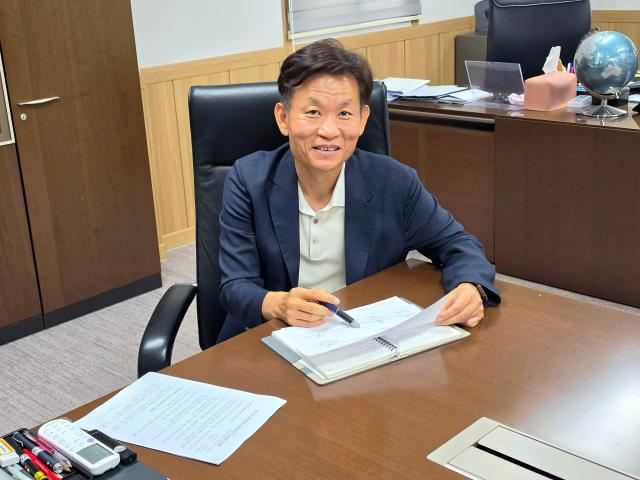
Hwang Jun-ho, the master planner of Solar City, a self-sufficient energy city in South Korea, described attracting semiconductor factories to the Honam region as a "strategic choice to elevate the nation's semiconductor competitiveness." He noted that the semiconductor industry, which has been concentrated in the Seoul metropolitan area, is facing limitations in power and water supply, making Honam, with its ample renewable energy and water resources, a potential breakthrough region.
In an interview with Aju Economy on June 24, Hwang emphasized the need for semiconductor factories in Honam, citing the example of Taiwan's TSMC. He explained that TSMC expanded its production bases beyond the Hsinchu Industrial Park to Taichung, Tainan, and Kaohsiung not only to mitigate disaster risks like earthquakes but also to address saturation issues related to power and water supply in specific areas. "Korea's semiconductor industry is also focused on securing advanced process technologies, but the existing power and water shortages in the metropolitan area have already reached a critical point," he said.
When asked if sufficient power is available for the semiconductor industry in Honam, Hwang's response was resolute. He stated, "It is not just a possibility; it must happen. There is an urgent need for advanced industries that consume large amounts of power to decentralize and locate in regions where power is produced." He pointed out that the limitations of long-distance transmission due to constraints on the East Coast and saturation of power supply in the metropolitan area indicate that the traditional reliance on long-distance transmission is no longer viable.
South West Coastal City Development is the implementing agency for the Solar City project in Haenam, Jeollanam-do. Solar City aims to establish a RE100 industrial complex based on renewable energy such as solar power, along with models for attracting AI data centers and advanced industries. Hwang explained, "Solar City is developing plans to supply clean power generated at power plants directly to nearby semiconductor factories or AI data centers without wasting it on transmission lines." He believes that combining large-scale energy storage systems (BESS) with AI-based energy management systems can also reduce fluctuations in power generation.
He highlighted Honam's strengths, including reclaimed tidal flats, lake surfaces, and excellent solar radiation. However, he noted that securing applications for the generated renewable energy remains a challenge. As issues related to grid capacity and output control grow, a structure where produced electricity is used locally is essential. Hwang described this as a "local energy self-sufficient city model where power produced in the region is directly used by local industries."
He also addressed policy challenges, stating that while the need for RE100 industrial complexes and renewable energy self-sufficient cities has increased, the pace of policy implementation has not kept up with on-the-ground demand. He expressed concern that the process of utilizing national-managed reclaimed land is not smooth due to inter-departmental coordination issues, and that uniform requirements for agricultural solar power could raise construction costs, leading to higher electricity supply prices.
Hwang concluded, "Renewable energy policy should shift from focusing solely on increasing generation capacity to integrating grid, storage, and demand. It is more important to consider how to use the generated electricity effectively rather than just how much electricity is produced."
* This article has been translated by AI.
Copyright ⓒ Aju Press All rights reserved.