
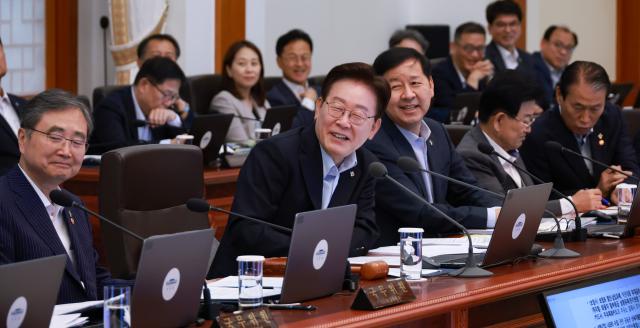
As the Lee administration prepares for its second-term cabinet formation, speculation is rife regarding personnel changes within the economic ministries. The appointment of Han Seong-sook as a candidate, coinciding with Prime Minister Kim Min-seok's bid for party leadership, has set the stage for potential shifts in key economic positions, including the Deputy Prime Minister for Economy.
According to sources in the government and political circles on June 24, the presidential office is reviewing personnel adjustments to boost governance momentum in the second year of its term following local elections. This reshuffle is seen as a significant step in establishing a "second-term governance system" through the reallocation of ministerial roles.
The economic ministries are directly impacted by this personnel flow. With major issues such as managing economic recovery, fiscal operations, industrial transitions, agricultural reforms, and labor matters at stake, there is discussion of a "partial reassignment" that balances policy continuity with renewal, rather than a complete overhaul.
Deputy Prime Minister and Minister of Economy and Finance Koo Yun-cheol has led the economic team, addressing key issues like economic response, budget and tax management, and inflation control. While recent improvements in macroeconomic indicators, such as a rebound in growth rates and a strong stock market, are seen as achievements, challenges remain, including high interest rates, high exchange rates, inflation pressures, and rising national bond yields.
There are simultaneous discussions about Koo's retention and potential reassignment. Given the numerous pressing issues, including the direction of economic policy for the second half of the year, tax reforms for the upcoming year, and management of the national bond market, some analysts predict a preference for continuity. However, there are also speculations that a change in the Deputy Prime Minister position could occur as part of a broader restructuring of the economic team.
In relation to the next economic team, the future of Minister of Trade, Industry and Energy Kim Jeong-kwan is also a variable. Once considered a candidate for Deputy Prime Minister, recent sentiment has shifted towards retaining him. With numerous challenges facing the ministry, including energy supply responses due to conflicts in the Middle East, managing export recovery, U.S. trade pressures, and restructuring supply chains in advanced industries, maintaining the current leadership appears likely.
The appointment of the Chief of the Office for Government Policy Coordination is also intertwined with personnel changes in the economic ministries. This position is responsible for monitoring the implementation of national tasks across ministries and coordinating policies. Candidates such as Lim Gi-geun, Vice Minister of the Ministry of Strategy and Finance, and Lee Hyung-il, First Vice Minister of the Ministry of Economy and Finance, have been mentioned. Recently, there has been a trend favoring candidates with experience in budget and national task management.
There is also interest in whether Minister of Agriculture, Food and Rural Affairs Song Mi-ryung, appointed during the previous administration, will be retained. While her retention is being discussed, there is speculation about the possibility of a political figure entering the cabinet. Potential candidates include Democratic Party lawmakers Oh Gi-koo and Yoon Jun-byeong. Oh, who chairs the National Assembly's Agriculture, Food, Rural Affairs, Oceans and Fisheries Committee, is recognized for his knowledge of agricultural issues and legislative processes, while Yoon is noted for his proactive stance on structural reform topics such as agricultural cooperative law reform and land surveys.
The Ministry of Climate, Energy and Environment and the Ministry of Employment and Labor are also among the departments that could see changes. Initially, there were rumors about Minister Kim Sung-hwan returning to his party, but recent sentiment leans towards his retention. Given that the ministry is directly responsible for implementing the president's climate and energy transition plans, adjustments at the deputy minister level are considered more likely than a ministerial change.
The Ministry of Labor has not yet shown clear signs of a potential change. This is due to the politically sensitive nature of issues such as retirement age extension, working hours, and labor relations.
A political insider noted, "The second-term cabinet is likely to reshape the governance framework for national tasks. Given the importance of policy continuity in the economic ministries, it is expected that there will be discussions about partial ministerial changes or retention rather than a complete overhaul."
* This article has been translated by AI.
Copyright ⓒ Aju Press All rights reserved.