
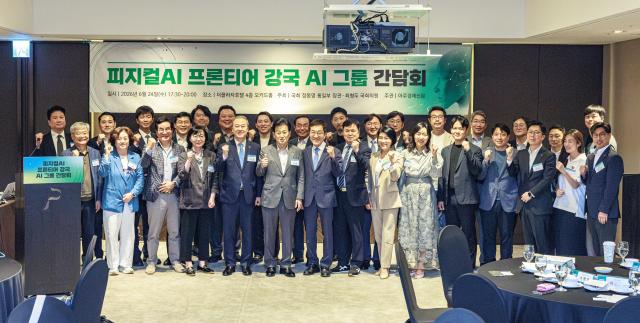
Experts from the South Korean government, academia, major conglomerates, and startups gathered to discuss the future of the artificial intelligence (AI) industry and collaboration strategies.
The 'Physical AI Frontier' meeting, hosted by Minister of Unification Jeong Dong-young and Rep. Choi Hyung-do, took place on June 24 at The Plaza Hotel in Seoul. The event aimed to outline South Korea's future strategies regarding AI industry policies and legislative directions in the era of physical AI.
Attendees included political figures and representatives from companies such as SK Telecom, LG, Doosan Robotics, and NC AI.
In his opening remarks, Minister Jeong stated, "Over the past year, physical AI has become a key topic in global technological competition. The government and the National Assembly must support the efforts of large corporations and startups to establish South Korea as the world's leading hub for physical AI."
He further noted that at the 2024 forum, the need for securing graphics processing units (GPUs) and focusing on physical AI, as well as the passage of a fundamental AI law, were discussed. "Since then, the speed of policy implementation has increased with GPU budget allocations and exemptions from preliminary feasibility studies. I hope the companies and startups gathered here can grow into global Korean tech giants, with Jeonju, Gimje, and Saemangeum as their base," he emphasized.
Rep. Choi Hyung-do remarked, "Physical AI is a bipartisan national project, and I will work in the National Assembly to help achieve our goal of becoming one of the top three AI nations through physical AI."
Kwak Young-gil, chairman of Aju News Corporation, stated, "AI must integrate both intelligence and physical capabilities. In the era of physical AI, South Korea can gain a competitive edge by combining semiconductors and energy resources. Saemangeum is an ideal location for building AI data centers and physical AI infrastructure due to its land availability, permitting conditions, and renewable energy potential." He also urged the government to facilitate research and development funding and infrastructure to allow companies to commercialize freely.
Shin Hyung-sik, the chair of the transition committee for the Jeonbuk Special Self-Governing Province, expressed, "Physical AI could become a new cash cow for Jeonbuk and South Korea. Just as semiconductors elevated Korea to developed nation status, physical AI will position Korea as a leading advanced country. We will do our utmost to ensure Jeonbuk leads in future industries."
Following this, Yang Oh-bong, president of Jeonbuk National University, delivered a special lecture on 'The Era of Physical AI and South Korea's Future Strategy.'
Jeonbuk National University established a 'Physical AI Demonstration Lab' in January, serving as a starting point and hub for manufacturing innovation in physical AI. The lab aims to enhance capabilities in smart processes and autonomous driving, where AI directly controls and demonstrates in industrial settings.
The university is advancing plans for living labs, proof of concept (PoC) facilities, heterogeneous robot collaboration software, and testbed construction. Ultimately, the goal is to establish a foundation for AI dark factories that enable automation and intelligence in manufacturing.
President Yang stated, "If generative AI is like an AI with a voice, then physical AI encompasses the brain and limbs. As a manufacturing powerhouse, South Korea must focus on manufacturing AI and AI dark factories."
He added, "The physical AI market is expected to grow to tens of trillions of dollars, making swift decision-making and talent acquisition crucial. The key to success will be how well we cultivate and secure talent that understands robotics, AI, and manufacturing together."
Yang also mentioned that Jeonbuk National University has completed the development of PoC facilities and software within four months and has implemented heterogeneous robot collaboration and process operation systems. "We aim to establish AI dark factory demonstration infrastructure based on seven zones and 30 units in the future," he said.
He concluded, "Jeonbuk National University has already secured a significant portion of the necessary space, allowing us to start projects simultaneously this year. We hope companies will leverage the infrastructure of Jeonbuk National University and Jeonbuk to engage in physical AI demonstrations and commercialization."
* This article has been translated by AI.
Copyright ⓒ Aju Press All rights reserved.