

Four universities in South Korea have been selected as national research institutes responsible for advancing basic research and leading innovative studies at a global level. The government plans to invest substantial funding into these university-affiliated research centers over the next decade to enhance technological competitiveness and secure cutting-edge technologies.
On June 29, the Ministry of Education and the Ministry of Science and ICT announced the final selection results for the 2026 basic research project, confirming the designation of Seoul National University, Sungkyunkwan University, Changwon National University, and Chungnam National University as national research institutes (NRL 2.0). Comprehensive support will begin on July 1.
The national research institute initiative aims to leverage the excellent research personnel and infrastructure of universities to foster sustainable, interdisciplinary, and large-scale research hubs, ultimately generating world-first and top-tier research outcomes. This program was first introduced in 2025 and is now in its second year. Each of the selected institutes will receive an unprecedented annual budget of 10 billion won, totaling 100 billion won over ten years.
On June 29, the Ministry of Education and the Ministry of Science and ICT announced the final selection results for the 2026 basic research project, confirming the designation of Seoul National University, Sungkyunkwan University, Changwon National University, and Chungnam National University as national research institutes (NRL 2.0). Comprehensive support will begin on July 1.
The national research institute initiative aims to leverage the excellent research personnel and infrastructure of universities to foster sustainable, interdisciplinary, and large-scale research hubs, ultimately generating world-first and top-tier research outcomes. This program was first introduced in 2025 and is now in its second year. Each of the selected institutes will receive an unprecedented annual budget of 10 billion won, totaling 100 billion won over ten years.
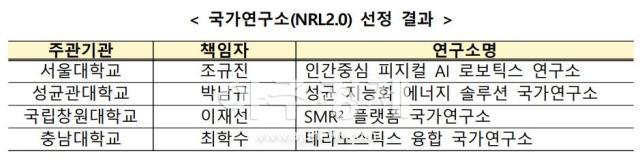
This year's selection process featured a division into two tracks to promote regional balanced development: Type 1 (national) for universities across the country and Type 2 (regional) exclusively for local institutions. This approach significantly expanded opportunities for regional universities to participate. After in-depth evaluations, Seoul National University and Sungkyunkwan University were chosen for Type 1, while Changwon National University and Chungnam National University were selected for Type 2.
The core research themes of the newly designated university research institutes encompass critical future technology areas. Seoul National University's 'Human-Centered Physical AI Robotics Institute' (led by Professor Jo Gyu-jin) focuses on developing intelligent robotic technologies that assist humans in daily life and medical environments. This initiative aims to enhance the quality of life in an aging society through hyper-personalized robotic services.
Sungkyunkwan University's 'Sungkyun Intelligent Energy Solutions National Research Institute' (led by Professor Park Nam-kyu) conducts research combining high-efficiency solar cells and energy storage technologies with AI and digital twins. The goal is to develop comprehensive energy solutions tailored to industries, ensuring stable energy supply and resilience against extreme load fluctuations, thereby contributing to carbon neutrality.
Changwon National University's 'SMR2 Platform National Research Institute' (led by Professor Lee Jae-sun) specializes in researching key materials, structural integrity, and system integration technologies for small modular reactors (SMRs), which are gaining attention as next-generation nuclear power sources. The institute aims to accelerate the establishment of an integrated platform to lead the global SMR market through AI autonomous driving and extreme environment validation.
Chungnam National University's 'Theranostics Convergence National Research Institute' (led by Professor Choi Hak-soo) aims to establish foundational technologies for theranostics, a precision medicine concept that simultaneously diagnoses and treats challenging diseases such as refractory tumors, infectious diseases, and degenerative brain disorders.
Following the announcement of the results on June 29, the ministries will finalize the selection after an appeal process and begin formal agreements with the selected institutions. Additionally, they plan to conduct on-site consulting with the Korea Research Foundation to provide close support for the new research institutes to establish themselves within the universities.
Lee Hae-sook, Director of the Higher Education and Lifelong Policy Office at the Ministry of Education, stated, "The national research institutes will play a pivotal role in transforming the research and development ecosystem of universities and contributing to regional development. We expect the selected institutes to produce world-class research outcomes and will provide comprehensive support to achieve this."
Kim Sung-soo, Director of Research and Development Policy at the Ministry of Science and ICT, also remarked, "We will continuously support the selected national research institutes to develop into world-class research centers and serve as leading models for research activities in South Korean universities."
The core research themes of the newly designated university research institutes encompass critical future technology areas. Seoul National University's 'Human-Centered Physical AI Robotics Institute' (led by Professor Jo Gyu-jin) focuses on developing intelligent robotic technologies that assist humans in daily life and medical environments. This initiative aims to enhance the quality of life in an aging society through hyper-personalized robotic services.
Sungkyunkwan University's 'Sungkyun Intelligent Energy Solutions National Research Institute' (led by Professor Park Nam-kyu) conducts research combining high-efficiency solar cells and energy storage technologies with AI and digital twins. The goal is to develop comprehensive energy solutions tailored to industries, ensuring stable energy supply and resilience against extreme load fluctuations, thereby contributing to carbon neutrality.
Changwon National University's 'SMR2 Platform National Research Institute' (led by Professor Lee Jae-sun) specializes in researching key materials, structural integrity, and system integration technologies for small modular reactors (SMRs), which are gaining attention as next-generation nuclear power sources. The institute aims to accelerate the establishment of an integrated platform to lead the global SMR market through AI autonomous driving and extreme environment validation.
Chungnam National University's 'Theranostics Convergence National Research Institute' (led by Professor Choi Hak-soo) aims to establish foundational technologies for theranostics, a precision medicine concept that simultaneously diagnoses and treats challenging diseases such as refractory tumors, infectious diseases, and degenerative brain disorders.
Following the announcement of the results on June 29, the ministries will finalize the selection after an appeal process and begin formal agreements with the selected institutions. Additionally, they plan to conduct on-site consulting with the Korea Research Foundation to provide close support for the new research institutes to establish themselves within the universities.
Lee Hae-sook, Director of the Higher Education and Lifelong Policy Office at the Ministry of Education, stated, "The national research institutes will play a pivotal role in transforming the research and development ecosystem of universities and contributing to regional development. We expect the selected institutes to produce world-class research outcomes and will provide comprehensive support to achieve this."
Kim Sung-soo, Director of Research and Development Policy at the Ministry of Science and ICT, also remarked, "We will continuously support the selected national research institutes to develop into world-class research centers and serve as leading models for research activities in South Korean universities."
* This article has been translated by AI.
Copyright ⓒ Aju Press All rights reserved.