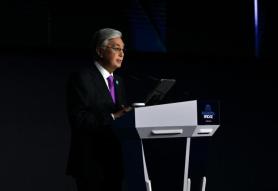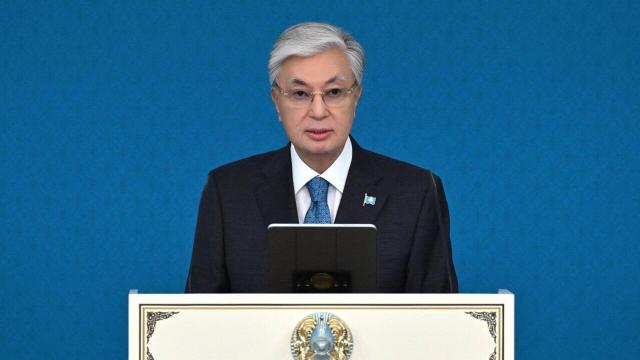
SEOUL, July 01 (AJP) - Kazakhstan's new Constitution entered into force on Wednesday, replacing the charter that had governed the country since 1995 and marking the culmination of a reform process that began nearly four years ago. President Kassym-Jomart Tokayev, in a statement from the presidential office, called the moment "a truly epochal moment" and the start of what he described as a new era of progress, reform, and modernization.
The document was approved by referendum on March 15, when, according to official results, close to eighty-seven percent of voters backed the new charter on a turnout of seventy-three percent, the highest for any national vote in Kazakhstan since 2019. It was the fifth referendum the country has held since gaining independence in 1991, and the third focused on constitutional change since 2022. Tokayev signed the document into law two days after the vote, and it consists of a preamble, eleven sections, and 104 articles.
Kazakhstan's first post-Soviet constitution, adopted in 1995 under founding president Nursultan Nazarbayev, established a strong presidency and a two-chamber parliament. That system carried Kazakhstan through three decades of rapid economic growth built largely on oil, gas, and mineral wealth, but it also concentrated decision-making power tightly around the presidency. In 2022, following unrest early that year, Tokayev pushed through a first round of amendments intended to loosen that concentration and expand the space for political competition. The Constitution that took effect this week goes considerably further, touching the bulk of the previous text rather than a narrow set of articles.
The most visible change is structural. Kazakhstan's parliament, long split between an upper and lower chamber, becomes a single legislative body called the Kurultai, a term drawn from the historical councils once used across the steppe to deliberate and decide matters collectively. Alongside it, the new Constitution creates a vice presidency, a position that did not exist before, and establishes the Halyk Kenesi, or People's Council, a consultative body meant to bring representatives from ethnic and cultural organizations, local governments, and civil society into the policymaking process. Officials in Astana have framed these changes as tools for faster, more accountable governance, replacing an arrangement that often left responsibility for legislative gridlock unclear.
Tokayev linked the reform explicitly to national identity as well as institutional design. He tied Constitution Day, now observed each year on March 15, to the start of the Nauryznama decade, connecting the country's spring renewal traditions to a set of stated civic values, among them Law and Order, Diligence and Progress, and Environmental Care. He described the goal as building what the presidential office calls a "Fair Kazakhstan," a state offering equal opportunity and development to all citizens, and said the country's unity as a nation would allow it to compete among the world's advanced states.
That last point, competing among advanced states, is where the reform's significance extends beyond Kazakhstan's borders. A more predictable legal framework, with clearer lines of institutional authority, is precisely the kind of signal that trade partners and foreign investors look for when deciding where to commit long-term capital. And few relationships illustrate what is at stake more clearly than the one Kazakhstan has been building with South Korea.
The numbers already tell a growing story. Trade between the two countries passed $3 billion in 2025, and South Korean companies have invested a total of $8 billion in Kazakhstan over the past decade, spanning manufacturing, energy, and mechanical engineering. In June, the eleventh meeting of the Kazakhstan-South Korea Joint Commission on Trade, Economic, and Scientific-Technical Cooperation convened in Astana, where officials from both sides discussed a comprehensive economic partnership agreement still under negotiation.
"The sides underscored the importance of the Joint Commission," Kazakhstan's state-operated news agency Qazinform reported citing government officials, adding that both countries confirmed their readiness to deepen the partnership and carry joint initiatives forward.
Nuclear energy has become one of the more concrete areas of cooperation. Kazakhstan, which holds the world's largest uranium reserves, has been in talks with South Korean partners over the deployment of small modular reactors (SMRs), a newer generation of nuclear technology built at a fraction of the size of conventional plants, along with workforce training and a memorandum of understanding still being finalized.
Deputy Energy Minister Sanzhar Zharkeshov has called energy a cornerstone of the bilateral relationship, and South Korean firms have also been invited to help modernize Kazakhstan's existing power plants under the country's Electric Power Industry Development Plan through 2035.
Critical minerals and rare earth metals, materials essential to batteries, electronics, and clean energy technology, featured prominently in the June discussions as well, with both governments exploring joint processing projects. So did the Trans-Caspian International Transport Route, often called the Middle Corridor, a rail and sea network that moves goods from Central Asia across the Caspian Sea toward Europe while bypassing Russian territory. As Kazakhstan continues to build out this corridor, it becomes a more direct link between South Korean industry and European markets, a role few countries in the region are positioned to play.
None of this cooperation depends on constitutional reform in a narrow, mechanical sense. But investors and diplomatic partners alike tend to read institutional signals closely, and a government that can point to a rewritten legal foundation, clearer accountability structures, and a stated commitment to the rule of law has an easier case to make at the negotiating table. Tokayev has accepted an invitation to visit Seoul and is expected to take part in the Central Asia-South Korea Summit later this year, a gathering that will bring the region's leaders together with President Lee Jae-myung's government at a moment when Kazakhstan is actively presenting itself as a stable, reform-minded partner.
Gabidulla Ospankulov, chairman of Kazakhstan's Investment Committee, described the country's position at a Seoul roundtable in May as Central Asia's largest economy and a transport and logistics hub connecting Asia and Europe. Representatives from Korea Eximbank, Doosan Energy, and other South Korean firms discussed investment opportunities in Kazakhstan directly with the Kazakh delegation, according to the Ministry of Foreign Affairs press service.
Copyright ⓒ Aju Press All rights reserved.