
The Customs Agency has uncovered a significant number of illegal imports and origin mislabeling of hazardous goods that threaten public safety and industrial site security. This includes the importation of unverified industrial equipment and the distribution of low-quality foreign products falsely labeled as domestic.
From December of last year to May of this year, the agency conducted a focused crackdown on illegal imports and origin mislabeling of industrial safety goods, resulting in the discovery of 35 cases valued at approximately 1.22 trillion won ($1.22 billion). Of these, 11 cases involved illegal imports, totaling 181 billion won, while 24 cases of origin mislabeling accounted for 1.039 trillion won, making up the majority of the total value.
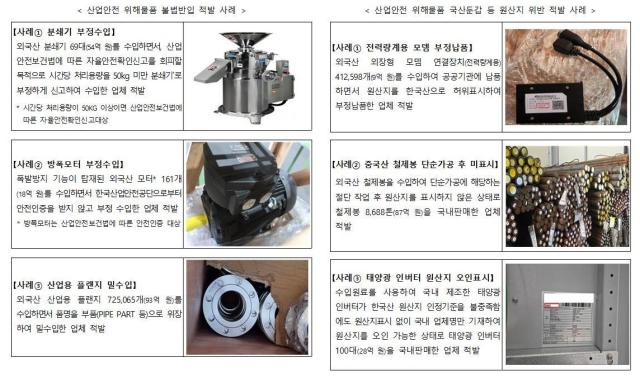
One notable case involved the illegal import of crushers. A company imported 69 foreign crushers valued at 5.4 billion won, falsely reporting their processing capacity as below 50 kilograms per hour to evade safety certification requirements under the Industrial Safety and Health Act. Crushers with a capacity exceeding 50 kilograms per hour must undergo safety certification.
The agency also detected the illegal import of explosion-proof motors. A company imported 161 foreign motors valued at 1.8 billion won without obtaining safety certification from the Korea Occupational Safety and Health Agency. Additionally, 720,506 foreign industrial flanges, worth 9.3 billion won, were smuggled in disguised as parts.
Industrial crushers, explosion-proof motors, and flanges are essential equipment used directly in manufacturing, chemical, and energy sectors. The introduction of equipment that has not undergone safety verification poses serious risks, including explosions, entrapment, and damage, making these violations more than mere customs infractions.
There were also several cases of origin mislabeling. One company imported 412,598 external modem connection devices for foreign power meters and falsely labeled their origin as South Korean when supplying them to public institutions. Another company was caught selling 8,688 tons of imported steel bars after only performing simple cutting operations without properly labeling their origin.
Origin mislabeling not only deceives consumers and clients but also undermines fair competition for domestic manufacturers. When low-priced foreign products are sold as domestic, local small and medium-sized enterprises that maintain quality standards are inevitably placed at a disadvantage in price competition.
The Customs Agency has issued corrective orders and administrative sanctions against the companies involved. Actions that intentionally damage or alter origin labels have been referred for investigation under the Foreign Trade Act. Cases of illegal imports are also being investigated for violations of customs law, with plans to file criminal charges.
The agency plans to enhance selective inspections and import requirement reviews at the customs stage and expand the collection of risk information through collaboration with relevant organizations. Furthermore, if criminal activities are detected, the agency intends to investigate not only the suspects but also the distribution networks connected to these crimes to dismantle illegal supply chains.
Kim Jeong, head of the Customs Agency's Investigation Bureau, stated, "The illegal import of unverified industrial safety goods and the distribution of low-quality foreign equipment misrepresented as domestic are serious criminal acts that lead to industrial accidents. We will thoroughly block the illegal import and distribution of hazardous goods that threaten the lives and safety of the public in industrial settings."
* This article has been translated by AI.
Copyright ⓒ Aju Press All rights reserved.