Investors now widely expect the benchmark policy rate to reach 3.0 percent by year-end after the central bank last week raised it by 25 basis points to 2.75 percent, its first increase since January 2023.
Some analysts see the next move coming as early as the Aug. 28 policy meeting.
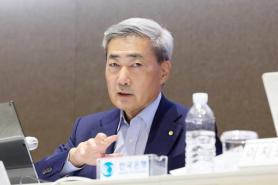
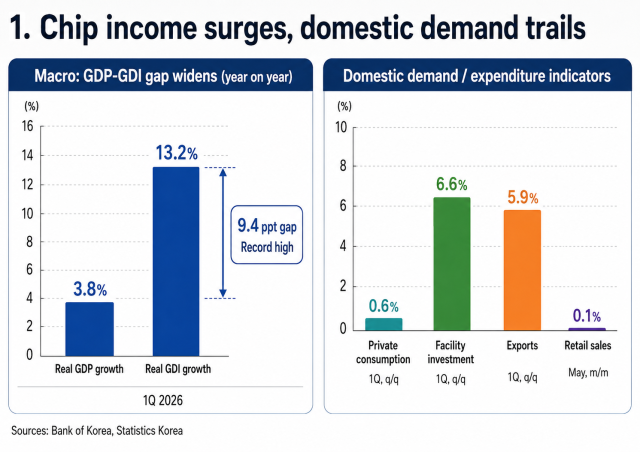
"We are seeing an exceptional condition. The gross domestic product has grown 3.8 percent (from a year earlier) in the first quarter whereas the gross domestic income grew much greater at 13.2 percent," Shin said after the July 16 monetary policy meeting.
"We have to see if this is a temporary phenomenon or one that could have a big impact on the economy."
Shin said the divergence suggested the economy may be entering a new phase in which income growth, fueled by soaring export prices, begins to feed domestic demand.
"If income improvement continues at this kind of strength, we may have to be wary of inflationary pressure from the demand side," he said.
Shin has also indicated that the latest rate increase marks the beginning of a broader tightening cycle.
Alongside imported inflation stemming from elevated energy prices and a weaker won, he has increasingly pointed to domestic pressures, including faster wage gains linked to the AI boom.
The government's recent decision to raise its 2026 economic growth forecast to 3.0 percent — the strongest pace since 2021 — has reinforced that narrative.
Semiconductor exports have powered much of the recovery, with outbound shipments reaching $551.3 billion as of July 20, keeping the country on course to touch the $1 trillion mark for the first time.
Government officials and the central bank argue that the current semiconductor cycle differs fundamentally from previous booms. Unlike earlier upcycles, they contend, the AI-driven surge is generating unprecedented corporate earnings that are flowing into wages, shareholder income, investment and tax revenues, creating a broader economic impact.
The BOK maintains that stronger semiconductor earnings will gradually spread through investment, household income and consumption while lifting corporate and earned-income tax receipts. Shin has rejected the view that the benefits will remain confined to a handful of chipmakers, although he acknowledged much of the fiscal windfall will become visible next year.
The central bank strengthened that argument in an Issue Note released Sunday, saying the latest improvement in Korea's terms of trade could have a more durable effect on domestic demand because it stems from structural AI-related semiconductor demand and higher export prices rather than temporary declines in oil prices.
According to the report, previous improvements in the terms of trade often reflected cheaper imported energy, which boosted purchasing power but faded as commodity prices recovered. This time, however, higher export prices driven by AI memory chips may sustain income gains for longer, encouraging consumption and business investment.
Yet evidence that the semiconductor windfall is spreading across the broader economy remains mixed.
Retail sales, construction activity and many service industries have recovered only gradually despite record exports and surging corporate earnings.
Corporate data also point to a disconnect between profits and employment.
Employment at 282 of Korea's 500 largest companies rose just 0.2 percent over the past three years even as sales increased 10.9 percent and operating profit jumped 81.0 percent, according to corporate tracker Leaders Index.
The contrast is even sharper in the semiconductor-heavy IT, electrical and electronics sector. Sales climbed 34.4 percent and operating profit surged 2,740.5 percent, yet employment increased by only 1,727 workers, or 0.6 percent.
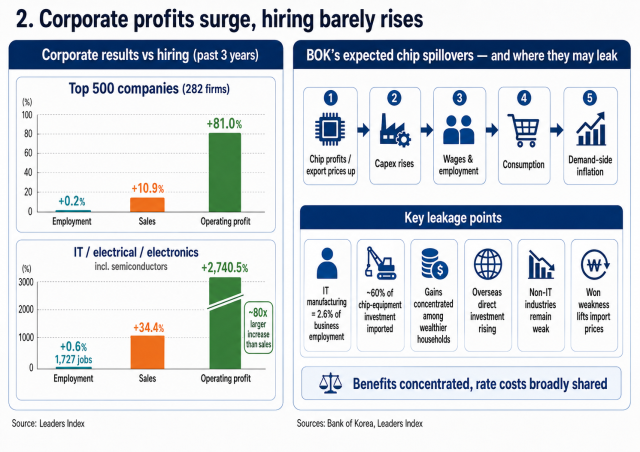
Its report noted that IT manufacturing accounts for only 2.6 percent of business-sector employment, limiting the direct transmission of semiconductor gains into household income. It also said most wage increases and equity gains accrue to high-income households with relatively low propensities to consume.
Investment spillovers may also prove weaker than headline figures suggest. Roughly 60 percent of semiconductor manufacturing equipment is imported, while Korean chipmakers have increasingly expanded production overseas, reducing the domestic impact of capital spending.
Persistent weakness in construction, retail, smaller manufacturers and other non-IT industries could further dilute the benefits from the export boom.
By contrast, the pressures supporting tighter monetary policy are already visible.
The won remains one of Asia's weakest major currencies. Shin has repeatedly argued that the Korea-U.S. interest-rate gap deserves close attention because cheaper won funding can encourage carry trades into dollar assets and increase hedging costs for overseas investments, reinforcing depreciation pressure.
Following last week's policy meeting, he said the BOK is closely monitoring offshore non-deliverable forward markets and is preparing additional research on how changes in the interest-rate differential affect currency flows.
Even after the July rate increase, Korea's benchmark rate remains 1 percentage point below the upper end of the U.S. Federal Reserve's 3.50-3.75 percent target range.
Currency weakness has also offset part of the income gains generated by stronger exports.
While Taiwan has benefited from the same AI-driven semiconductor cycle, the Korean won has fallen about 13 percent against the U.S. dollar since the end of 2023, compared with roughly 5 percent for the Taiwan dollar. That depreciation has continued to raise import costs for energy, food and raw materials, with Shin noting that import prices remain around 20 percent higher than a year earlier.
Meanwhile, financial stability concerns continue to build.
Housing prices have accelerated across Seoul and much of Gyeonggi Province, while household lending has continued expanding by roughly 8 trillion won to 9 trillion won a month despite tighter lending regulations.
Those pressures complicate the policy outlook.
The immediate beneficiaries of the semiconductor boom remain concentrated among large exporters, shareholders and highly paid technology workers, while higher borrowing costs are felt much more broadly by indebted households, small-business owners, builders and smaller manufacturers.
For markets, the debate is no longer whether semiconductors are lifting Korea's national income — they clearly are.
The more important question is whether those gains will spread widely enough through wages, consumption and investment to justify a sustained tightening cycle before the broader domestic economy fully recovers.
That question is likely to shape not only the Bank of Korea's next rate decision, but also how investors judge the durability of Korea's AI-driven economic resurgence in the months ahead.

Copyright ⓒ Aju Press All rights reserved.