
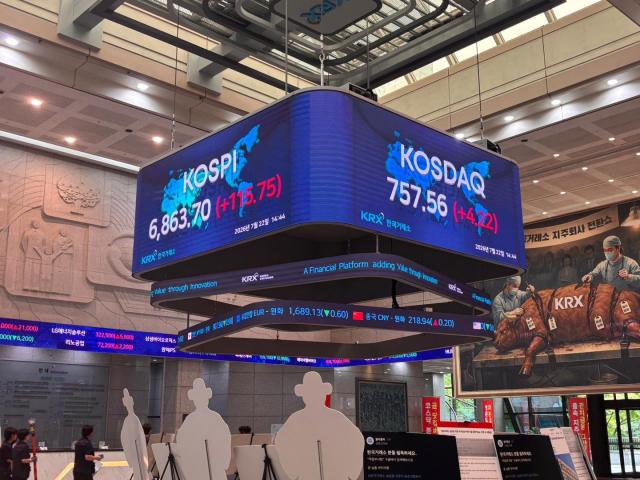
SEOUL, July 31 (AJP) — South Korea's stock market staged one of the most dramatic reversals in its history Friday as record foreign buying and twin near-30 percent surges in Samsung Electronics and SK hynix erased days of panic selling, signaling that global investors remain convinced the artificial-intelligence investment boom is far from over.
Foreign investors snapped up a record 7.18 trillion won ($5.2 billion) worth of KOSPI shares, fueling the benchmark index's 17.91 percent rally to 6,595.45 and adding about 834 trillion won to the market's capitalization in a single session.
The tech-heavy KOSDAQ jumped 11.63 percent to 719.76. Institutions added another 1.18 trillion won, while retail investors booked profits, selling a net 8.25 trillion won.
The buying was overwhelmingly concentrated in semiconductors, with SK hynix attracting a record 3.6 trillion won in foreign purchases, after drawing nearly 5 trillion won earlier in the day.
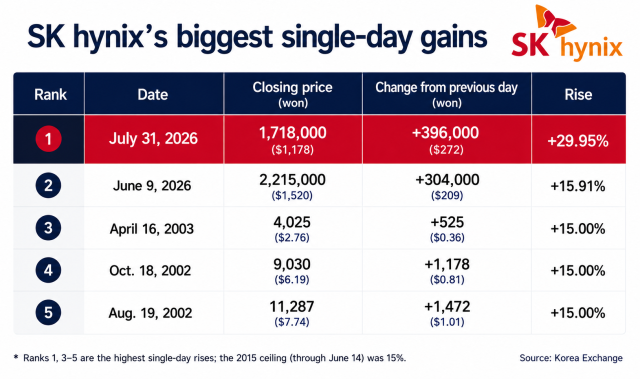
SK hynix soared 29.95 percent to 1,718,000 won, locking at the daily upper limit and marking its biggest one-day gain since Korea widened daily trading bands to 30 percent in 2015. Samsung Electronics surged 26.81 percent to 262,500 won, the largest single-day advance in the company's history.
The rally spread rapidly across Korea's semiconductor ecosystem.
Samsung Electro-Mechanics climbed 29.92 percent, while SK Square, SK hynix's largest shareholder, jumped 29.91 percent to its daily ceiling. Hanmi Semiconductor, Jusung Engineering and numerous chip-equipment makers also rallied sharply as investors poured money into companies tied to AI infrastructure.
According to Korea Exchange data, the semiconductor and semiconductor-equipment sector surged 28.4 percent, the strongest performance among all industries. Electronics equipment advanced 26.7 percent, electrical equipment gained 21.2 percent, telecommunications equipment rose 15.0 percent, while display equipment and components climbed 11.8 percent.
The catalyst arrived overnight from Wall Street.
Microsoft reassured investors by maintaining plans to spend roughly $190 billion on AI infrastructure this year, saying Azure cloud demand continues to outstrip available computing capacity despite record investment.
A day later, Amazon reinforced that message by lifting its planned 2026 capital expenditure to about $220 billion from $200 billion, after reporting its fastest Amazon Web Services growth in more than four years. Chief Executive Andy Jassy said demand for AI computing remains well ahead of available capacity and that much of the company's future cloud infrastructure has already been reserved.
Together, the earnings reports effectively dispelled growing concerns that hyperscale AI investment was beginning to slow after months of unprecedented spending.
The reversal was particularly striking because it came only days after one of the steepest selloffs Korean semiconductor stocks had experienced in years.
Earlier this week, fears over China's rapidly expanding memory-chip industry, questions about whether hyperscalers would curb AI spending, and forced deleveraging tied to single-stock leveraged ETFs triggered a foreign exodus from Korean equities. SK hynix and Samsung Electronics together lost hundreds of trillions of won in market value as hedge funds unwound positions and leveraged products accelerated selling pressure.
Friday suggested global investors had reached the opposite conclusion.
Rather than viewing recent volatility as the start of an AI downturn, overseas funds treated the correction as a buying opportunity, returning to the companies they see as indispensable suppliers to the world's AI infrastructure expansion.
The breadth of the rally also reflected confidence that AI spending extends well beyond memory chips.
Continued investment in AI data centers is expected to support demand for high-bandwidth memory and conventional DRAM while driving fresh orders for advanced packaging, semiconductor manufacturing equipment, precision components and electronic materials throughout Korea's supply chain.
More broadly, Friday's record inflows underscored how closely Seoul's fortunes have become tied to Wall Street's AI trade.
Microsoft and Amazon's earnings immediately translated into the largest foreign buying spree in Korean stock-market history, highlighting Samsung Electronics and SK hynix's increasingly central position in the global AI supply chain.
According to Rayliant Global Advisors, the 60-day correlation between the KOSPI and the Nasdaq 100 has climbed to roughly 0.50, the highest level since 2021, as Korean equities increasingly move in tandem with expectations for U.S. hyperscaler AI investment rather than traditional domestic economic drivers.
The rally also highlighted a valuation paradox.
Despite generating operating margins of around 70 percent at Samsung Electronics' semiconductor division and more than 76 percent at SK hynix, the two companies continue to trade at valuation multiples well below many global AI beneficiaries that produce only a fraction of their profits.
Friday's spectacular rebound therefore represented more than a relief rally after a week of forced selling.
It marked a renewed vote of confidence that the AI infrastructure build-out remains intact and reaffirmed South Korea's position at the heart of that investment cycle.
For global investors, Seoul is increasingly no longer simply an export-driven market tied to China or consumer electronics. It has become one of the world's clearest proxies for the AI supercycle, where Wall Street's commitment to spend hundreds of billions of dollars on artificial intelligence can trigger record capital flows into Korean semiconductor stocks overnight.

Copyright ⓒ Aju Press All rights reserved.
