The Bank of Korea said Friday that growth in legacy M2 accelerated from 8.0 percent in December to 9.1 percent in February, 10.4 percent in April, 11.6 percent in May and 12.3 percent in June.
It was the first time the measure had exceeded 12 percent since January 2022, when it increased 12.7 percent.
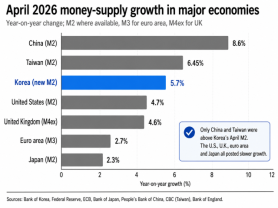
Growth in current M2 also climbed to 6.0 percent from 5.8 percent in May, marking its strongest reading since February 2023 and the fifth consecutive increase in the annual growth rate.
The current pace remained below the 7.5 percent average recorded between 2005 and 2025, making it difficult to conclude that the economy as a whole is awash with excess cash.
The gap between the two measures largely reflects non-money-market fund shares, which are included in legacy M2 but excluded from current M2 following the BOK’s statistical overhaul in December 2025.
Fund shares surged 64.5 percent from a year earlier and contributed 6.5 percentage points to legacy M2 growth, accounting for more than half of the 12.3 percent increase.
Subtracting that contribution leaves 5.8 percentage points, broadly in line with current M2 growth and underscoring why the legacy headline cannot be treated as a like-for-like measure of cash available for immediate spending.
The increase was not entirely a statistical effect, however, as narrow money M1 grew 10.0 percent from a year earlier, while financial-institution liquidity, or Lf, rose 8.5 percent and overall liquidity, or L, increased 9.4 percent.
All three rates accelerated from May, suggesting that the buildup in liquidity extended beyond the investment-fund component of legacy M2.
On a seasonally adjusted basis, average current M2 stood at 4,213.0 trillion won ($3.0 trillion), up 29.4 trillion won, or 0.7 percent, from the previous month after a 0.8 percent increase in May.
Money-market funds rose by 7.3 trillion won, deposits with maturities of less than two years increased by 7.1 trillion won and money trusts with maturities of less than two years gained 6.3 trillion won.
The central bank attributed the increases to greater use of short-term surplus funds by nonfinancial companies, higher corporate deposit holdings and inflows of funds from semiconductor companies into money trusts.
By holder, money balances at nonfinancial companies jumped 45.7 trillion won and those at other financial institutions increased 5.4 trillion won.
Holdings by households and nonprofit organizations fell 19.8 trillion won, while those held by other sectors, including social security funds and local governments, declined 1.1 trillion won.
The composition indicates that the latest liquidity buildup was concentrated in corporate cash and financial products rather than reflecting a household-wide surge likely to flow directly into consumption.
Average M1 stood at 1,402.9 trillion won, up 0.4 percent from May, while Lf increased 1.0 percent to 6,368.7 trillion won and the month-end L measure gained 0.8 percent to 8,115.3 trillion won.
Current M2 remaining below its long-term average argues against declaring an economy-wide liquidity glut, but the four-year high in legacy M2 and the synchronized acceleration across other monetary aggregates strengthen the case for monitoring corporate cash and potential spillovers into financial markets.
___________________________________________________________________________________
AJP Takeaways
South Korea’s legacy M2 money supply grew 12.3 percent year on year in June 2026, its fastest pace since January 2022 and its first reading above 12 percent in four years and five months.
Current M2 growth reached a 40-month high of 6.0 percent but remained below its 7.5 percent long-term average, while surging fund shares accounted for 6.5 percentage points of the legacy measure’s increase.
Nonfinancial companies added 45.7 trillion won to their money holdings while household balances fell 19.8 trillion won, indicating that Korea’s liquidity growth was concentrated in corporate and financial channels rather than household consumption.

Copyright ⓒ Aju Press All rights reserved.