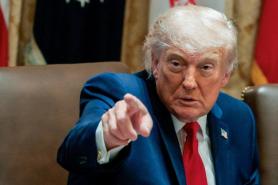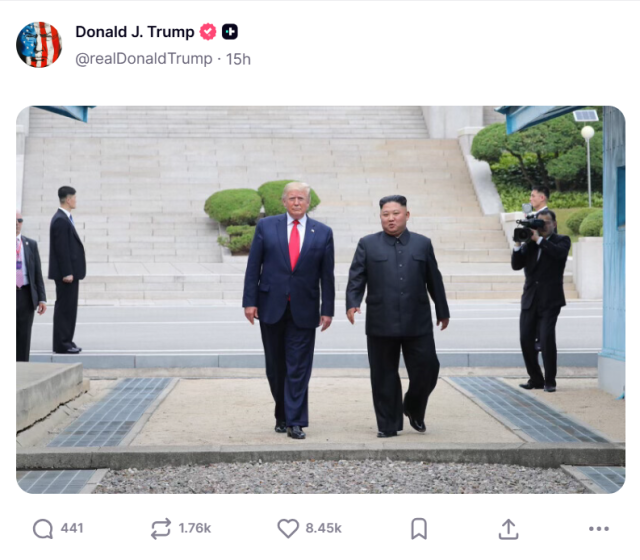
Washington may have "obliterated" Iran's nuclear program, as Trump puts it, but Pyongyang already possesses what he describes as 57 "very powerful" nuclear weapons — an arsenal he appears more inclined to address through renewed diplomacy and his lingering personal rapport with Kim Jong Un.
Trump's contrasting approaches to the two nuclear challenges pose a growing conundrum for Seoul, which on Tuesday reiterated its commitment to denuclearization amid a series of mixed signals from Washington.
The question has gained urgency following the latest phone call between South Korean Foreign Minister Cho Hyun and U.S. Secretary of State Marco Rubio.
The two agreed Monday to maintain close communication and cooperation for peace on the Korean Peninsula and the "resolution of North Korea's nuclear issue," according to Seoul's Foreign Ministry.
Unlike previous high-level statements, however, the readout did not explicitly mention the "denuclearization of the Korean Peninsula."
The U.S. State Department's separate readout was even more terse, making no mention of North Korea, its nuclear program or denuclearization.
The omission alone does not mean Washington has recognized North Korea as a legitimate nuclear-weapon state.
Only three months ago, South Korea, the United States and Japan submitted a joint working paper to the 2026 Nuclear Non-Proliferation Treaty Review Conference stating unequivocally that North Korea "cannot have the status of a nuclear-weapon State" under the treaty and reaffirming their commitment to its complete denuclearization.
Trump's recent remarks, however, suggest a growing willingness to acknowledge North Korea's nuclear arsenal as an enduring strategic reality even if Washington stops well short of granting Pyongyang formal nuclear status.
Trump said last week that he expects to meet Kim later this year and publicly estimated that North Korea possesses 57 "very powerful" nuclear weapons.
"He's got them," Trump said, while again emphasizing his personal relationship with the North Korean leader.
South Korean Defense Minister Ahn Gyu-back offered an even higher range during a parliamentary hearing, citing outside estimates that put North Korea's arsenal at between 80 and 120 nuclear weapons.
He did add that the South Korean military could not provide an exact figure and stressed that Seoul still does not officially recognize North Korea as a nuclear-armed state.
The increasingly explicit discussion of how many nuclear weapons Pyongyang possesses illustrates how far the policy debate has moved.
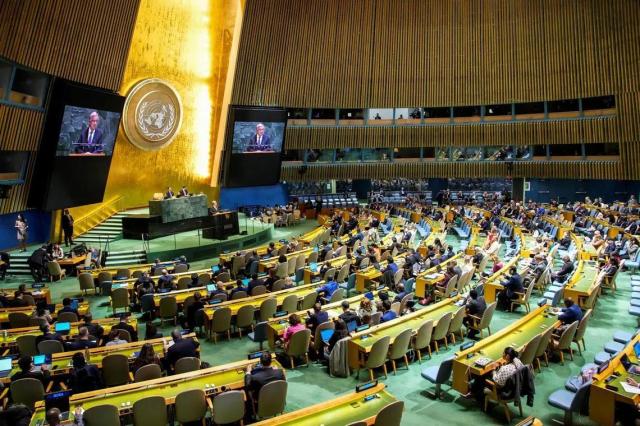
Governments are increasingly forced to consider how to deter, contain and negotiate with a state that already possesses one while preserving denuclearization as the ultimate objective.
Washington still cannot simply confer recognized nuclear-weapon-state status on North Korea under the existing international nonproliferation framework.
Trump's comments are therefore better understood as an acknowledgement of the arsenal North Korea already possesses rather than legal acceptance of Pyongyang as a recognized nuclear power.
"The complete denuclearization of North Korea will probably remain the basic policy objective," said Ko Yu-hwan, professor emeritus of North Korean studies at Dongguk University, projecting that Trump's recent moves appear aimed in part at creating conditions for another summit with Kim.
Ko said Trump's public references to North Korea's arsenal and his push for renewed dialogue could be seen as indirect attempts to accommodate some of Pyongyang's demands for talks without formally accepting North Korea as a nuclear-weapon state.
Another U.S.-North Korea summit could nevertheless have the indirect effect of acknowledging North Korea's nuclear status in practice, Ko added, even if Washington continues to deny it formally.
The distinction between legal status and diplomatic reality is becoming increasingly important.
The Nuclear Non-Proliferation Treaty defines a nuclear-weapon state as one that manufactured and exploded a nuclear weapon or other nuclear explosive device before Jan. 1, 1967. The definition limits recognized status under the treaty to the United States, Russia, Britain, France and China.
North Korea joined the NPT as a non-nuclear-weapon state in 1985, announced its withdrawal in 2003 and conducted its first nuclear test in 2006. Possessing nuclear weapons therefore does not give Pyongyang the same treaty status as the five recognized nuclear powers.
U.N. Security Council resolutions impose additional obligations.
Resolution 1718, adopted under Chapter VII of the U.N. Charter after North Korea's first nuclear test, demands that Pyongyang conduct no further nuclear tests, return to the NPT and International Atomic Energy Agency safeguards and abandon "all nuclear weapons and existing nuclear programmes" in a complete, verifiable and irreversible manner.
A change in U.S. diplomatic tactics would not erase those obligations.
Washington could nevertheless pursue an interim freeze, arms reduction or risk-reduction agreement with Pyongyang without first securing complete denuclearization.
A U.S. president cannot unilaterally overturn existing Security Council resolutions, but Washington can still pursue diplomacy on the assumption that North Korea’s nuclear arsenal is unlikely to disappear anytime soon.
The resulting gap between legal objective and strategic reality is where Seoul's dilemma becomes more difficult.
Washington could continue to support denuclearization in principle while negotiating with North Korea on the assumption that Pyongyang will retain nuclear weapons for the foreseeable future.
South Korea would remain bound by the rules governing a non-nuclear state throughout that period.
Article II of the NPT prohibits non-nuclear-weapon states from manufacturing or otherwise acquiring nuclear weapons. North Korea's continued possession therefore gives Seoul no automatic legal right to follow suit.
The strategic imbalance could, however, strengthen South Korea's political case for demanding greater protection from Washington.
"If Trump effectively tolerates North Korea's possession of nuclear weapons in that process, it could pose a threat to our security," Ko said, adding that such a development could revive calls for independent nuclear armament in both South Korea and Japan.
The more immediate response, he said, would likely be demands to strengthen the credibility and implementation of U.S. extended deterrence.
A U.S. shift from pursuing rapid denuclearization toward managing North Korea's nuclear risks could also encourage Seoul to seek broader strategic options, including progress on nuclear-powered submarines and greater rights involving uranium enrichment and spent-fuel reprocessing, Ko said.
Neither option would amount to nuclear armament. Both would, however, expand South Korea's nuclear-related capabilities and require extensive legal, technical and political coordination with Washington.
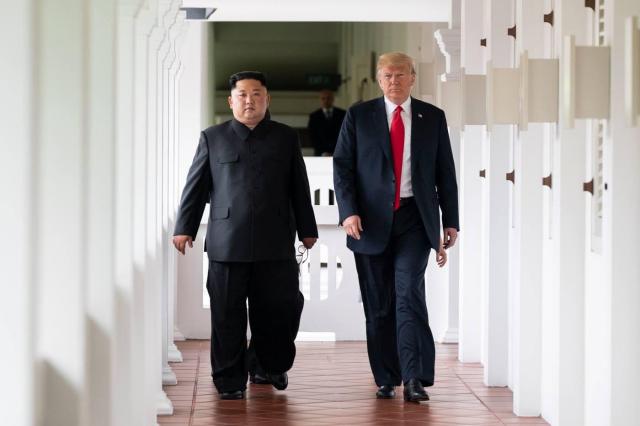
A recent Sejong Institute policy brief suggests the alliance may also need much clearer agreement over how different forms of North Korean nuclear use should be interpreted and answered.
The report, written by Jo Bee-yun, a research fellow at the institute, drew on a tabletop exercise involving South Korean, U.S., Japanese and Australian participants. The exercise exposed a potentially consequential gap between Seoul and Washington over how to respond to a limited nuclear scenario.
In one case, North Korea conducted a nuclear demonstration over waters near Incheon without causing casualties.
South Korean participants viewed the move as crossing the nuclear threshold and favored calibrated escalation, including requesting a limited U.S. nuclear response or a demonstration of nuclear capability.
U.S. participants interpreted the absence of casualties differently. They regarded the action as a possible signal that Pyongyang intended to limit further escalation and placed greater emphasis on de-escalation and ending the conflict.
The difference highlights a weakness that broad declarations of extended deterrence do not necessarily resolve.
Washington has long warned that any North Korean nuclear attack would result in the end of the Kim regime. A real crisis, however, may not fit neatly into a scenario involving an unmistakable large-scale nuclear attack.
Pyongyang could conduct a demonstration, employ a tactical weapon, strike an isolated military target or calibrate nuclear use specifically to create uncertainty over whether Washington should respond with nuclear force.
Ambiguity over such scenarios would become more consequential if U.S. policy increasingly focused on managing North Korea's arsenal instead of expecting its rapid elimination.
Jo argued that the allies should develop different response packages depending on the form, target, damage and political effect of North Korean nuclear use.
Possible categories would distinguish among a nuclear demonstration, limited tactical nuclear use, an attack on allied military assets, a strike on South Korean territory and a large-scale strategic attack threatening the country's survival.
The report also warned that excessive reliance on case-by-case U.S. political approval could create openings for North Korean coercion.
Pyongyang could conclude that competing U.S. commitments elsewhere might delay an allied response, weaken Washington's willingness to escalate or allow North Korea to isolate Seoul through limited provocations backed by nuclear threats.
For South Korea, the paradox would then become sharper.
North Korea could remain nuclear-armed in practice while Seoul continued to comply with the legal and political constraints of a non-nuclear state.
Formal U.S. recognition of North Korea as a nuclear power is therefore not necessarily the most immediate risk.
Washington could preserve denuclearization in official statements while shifting diplomacy toward freezes, arms control, risk reduction or other arrangements premised on North Korea retaining at least part of its arsenal for years.
Such a shift would place far greater importance on what sits beneath the U.S. nuclear umbrella.
Seoul would have stronger reason to seek deeper participation in nuclear planning, clearer agreements on responses to different forms of North Korean nuclear use and more reliable access to U.S. strategic assets and other deterrence capabilities.
The language of denuclearization would still matter. The practical guarantees accompanying it would matter more.
Seoul's central question may therefore no longer be simply whether Washington continues to support denuclearization in principle.
The harder question is what the United States is prepared to provide South Korea if denuclearization remains the declared destination while North Korea's nuclear arsenal becomes a reality the alliance must manage for years to come.
AJP Takeaways
• Donald Trump's open acknowledgement of North Korea's nuclear arsenal is widening the gap between Washington's formal denuclearization policy and its potential willingness to manage Pyongyang as a long-term nuclear reality.
• North Korea cannot gain recognized nuclear-weapon-state status under the NPT simply by possessing nuclear weapons, while U.N. Security Council resolutions continue to require Pyongyang to abandon its arsenal.
• A prolonged period of de facto North Korean nuclear possession could increase South Korean demands for stronger U.S. extended deterrence, clearer nuclear planning and broader nuclear-related capabilities.
• A Sejong Institute tabletop exercise exposed differences between South Korean and U.S. responses to limited North Korean nuclear use, highlighting the need for more detailed alliance planning as denuclearization becomes a longer-term goal.

Copyright ⓒ Aju Press All rights reserved.