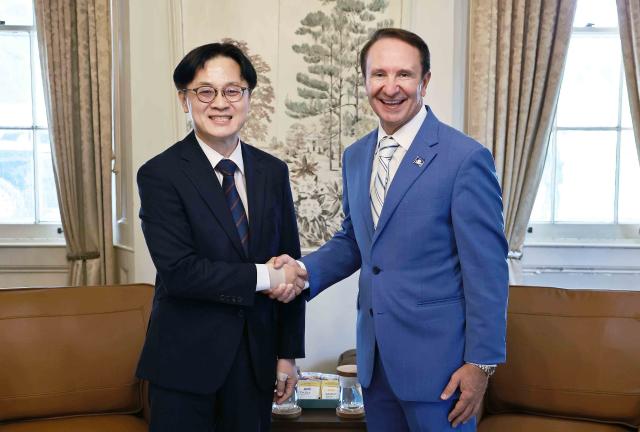
SEOUL, September 11 (AJP) -South Korean Industry Minister Kim Jung-kwan shuttled back to the United States from Europe after accompanying President Lee Jae Myung on his state visit to France earlier this week, making his second U.S. trip in little more than a week to finish the first action plans under Seoul's $350 billion investment commitment.
Kim traveled to the United States after completing his European schedule via Belgium and is due to remain there through Saturday. He is expected to meet U.S. Commerce Secretary Howard Lutnick and other officials as the two sides seek to pin down investment size, financing, returns and risk-sharing ahead of a planned closed-door briefing to South Korea's National Assembly on Sept. 17.
The accelerated diplomacy comes as reports on the investment blueprint have cascaded from South Korean media to The Wall Street Journal, often running ahead of what either government is prepared to confirm.
The Wall Street Journal reported Thursday that Seoul and Washington were nearing an agreement on U.S. energy projects potentially worth more than $100 billion, centered on financing for as many as eight nuclear reactors and a roughly $20 billion natural gas-fired power project in Texas supplying electricity to artificial intelligence data centers.
The newspaper said the first reactors could use technology from U.S.-based Westinghouse Electric, while some later units could involve Korean technology. It also said Seoul could provide an initial payment of more than $2 billion before the end of September if negotiations proceed as planned.
Neither government has confirmed those details.
South Korea's Ministry of Trade, Industry and Resources said investment plans remain under negotiation, while a White House official told Reuters that reports of an agreement should be regarded as "baseless speculation" unless formally announced.
The cautious responses follow a week of increasingly specific reports at home.
Some local media reported that a combined-cycle gas power project in Encinal, Texas, had effectively been selected as Korea's first investment. The project has been reported at about $22 billion to $23 billion with generation capacity of roughly 6.3 gigawatts.
The ministry immediately pushed back, saying no first project had been finalized and that an announcement would come only after consultations with Washington and procedures required under Korean law.
The ministry also denied a Hankyoreh report that candidate investments had narrowed to a Texas gas project estimated at $23.3 billion, a framework for eight U.S. nuclear reactors worth about $120 billion and a roughly $67 billion Alaska LNG project. It also reported that Seoul was considering an investment in Westinghouse and could make its first U.S. remittance late this month.
But it added nuclear cooperation was also still being negotiated and no specific arrangement had been reached.
A separate report Tuesday raised an even more politically sensitive issue by saying Washington was pressing Seoul for investments exceeding the $350 billion promised under last year's tariff agreement.
A lawmaker, citing a ministry briefing, said the combined amount sought by Washington for the Texas power project, nuclear plants and Alaska LNG could exceed the $200 billion set aside for strategic investment.
The ministry issued an unusually categorical denial. It said it was not true that the United States had requested investment exceeding the overall $350 billion commitment or that Korea's strategic investment would exceed the agreed $200 billion.
Under the memorandum signed by Seoul and Washington last November, Korea agreed to provide up to $200 billion for investments in strategic sectors including energy, semiconductors, pharmaceuticals, critical minerals and artificial intelligence. Actual funding is capped at $20 billion in any calendar year and is to be called according to project milestones.
The remaining $150 billion is earmarked for shipbuilding cooperation and can include Korean corporate direct investment, guarantees and ship financing rather than government cash alone.
The original agreement also built in safeguards sought by Seoul after months of negotiations over how much financial risk Korea would shoulder.
Only projects deemed commercially reasonable — capable of generating sufficient cash flow to repay principal and interest — are supposed to qualify. An umbrella investment vehicle was designed to pool returns from individual projects so losses at one could potentially be offset by gains elsewhere. Before repayment of principal and interest, investment returns were to be divided equally between Korea and the United States.
Commercial viability has been Seoul's consistent red line, particularly for large projects with long construction periods and uncertain returns, which partly can explain why implementation has moved more slowly than Washington wanted.
Almost a year after the investment package was agreed, Korea has yet to commit money to its first project, while Japan has already unveiled projects under its own U.S. investment agreement. U.S. frustration has grown, and Trump earlier threatened to restore higher tariffs on Korean goods over delays in implementing the deal.
AJP Takeaways
- Industry Minister Kim Jung-kwan returned to the United States to finalize implementation plans for South Korea’s $350 billion U.S. investment commitment.
- Media reports have floated more than $100 billion in energy projects, including nuclear plants and a Texas gas-fired power project, but Seoul says no specific project or funding timetable has been finalized.
- The ministry has denied that Washington is seeking commitments beyond the agreed $350 billion, including the $200 billion ceiling for strategic investments.
Copyright ⓒ Aju Press All rights reserved.