

SEOUL, September 11 (AJP) - Drums pound, bells shake and chants rise as a mudang, or Korean shaman, appears to slip between worlds, communicating with spirits through an electrifying ritual of music, dance and trance.
For millions of moviegoers, the spectacle became familiar through a famous gut scene in director Jang Jae-hyun's 2024 occult blockbuster "Exhuma."
Gut, an ancient Korean shamanic ritual performed to communicate with spirits, comfort the dead, seek blessings or ward off misfortune, has traditionally taken place largely away from public view.
Now it is moving onto the stage.
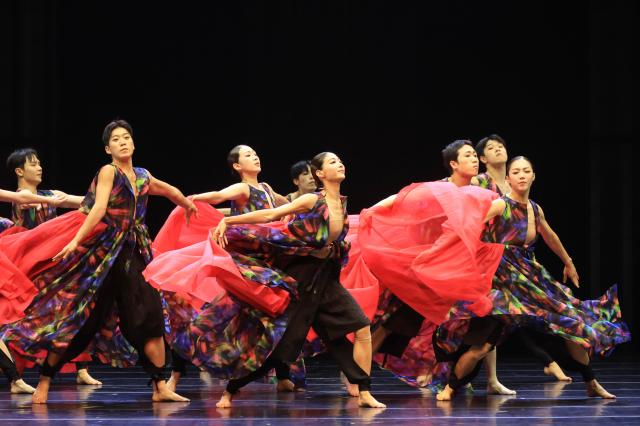
The Seoul Metropolitan Dance Theatre's "Gut: Whispering Steps," running at the Sejong Center in Seoul through Sunday, takes its central motif from mugamseogi, a practice found in Seoul gut in which the person for whom the ritual is held puts on a shaman's robes and dances spontaneously near its climax.
Onstage, the ritual is dismantled and rebuilt in a contemporary language. The shaman's fan and bells become theatrical objects, while obangsaek, the traditional five-direction colors, runs through the costumes and choreography. Contemporary music and cinematic imagery push the ritual into a new artistic form.
The production arrives as Korean shamanism is appearing far beyond ritual space.
It has driven a box-office blockbuster, supplied the premise for a dating show and helped shape the spiritual world behind the most-watched original title in Netflix history.

The convergence raises a question: After K-pop opened one of the world's biggest gateways into Korean culture, could the country's much older spiritual traditions become another?
For artistic director Yoon Hye-jung, the attraction of mugamseogi was not primarily supernatural.
Yoon said she encountered the practice while researching shamanic dances from five regions of Korea. What caught her attention was the shift in agency. A person may commission a gut in hopes of comfort or good fortune, but in mugamseogi, that person ultimately puts on the shaman's clothes and moves.
"If our ancestors had a process of finding themselves through mugamseogi, I thought we also need that process today," Yoon said at a press call Thursday.
In popular culture, Korean shamanism is increasingly moving beyond its long association with fortune-telling and superstition.
Director Jang Jae-hyun's "Exhuma," centered on two young shamans, a feng shui expert and a mortician, sold 11.91 million tickets in South Korea and became the country's most-watched film of 2024.
Its appeal did not stop at Korea's borders.
By the end of March 2024, the film had drawn more than 2.23 million moviegoers in Vietnam and 2.3 million in Indonesia, setting records for a Korean film in both markets at the time.
The numbers suggested that rituals, spirits and beliefs deeply rooted in Korean culture were not necessarily barriers for audiences elsewhere.
Television took another route.
SBS reality show "Possessed Love" placed young fortune tellers and spiritual practitioners inside a dating program, mixing romance with saju readings, tarot cards, shamanic practices and questions of fate. Its second season was sold to 62 countries.
Then the imagery went fully global through "KPop Demon Hunters."
The Netflix animation combines K-pop with Korean folklore and supernatural imagery in the story of three pop stars who fight demons.
Since its June 20, 2025 debut, it has amassed more than 600 million views, becoming Netflix's most popular original title ever and the first to remain in its Global Top 10 for 52 consecutive weeks. It entered the Top 10 in all 93 countries where Netflix publishes rankings and reached No. 1 in 76.
Those numbers do not mean hundreds of millions of viewers suddenly became interested in Korean shamanism.
But they do mean imagery drawing partly on Korea's older spiritual traditions has reached a global audience on an extraordinary scale.
Angie Heo, an associate professor of the anthropology and sociology of religion at the University of Chicago, has linked the spectacle of K-pop in the film with the performative character of Korean shamanism.
"Shamanism is also a performance. It's dancing, it's a lot of music," Heo said in an interview published by the University of Chicago.
She cautioned, however, against equating the film's demon hunters with actual Korean shamans, whose role traditionally involves dealing with restless spirits rather than hunting demons.
For some Korean viewers, the film's success has nevertheless changed the scale at which they imagine such stories can travel.

Jeong Je-hyeon, a 36-year-old office worker in northern Gyeonggi Province, said Korean occult films including "The Priests," "The Wailing," "Svaha: The Sixth Finger" and "Exhuma" gradually drew him into the genre.
"It no longer feels like movies such as 'Exhuma' are the ones introducing Korean shamanism or occult culture to the world," Jeong told AJP. "After 'KPop Demon Hunters' became such a big hit, it almost feels like it is now leading the way in introducing Korean occult stories overseas."
"I don't think Korean shamanism is any less compelling than zombies or jiangshi," he added. "The stories themselves are strong and they have a clear narrative arc. I think they could go much further."
Still, a string of successful productions does not establish the arrival of a new genre called "K-shamanism."
K-pop is an identifiable commercial industry backed by entertainment companies, training systems, distribution networks and global fandoms.
Korean shamanism, by contrast, is a living religious and folk tradition with regional variations that cannot be reduced to demons, colorful costumes or supernatural spectacle.
What appears to be happening instead is that shamanism is becoming a cultural vocabulary translated into different forms — an occult mystery in "Exhuma," a reality-TV premise in "Possessed Love," a pop fantasy in "KPop Demon Hunters" and now contemporary dance in "Gut: Whispering Steps."
Yoon said the dance company deliberately avoided reproducing an actual gut.
Instead, it selected recognizable elements including obangsaek, the shaman's fan and bells, and amplified them for the stage.
The point, she said, was not to celebrate shamanism as a belief system. It was to recognize gut as part of the lives of earlier generations and use fragments of that tradition to tell a story for audiences today.
That tension between tradition and reinvention may help explain why gut has become fertile material for contemporary creators.
The ritual already contains music, dance, costumes, storytelling and collective performance. Its themes of grief, fortune, death, healing and release can travel even when audiences know little about the tradition behind them.

But the further shamanic imagery moves from the ritual itself, the greater the risk that a complex living tradition is flattened into bright robes, demons and spectacle.
For decades, K-pop gave audiences abroad a distinctly modern entry point into South Korea.
Now Korean creators are increasingly looking in the opposite direction — toward rituals, spirits and worldviews that existed long before K-pop.
Whether that eventually becomes something recognizable as "K-shamanism" remains an open question.
What is already visible is the translation: a door widened by K-pop is now leading some audiences deeper into Korea's cultural past.
AJP Takeaways
- Korean shamanism is moving beyond ritual spaces into mainstream culture, appearing in films, reality TV, animation and contemporary dance.- "Exhuma" drew 11.91 million admissions in South Korea, while "Possessed Love" was sold to 62 countries, showing that shamanic themes can travel across formats and markets.
- Netflix's "KPop Demon Hunters" pushed Korean supernatural imagery onto a far larger global stage, surpassing 600 million views and reaching the Top 10 in all 93 markets tracked by Netflix.

Copyright ⓒ Aju Press All rights reserved.
