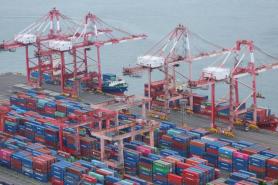
The central bank said exports accounted for 16.1 percent of total demand, which covers both intermediate materials used in production and finished goods and services, up from 14.7 percent in 2023.
Of all spending on finished goods and services, the share going to exports rose to 31.8 percent from 29.4 percent.
The BOK attributed the increase largely to stronger exports of computers, electronic and optical products, including semiconductors.
Merchandise exports continued to rise, reaching a record $709.7 billion in 2025, up 3.8 percent from a year earlier and surpassing $700 billion for the first time.
From Jan. 1 through Sept. 20, 2026, exports totaled $765.0 billion, up 55.0 percent from the same period last year and already exceeding the full-year record set in 2025.
August shipments rose 68.7 percent from a year earlier to $98.25 billion, while semiconductor exports jumped 209 percent over the same period.
The more recent trade figures cover only merchandise exports and are not directly comparable with the broader, economy-wide export-share figures compiled by the central bank.
Manufactured goods accounted for 26.0 percent of total value added in 2024, up from 25.0 percent a year earlier.
The service sector's share fell to 64.1 percent from 65.4 percent over the same period, reversing the increase recorded in 2023.
Assembly-processed products, including computers, electronic and optical equipment, electrical equipment, machinery and transport equipment, increased their share of value added to 12.2 percent from 10.5 percent.
The economy-wide value-added ratio rose to 42.0 percent from 41.2 percent in 2023, helped by higher operating surpluses in manufactured exports.
Dependence on imported intermediate inputs eased to 13.3 percent from 13.6 percent as import prices for raw materials continued to decline.
The share of production induced by exports rose to 35.1 percent in 2024 from 32.7 percent a year earlier, while their share of induced value added increased to 28.2 percent from 25.4 percent.
Exports accounted for 22.2 percent of employment induced by final demand, up from 20.7 percent in 2023.
Total full-time-equivalent employment nevertheless fell by 28,000 to 25.96 million, with declines concentrated in construction and agriculture, forestry and fisheries.
Permanent employment increased by 60,000, while temporary and daily workers fell by 55,000 and self-employed and unpaid family workers declined by 33,000.
Services accounted for 36.4 percent of intermediate inputs in 2024, up from 35.4 percent a year earlier, led by producer services including information and communications, finance and insurance and professional services.
Services also accounted for 72.0 percent of full-time-equivalent employment, compared with 71.7 percent in 2023.
AJP Takeaways
- South Korea's exports accounted for 16.1 percent of total demand in 2024, up from 14.7 percent in 2023 as semiconductor-related exports increased sharply.
- Manufactured goods increased their share of South Korea's value added to 26.0 percent from 25.0 percent, while exports accounted for larger shares of production, value added and employment induced by final demand.
- South Korea's merchandise exports subsequently reached a record $709.7 billion in 2025 and exceeded that full-year total by Sept. 20, 2026, although the trade figures are not directly comparable with the BOK's input-output measures.

Copyright ⓒ Aju Press All rights reserved.