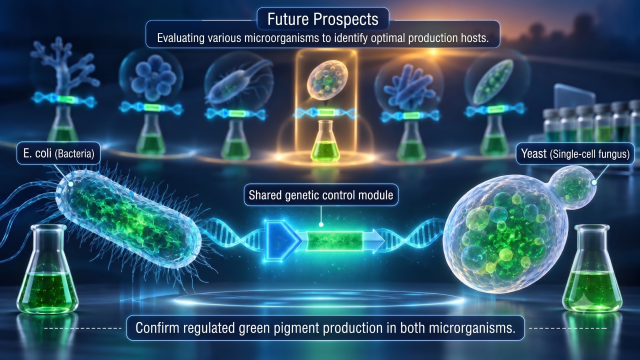
SEOUL, September 28 (AJP) - A South Korean research team has built a set of genetic switches that work in both bacteria and yeast, two microbes that read DNA in ways different enough that a production recipe written for one has to be rebuilt almost from the ground up for the other. The design removes much of that rebuilding, and with it one of the slower steps in turning microbes into factories for drugs, chemicals and materials.
Applied to a pathway that makes a green pigment, the strongest version of the switch raised output about 3.1 times over the weakest in the bacterium Escherichia coli, and about 2.6 times in baker's yeast, Saccharomyces cerevisiae. The team built nine versions in all, spanning weak, moderate and strong output, and the ranking held in both hosts.
KAIST said Monday that the work was led by Lee Ju-young, an associate professor in its Graduate School of Engineering Biology.
Microbes already manufacture insulin, antibiotics, food additives and industrial chemicals. The organism is given the genes for a desired substance, and it produces that substance as it grows. E. coli, a common gut bacterium, and baker's yeast, the same organism used to leaven bread and ferment beer, are the two workhorses of the field.
Getting a microbe to make what is wanted is not only a matter of inserting the right genes. Each gene has to run at the right level. The part that sets that level is a promoter, a stretch of DNA sitting in front of a gene that determines how hard it runs, in the way a dial sets the speed of a machine.
Bacteria and yeast use entirely different dials. E. coli starts reading a gene from two short sequences known as the minus 10 and minus 35 motifs, and begins building the protein at a marker called the Shine-Dalgarno sequence. Yeast, a more complex kind of cell, uses a structure called a TATA box to start reading and a different marker, the Kozak sequence, to begin building. A promoter tuned for one is often inert in the other.
The team's answer was to put both sets of instructions in the same piece of DNA. The hybrid promoter carries the bacterial motifs and the yeast ones side by side, so each organism finds the signals it recognizes and ignores the rest. Three yeast core promoters and three bacterial promoters were combined in every possible pairing to produce the nine variants.
Consistency across the two hosts was the point of the exercise. A promoter that ran strongly in E. coli generally ran strongly in yeast as well, which does not mean the two organisms made equal amounts of anything. It means a researcher can predict which setting is high and which is low before switching hosts, instead of measuring everything again.
To test whether the switches could drive real production and not just a single gene, the team applied them to prodeoxyviolacein, a green pigment that requires three genes to work in sequence. The pigment is a standard test case because the output is visible and depends on all three genes running in balance.
The promoters also worked in Corynebacterium glutamicum, a bacterium used industrially to make amino acids, and in Pichia pastoris, a yeast widely used to produce proteins.
The immediate use is screening. Researchers hunting for the best producer of a given substance can run the same genetic design through several microbes at once and compare the results, rather than redesigning the controls for each candidate. That kind of parallel testing is the basic operation of a biofoundry, a facility that automates the design, building and testing of engineered microbes.
What the work does not do is raise yields on its own. Consistent relative strength across hosts is not the same as equal production, and squeezing more output from any one organism still requires organism-specific tuning. The study demonstrated control across species, not a finished production process.
The paper was published in the Sept. 23 issue of Nucleic Acids Research and released online on Sept. 8. Son So-hee, Moon Soo-young and An Nan-yeong share first authorship.
"This study is meaningful in that it presents a common design principle that allows the relative strength of a promoter to be predicted even when the microbe changes," Lee said. She added that she expects it to speed up the development of biomanufacturing by enabling researchers to design and compare a range of microbial cell factories more quickly.
[Reference Information]
Journal/Source: Nucleic Acids Research
Title: Modular synthetic cross-kingdom promoters enable coordinated expression in Escherichia coli and Saccharomyces cerevisiae
Link/DOI: https://doi.org/10.1093/nar/gkag868
AJP Takeaways
- KAIST said Monday that a team led by Lee Ju-young built nine hybrid promoters carrying both bacterial and yeast control signals in a single piece of DNA, letting the same genetic design run in Escherichia coli and baker's yeast without being rebuilt for each host.
- Escherichia coli and Saccharomyces cerevisiae produced about 3.1 times and about 2.6 times more of a green pigment under the strongest version of the switch than under the weakest, and the promoters also worked in Corynebacterium glutamicum and Pichia pastoris, though the team said raising actual yields still requires tuning specific to each organism.
- Nucleic Acids Research carried the paper in its Sept. 23 issue after releasing it online on Sept. 8, with Son So-hee, Moon Soo-young and An Nan-yeong sharing first authorship, details confirmed against the journal record rather than the university announcement.

Copyright ⓒ Aju Press All rights reserved.